After the Gods Fell Silent – Christopher Hitchens, Disbelief, and the Persistence of Wonder
When religious belief collapses, it rarely leaves relief in its wake. What remains is longing: for meaning, coherence, and wonder. Losing faith does not extinguish that desire; it clarifies it, and forced us to ask what can be revered without abandoning reason.

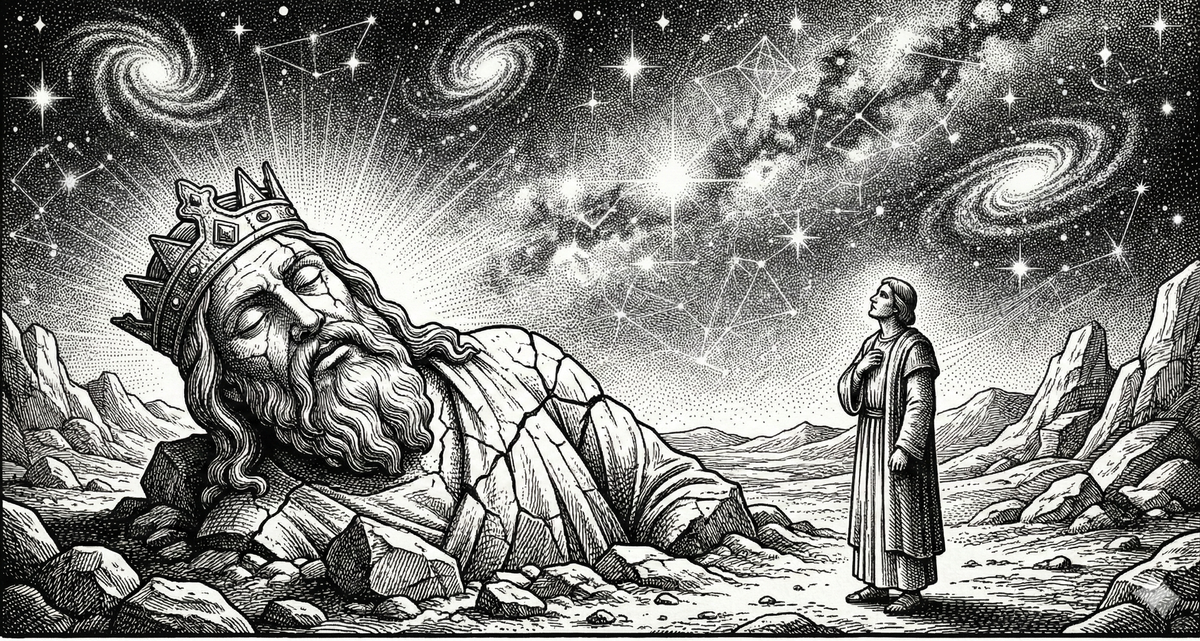
There is a particular kind of loss that does not announce itself as tragedy.
When belief collapses, it often does so quietly — not with drama, but with a slow, accumulating sense that something once central no longer fits. The words still exist. The rituals remain intelligible. But the animating conviction has gone missing. What remains is not rebellion, but an unease that grows harder to ignore: I can no longer say this honestly.
That was my experience with religion.
I did not leave it because I wanted less meaning. I left because I could no longer accept meaning at the cost of truth. The collapse did not feel like liberation. It felt like the sudden removal of a structure that had quietly organized my moral life, my sense of time, and my orientation toward suffering. When it fell away, it left behind a gap — not just intellectual, but existential.
Into that gap stepped Christopher Hitchens.
Hitchens as Scaffolding
I encountered Hitchens at a moment when doubt had already taken hold, but clarity had not yet arrived. His work did not create my disbelief — it stabilized it. He gave voice to an intuition I was struggling to articulate: that disbelief could be principled, moral, and intellectually serious.
Hitchens mattered not simply because he argued against religion, but because he did so without apology. He treated belief as something that must earn its place — not something exempt from scrutiny because it offers comfort. In doing so, he returned dignity to doubt at a moment when doubt felt isolating.
There is a difference between disbelief as negation and disbelief as integrity. Hitchens modeled the latter. He insisted that refusing to believe what one finds untrue is not a moral failure, but a moral obligation. That insistence mattered profoundly to me.
At that stage of my life, I did not need nuance. I needed permission — permission to say no without collapse. Hitchens provided that permission with uncommon rhetorical force.
He was not a destination. He was a bridge.
What Disbelief Does Not Erase
Yet disbelief, once stabilized, reveals something unexpected. It does not abolish longing. If anything, it clarifies it. What remains is a persistent yearning — a Sehnsucht — for depth, coherence, and participation in something larger than the self. Religion offers to resolve that ache by naming its object and promising its fulfillment. I no longer find that promise honest. What I am learning instead is how to live without resolving the longing at all.
There is no altar at which this longing is satisfied, no doctrine that closes it cleanly. Instead, it becomes something that must be carried, not as a defect to be corrected, but as a signal of orientation. We can allow it to surface when confronted with the vastness of the universe, the fragility of human lives, or the quiet endurance of beauty created without guarantee of permanence. The longing does not demand resolution. It demands honesty.
Rejecting theology does not extinguish the desire for meaning, wonder, or moral depth. Instead it clarifies it. The problem is not that religion asks too much of the human spirit. It is that it asks too much of intellectual honesty.
What I lost when belief fell was not God alone, but a cosmology that made suffering legible, death narratable, and goodness anchored. That loss mattered. Pretending otherwise would have been another form of dishonesty.
Here is where some forms of atheism fall short — not in their critique, but in their silence afterward. It is one thing to dismantle inherited illusions. It is another to live in the open terrain that remains.
For a long time, Hitchens seemed to belong entirely to the first task.
Until the end.
The End and the Turn Toward Affirmation
In what is often referred to as his final public speech — sometimes titled The End — Hitchens makes a quiet but profound turn. Gone is the relentless demolition. In its place is something more vulnerable and, in many ways, more human.
He speaks not of God, but of wonder.
He gestures toward science, toward the vastness of the universe, toward art, literature, courage, curiosity — toward the things that can still arrest us with awe without asking us to suspend disbelief. He rejects idols — religious and political alike — not in favor of emptiness, but in favor of participation in the ongoing human conversation about what is true, good, and beautiful.
This moment matters.
Facing mortality, Hitchens does not retreat into nihilism. Nor does he soften his intellectual commitments. Instead, he affirms that meaning does not require transcendence in the supernatural sense. It requires engagement — with reality as it is, with others as they are, with the finite time we are given.
In that speech, something essential becomes clear: Hitchens was never trying to strip the world of meaning. He was trying to relocate it.
What Remains After Belief
I no longer experience the absence left by religion as a void. I experience it as a responsibility.
Meaning, it turns out, is not something bestowed. It is something assembled: from attention, honesty, care, and continuity across time.
One way I assemble it is by entering the long human conversation itself: returning to books, ideas, and works of art that were created under conditions of uncertainty and finitude no less severe than our own. Reading across centuries is not an escape from the present; it is a way of remembering that others have stood where we stand now and still found reasons to speak, to create, and to endure.
Hitchens helped me reject false certainty. What he did not, and perhaps could not, provide was a finished replacement. That is not a failure. It is an invitation.
The danger is not atheism. The danger is mistaking demolition for completion.
I have no desire to return to unexamined belief. What I cannot accept is belief that demands silence from reason, that treats doubt as a moral failure, or that asks me to betray my own capacity for judgment in exchange for comfort. I also refuse to pretend that disbelief alone is sufficient. What I seek now is not permission to doubt, but practices that sustain depth without illusion — ways of standing in this universe, here and now, without outsourcing meaning to authority or fantasy.
In that sense, I am no longer following Hitchens.
I am continuing the conversation he insisted mattered most.
What Can Be Revered Without Being Worshipped
Perhaps the deepest inheritance Hitchens left me is not disbelief, but courage — the courage to insist that meaning be real, or not at all.
I no longer believe in God. I do believe in wonder. I believe in the fragile, improbable fact that a universe capable of producing consciousness is worthy of reverence — not because it promises redemption, but because it does not.
The gods fell silent.
What remains is not emptiness, but work.
And that, finally, feels honest.
Reading List & Conceptual Lineage
This essay did not emerge in isolation. It stands within a broader conversation about belief, disbelief, meaning, and intellectual responsibility that spans disciplines and centuries. The following works and thinkers have shaped my thinking at various stages of that journey.
Christopher Hitchens
- God Is Not Great
A formative work in my rejection of unexamined belief and inherited authority. Its lasting value lies not in its polemics, but in its insistence that meaning must survive scrutiny to be worthy of us. - Mortality
Hitchens’s reflections on illness and finitude reveal a quieter, more vulnerable voice—one that affirms dignity, courage, and wonder without metaphysical consolation. - “The End” (final public speech)
Hitchens’s closing appeal to secular wonder. Rather than a final critique of religion, this speech gestures toward science, art, courage, and the shared human conversation as sources of meaning worthy of reverence—without requiring the suspension of reason.
The Moral and Existential Stakes of Disbelief
- Man's Search for Meaning — Viktor Frankl
A powerful account of meaning as something discovered and constructed under conditions of extreme suffering, without reliance on illusion. - The Myth of Sisyphus — Albert Camus
A clear-eyed confrontation with absurdity that refuses both nihilism and false hope, insisting instead on lucid endurance.
Science as a Source of Wonder
- Cosmos: A Spacetime Odyssey
A foundational example of how scientific understanding can deepen, rather than diminish, awe. - Pale Blue Dot — Carl Sagan
A meditation on scale, humility, and responsibility in a universe that offers no guarantees. - A Brief History of Time — Stephen Hawking
A reminder that confronting the deepest structures of reality can be an act of reverence without worship.
Meaning, Continuity, and Human Lineage
- The Human Condition
A profound exploration of action, responsibility, and continuity in a world without transcendent assurances. - The Brothers Karamazov — Fyodor Dostoevsky
A searching examination of faith, doubt, moral responsibility, and suffering that takes unbelief seriously without trivializing belief.
Contemporary Reflections on Meaning Without Illusion
- Life as No One Knows It — Sara Walker
A scientific exploration of life, agency, and emergence that reframes meaning as something assembled through time and structure rather than bestowed. - The Beginning of Infinity — David Deutsch
An argument for open-ended progress grounded in explanation, criticism, and the refusal of epistemic finality.
Closing Note on Lineage
These works do not agree with one another, nor should they. What unites them is a shared refusal to outsource meaning to authority, certainty, or consolation. They represent different attempts to answer the same enduring question:
How does one live honestly in a universe that offers no guarantees—yet still calls forth wonder, responsibility, and care?
This essay is my contribution to that ongoing conversation.