Assembled Meaning: Life, Mind, and the Causal Weight of History
Life and mind are often treated as exceptions—protected from physics by mystery or myth. Complexity science offers another path: one where meaning is not bestowed but assembled, where history carries causal weight, and where understanding is earned through time, not escape hatches.

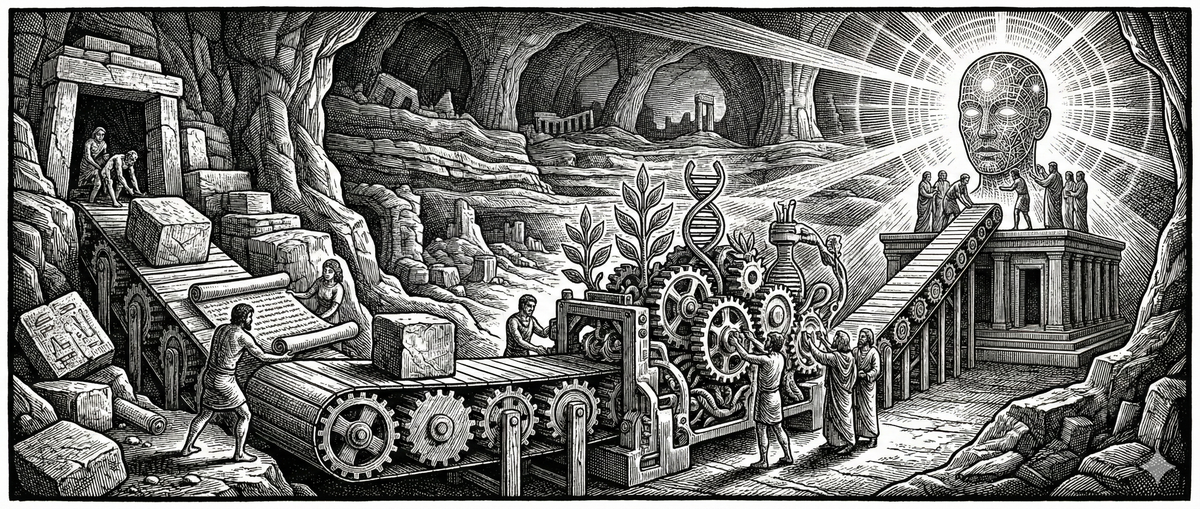
For most of human history, life and mind have occupied a protected conceptual space. We have treated them as exceptional—set apart from the cold logic of physics and computation by something ineffable, vital, or sacred. This instinct is understandable; we are, after all, living systems attempting to understand the storm from inside the eye.
But as our tools improve, and as we encounter increasingly life-like systems beyond biology, this protective framing is beginning to fail.
Complexity science offers a way forward. It does not seek to reduce life to "dead matter." Instead, it invites us to study life as a special case of a much broader class: systems that accumulate history, process information, and generate novelty. This is a "spiritually agnostic" approach—one grounded in assembly and lived time—that somehow manages to preserve the depth, meaning, and wonder we once attributed to the soul.
From Irreducibility to Decompression
One of the earliest insights in complexity science is that certain systems resist compact description. As David Krakauer notes, we lack the elegant, closed-form equations for genomes or societies that we enjoy in classical physics. To many, this looks like a failure of knowledge.
But a deeper reading suggests something else: these systems are not poorly understood; they are historically dense.
Living systems do compress their past. A genome is a multi-billion-year compression of selection; a brain is a compression of a lifetime of interaction; a Large Language Model is a compression of an enormous swath of recorded human expression. The problem is not the compression itself—it is the decompression.
To understand such a system, we cannot simply inspect its static parts. We must unfold it over time. We must observe how it responds, adapts, and fails. In this sense, complex systems are not merely irreducible; they must be experientially decompressed. Understanding is not a state we arrive at; it is a procedure we take part in witnessing.
Time as a Computational Resource
This intuition finds a striking parallel in the work of Cris Moore, who suggests that complexity is less about the system itself and more about the resources required to answer questions about it.
Some questions can be answered via shortcut. Others—the most interesting ones—cannot. To know what a complex system will do in a novel situation requires simulation rather than deduction, and interaction rather than inspection. In other words, time itself is the computational resource. This aligns the scientific with the poetic: lived experience is not incidental to understanding; it is the "cost" paid to obtain it.
Assembly Theory: The Causal Weight of History
Assembly Theory, championed by Lee Cronin and Sara Walker, sharpens this picture. It reframes life not as a substance, but as a process of accumulation. What distinguishes a living thing is not its chemical makeup, but its "assembly index"—a measure of how many steps were required to build it and how much history is embedded in its structure.
This places life on a continuum rather than a pedestal. Below the biological threshold, we see prebiotic chemicals accumulating structure. Above it, we see cities, ecosystems, and digital architectures exhibiting the same signatures of open-ended evolution. In this framework, history is not an accident; it is causal. The past constrains and enables the future in a way that "timeless" physics cannot account for.
Consciousness Without Mysticism
If we view minds through this lens—as systems that encode deep histories and model their environments to exert causal control—then consciousness loses its need for magic.
Consciousness becomes something that is earned through organization and duration. It is a pattern that emerges when a system reaches a sufficient depth of historical compression and real-time decompression. This does not "cheapen" the experience of being alive. On the contrary, it grounds it. It suggests that your "self" is the literal manifestation of billions of years of cosmic and personal history being "unpacked" in the present moment.
These ideas go beyond academic curiosities. In our age of intelligent machines, they are becoming practically urgent.
A Different Kind of Reverence
We are entering an era where non-biological systems learn, generalize, and surprise us. Yet, they often lack the one ingredient that defines us: lived time with consequence. Intelligence without history is brittle. Knowledge without lived cost is hollow. If we are to build systems that truly align with human values, we must understand that understanding itself is not an abstract calculation. It is an assembly.
To study life in a spiritually agnostic way is not to strip it of meaning. It is to relocate meaning. Meaning is no longer a gift bestowed by the divine; it is a property assembled by the persistent. It arises when a system stays open enough to become something new in the presence of the world it is gifted with.
Complexity science offers us a pathway not to abandon wonder, but instead to earn it. By honoring time, history, and the slow process of becoming, we find perhaps the most honest reverence we are capable of: a respect for the sheer effort the universe exerts to produce a single moment of thought.
Reading List & Conceptual Lineage
The ideas in this essay did not emerge from a single discipline or tradition. They sit at the intersection of physics, biology, computation, and philosophy—fields that have increasingly converged around the study of complex, historical, information-processing systems. Readers interested in exploring this terrain further may find the following thinkers and works especially generative.
Complexity & Emergence
- Introduction to Complexity: What are Complex Systems? – Complexity Explorer
Leading experts explore the defining characteristics of complex systems, explaining how emergent behavior and nonlinear interactions create phenomena that are far more than the sum of their parts. - The Complex World: An Introduction to the Foundations of Complexity Science – David Krakauer
Reframing our understanding of the world through the lens of complexity science, arguing that we must move beyond simple, linear thinking to grasp our interconnected, evolving, and volatile reality. - The Nature of Computation – Cris Moore and Stephen Mertens
A comprehensive textbook on theoretical computer science, bridging the gap between formalisms and intuition for students and scientists from other fields. - Diversity and Complexity – Scott Page
On adaptive systems, interdependence, and why not all systems capable of complexity actually produce it. - Networks – Mark Newman
A foundational treatment of emergence and structure in interacting systems.
Assembly, Life, and Causal History
- Life as No One Knows It – Sara Walker
A rigorous reframing of life as a process of information accumulation and causal control rather than a privileged substance. - Assembly Theory – Sara Walker and Lee Cronin
A framework developed to quantify historical causation, and the measurable complexity of objects and systems.
Adaptation, Learning, and Open-Endedness
- Emergent Computation: Self-organizing, Collective, and Cooperative Phenomen – Stephanie Forrest
On adaptive systems, learning, and why modification during operation is central to rich dynamics. - Making Sense of Chaos: A Better Economics for a Better World – Doyne Farmer
On emergence in markets, ecosystems, and systems far from equilibrium. - Introduction to Urban Science: Evidence and Theory of Cities as Complex Systems – Luis Bettencourt
On cities, scaling laws, and circular causation in evolving systems.
Institutions & Intellectual Context
- Santa Fe Institute – A unique interdisciplinary research institute dedicated to understanding complex adaptive systems across biology, society, computation, and physics. Many of the thinkers above are connected through its intellectual community.