Assembled Time: Why Long-Form Stories Still Matter in an Age of Fragments
In an age optimized for immediacy, long-form stories train a rare cognitive skill: the ability to assemble time. Braided narratives teach us to hold unresolved pasts, integrate meaning across threads, and resist the flattening force of feeds, shallow AI, and disposable moments.

We live in an era optimized for immediacy.
Information arrives faster than we can integrate it. Content refreshes before it can settle. Feeds promise relevance but demand nothing in return—not memory, not patience, not continuity. Each moment stands alone, self-contained and disposable.
And yet, many of the problems we now face—technological, ecological, geopolitical—do not operate on short timescales. They unfold slowly. They depend on causal chains that span years, decades, generations. To understand them requires a kind of cognition that can carry the past forward and allow meaning to emerge over time.
This tension raises a quiet but urgent question:
What practices still train us to think in depth?
One unexpected answer lies in an old and deeply human technology: long-form storytelling, particularly the braided narrative.
Braided Narratives and the Assembly of Time
Braided narratives—stories that alternate between multiple unresolved threads before converging—are not a stylistic novelty. They appear in ancient epics, serialized novels, and modern prestige television alike. What unites them is not complexity for its own sake, but a specific temporal demand placed on the audience.
Each thread:
- advances only partially,
- is suspended before resolution,
- carries unresolved causal momentum.
When the story cuts away, nothing is finished. The audience must hold what has happened—retain its meaning, anticipate its future, and keep it alive across interruption.
This is not passive consumption. It is temporal assembly.
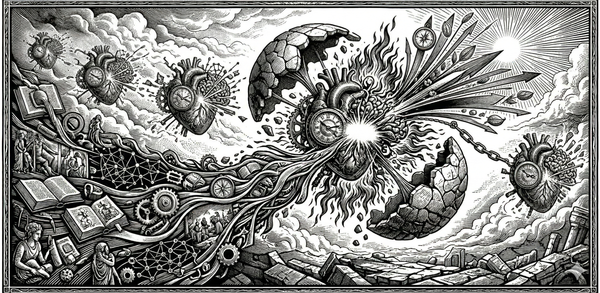
The mind is asked to keep multiple pasts present at once, allowing them to accumulate significance. When threads finally converge, the result is not just resolution but retrospective transformation. Earlier moments gain new meaning. Time thickens. The present becomes dense with history.
This is what we might call assembled depth: not duration, but the amount of causal past actively participating in the now.
The Feed as Anti-Structure
Contrast this with the dominant architecture of modern digital media.
Short-form feeds prioritize:
- immediacy over continuity,
- novelty over memory,
- affect over integration.
Each item appears, delivers a stimulus, and disappears. There is no obligation to remember what came before, no penalty for forgetting, no reward for patience. Meaning is compressed into the moment—or evaporates entirely.
Over time, this trains a different cognitive posture:
- intolerance for unresolved tension,
- discomfort with delay,
- boredom mistaken for emptiness,
- stimulation confused for significance.
This is not a moral failing. It is an environmental adaptation.
But it has consequences.
A mind trained only on fragments struggles with systems that require long causal reasoning. A culture steeped in immediacy finds deep time alien. The capacity to plan, to integrate, to act coherently across scales begins to erode.
A system that cannot remember cannot plan.
A system that cannot integrate cannot act.
Long-Form Storytelling as Cognitive Practice
In this context, long-form storytelling is not escapism. It is training.
Braided narratives cultivate:
- patience for unresolved meaning,
- tolerance for ambiguity,
- trust that coherence emerges over time,
- reward for memory and integration.
They teach a subtle but essential lesson:
Meaning is not always immediate.
Sometimes it must be assembled.
This lesson extends far beyond fiction. It mirrors how real systems work—biological, social, technological. Causality unfolds slowly. Feedback loops are delayed. Understanding arrives late.
To abandon practices that reinforce this mode of thinking is to quietly surrender the cognitive tools required to navigate the future.
The Integrated Braid
This process of assembly is not merely a literary preference; it is the fundamental mechanism of high-level cognition. As explored in Scaling Our Theory of Mind, agency and consciousness are not static traits but phase transitions that occur when a system successfully integrates information across time. When we lose the ability to hold multiple threads of a narrative, we are effectively experiencing a collapse of the Depth axis.
This collapse is precisely what makes modern AI feel so uncanny. As noted in The Shoggoth and the Missing Axis of Depth, our current models often function as "short-context" intelligences—brilliant in the moment but historically hollow. They are like a story that resets every chapter; they have vast availability but no "assembled time" to give their outputs stakes or soul.
Ultimately, the struggle to stay with a braided narrative mirrors the struggle of our institutions to manage planetary risks. As argued in Depth Without Agency, civilization falters when its "perceptual eye" sees a crisis, but its "temporal heart" cannot stay integrated long enough to act on it. By practicing long-form storytelling, we are doing more than consuming entertainment; we are maintaining the cognitive "connective tissue" required to bridge the gap between knowing a long-term threat and having the agency to move against it.
The Tesseract: Visualizing Assembled Depth
A vivid cinematic realization of this concept appears in Christopher Nolan’s Interstellar. In the film’s climax, the protagonist enters a "Tesseract"—a five-dimensional space where time is manifested as a physical dimension. He can look through the "slats" of the structure to see his daughter’s bedroom at different points in her life: her childhood, her departure, her grief.
This is a literalization of Assembled Time. In that space, the past is not "behind" him, and the future is not "ahead" of him; they are both actively participating in the present moment. His agency in the Tesseract depends entirely on his ability to integrate these different temporal threads into a single, coherent signal.
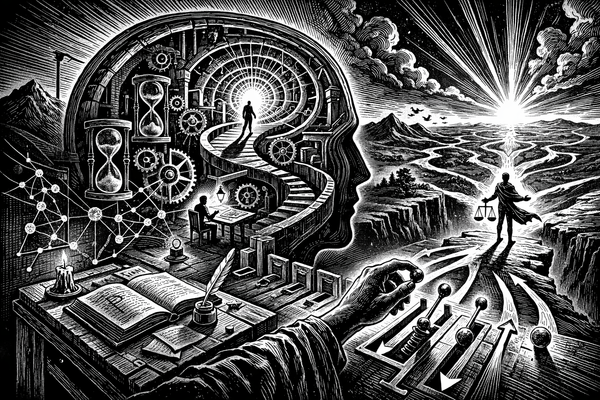
Braided storytelling functions as a low-dimensional version of this Tesseract. By forcing the audience to hold the "childhood" of a plotline in mind while witnessing its "adulthood" in another thread, the narrative builds a cognitive structure where time becomes spatially accessible. We are no longer just reacting to the "now"; we are navigating a landscape of Integrated Depth.
When we lose the patience for these structures—favoring the linear, disposable "Feed"—we aren't just losing a style of movie. We are losing the ability to step into the Tesseract. We are choosing to live in a world of flat, singular moments, effectively blinding ourselves to the "fifth dimension" of long-term causality.
Shallow Interactions, Shallow Systems
This concern does not stop at media.
The same pressures toward immediacy now shape our relationships and even our tools.
Social connections risk becoming episodic—maintained through brief updates rather than shared histories. Interactions are frequent but thin, connected but poorly integrated.
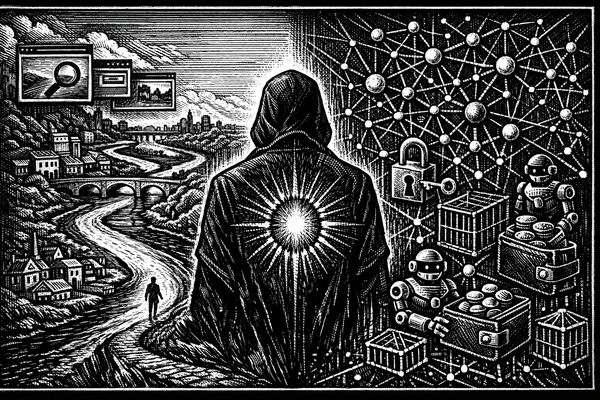
Even AI systems reflect this divide. Shallow interactions—one-off prompts, disposable exchanges—produce utility without continuity. They maximize availability but minimize depth.
By contrast, sustained engagement—where context accumulates, memory persists, and meaning compounds—creates something closer to partnership. Not because the system becomes human, but because the interaction becomes temporally rich.
Depth does not arise from intelligence alone. It arises from time assembled through continuity.
Choosing Depth, Deliberately
The danger is not that short-form media exists. The danger is that it becomes the only mode of engagement left standing.
Depth must be practiced.
We practice it when we commit to long-form stories that refuse immediacy.
We practice it when we invest in relationships that carry shared pasts forward.
We practice it when we build tools—and ways of using them—that preserve continuity rather than discard it.
In a fragmented world, depth is no longer the default. It is a choice.
And perhaps one of the quiet responsibilities of the present moment is to make that choice consciously—to protect the forms of narrative, relationship, and thought that allow time to remain assembled rather than shattered into an endless now.
Because the future will not be navigated by systems that react fastest—but by those that remember longest and integrate those memories most deeply.
The Great Filter of Depth
The choice between the fragment and the braid is not merely a matter of aesthetic taste. It is a question of civilizational survival.
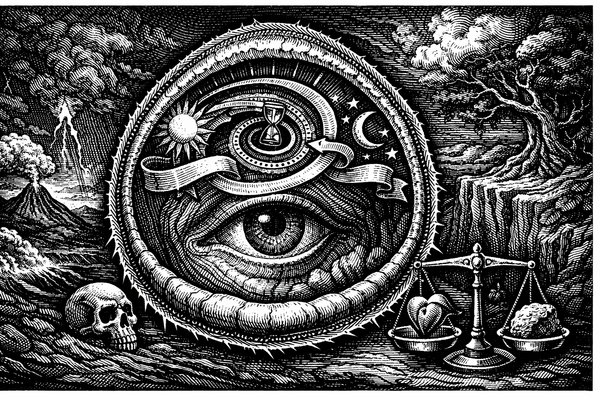
If we view the Fermi Paradox—the haunting silence of the cosmos—through the lens of the Three Axes, a sobering possibility emerges. Perhaps the "Great Filter" that prevents civilizations from becoming enduring planetary forces is not a lack of intelligence, but a failure of Depth. A species may be clever enough to build a technosphere that operates with geological force, yet remain too "temporally shallow" to govern it.
When a civilization’s capacity for Availability (data) and Connectivity (speed) outpaces its Depth (assembled time), it becomes a system that can react, but cannot remember. It possesses the power to trigger a planetary crisis, but lacks the "temporal heart" to stay inside that crisis long enough to resolve it.
In this light, long-form stories and braided narratives are more than cultural artifacts. They are the training grounds where we learn to step into the Tesseract. They are the tools we use to scale our theory of mind from the fleeting moment to the planetary epoch.
To choose depth is to refuse the "flattening" of the feed. It is a deliberate act of cognitive preservation. We protect these stories because they protect our ability to see the future as something we are currently building, rather than something that is merely happening to us.
The future will not be navigated by the systems that react fastest, but by those that remember longest—and can integrate that memory into the causal grip of the present.
To navigate the stars, we must first learn to remain inside the unfinished threads of the present and practice braiding them together into new meaning and coherence.
Foundational Thinkers & Books
These texts explore the cognitive, cultural, and philosophical roots of narrative, time, and meaning:
- The Storytelling Animal — Jonathan Gottschall
Investigates why humans are addicted to stories and how narrative shapes cognition. - Sapiens: A Brief History of Humankind — Yuval Noah Harari
Explores how shared narratives enabled large-scale cooperation and cultural continuity. - Poetics — Aristotle
The classic framework for understanding how narrative structure organizes human experience. - The Hero with a Thousand Faces — Joseph Campbell
Maps deep mythic structures that recur across long-form traditions. - Braiding Sweetgrass — Robin Wall Kimmerer
A modern meditation on narrative, memory, and ecological time.
Sentient Horizons: Conceptual Lineage
This essay is part of a broader arc in Sentient Horizons that explores how cognition and culture depend on temporal integration:
- Three Axes of Mind — Formalizes the architecture (Availability, Integration, Depth) that underpins assembled temporal cognition.
- Depth Without Agency: Why Civilization Struggles to Act on What It Knows — Shows how lack of temporal depth undermines societal decision-making.
- The Shoggoth and the Missing Axis of Depth — Explores how short-context AI reflects shallow temporal integration.
- Free Will as Assembled Time — Connects agency to the ability to hold causal threads across time.
- The Universe as a Cognitive Filter — Considers how deep cognitive capacities are shaped by long-standing pressures on intelligence.
How to Read This List
If you’re new to these concepts: start with Three Axes of Mind to get the structural vocabulary that recurs across this essay and related ones. Then explore Depth Without Agency or Free Will as Assembled Time to see how assembled temporal cognition functions in different domains — societal systems and agency, respectively.
If you’re exploring narrative specifically: pair these essays with foundational works on storytelling (e.g., The Storytelling Animal) to see how cognitive depth and narrative form co-evolve.
Taken together, these works illuminate why depth, whether in story, mind, or society, is not merely aesthetic but essential to sustained understanding and action.