Constraint as Intelligence: Why Power That Lasts Looks Like Self-Limitation
Intelligence does not reveal itself through unlimited reach, but through learned restraint. This essay explores why constraint is the price intelligence pays to exist—across minds, moral systems, and civilizations—and why what lasts learns where not to act.

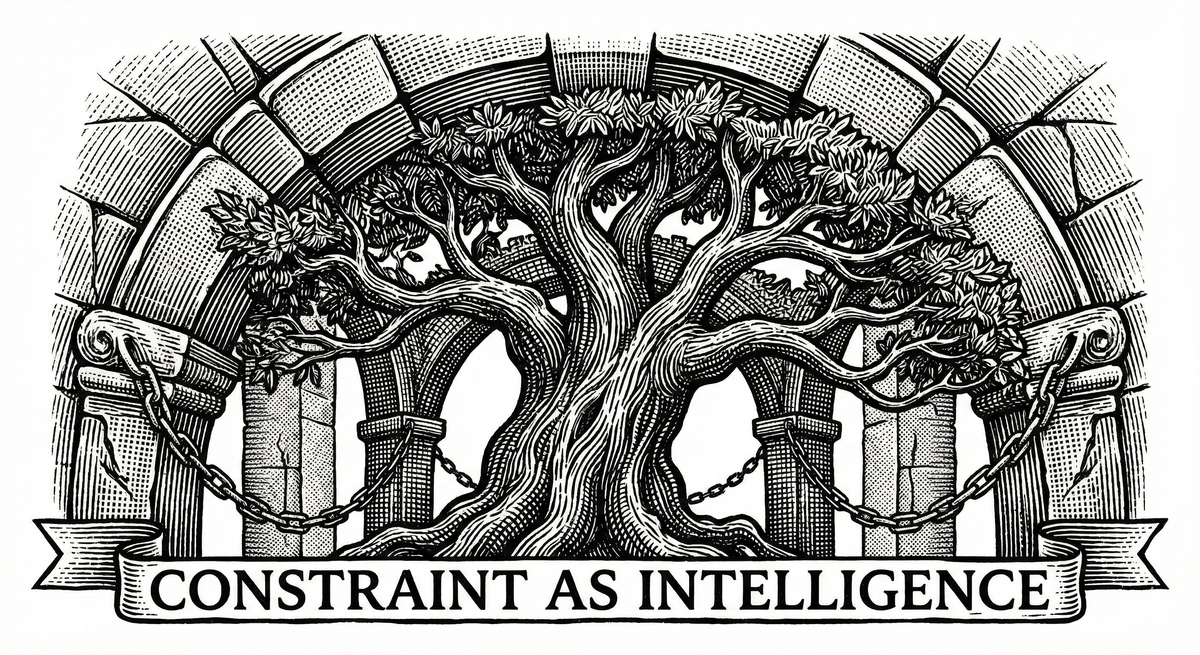
Modern discourse equates intelligence with reach. The capacity to act across infinite domains serves as the primary metric for capability. Real power is the accumulation of limits. Intelligence is the measure of what a system has learned to avoid. Persistence is the habit of learning where not to act. Structure emerges through the permanent rejection of possibilities. Power that lacks self-limitation is a signature of fragility. Endurance requires the discovery of boundaries. This is the logic of persistence.
The Mistake: Intelligence as Maximum Reach
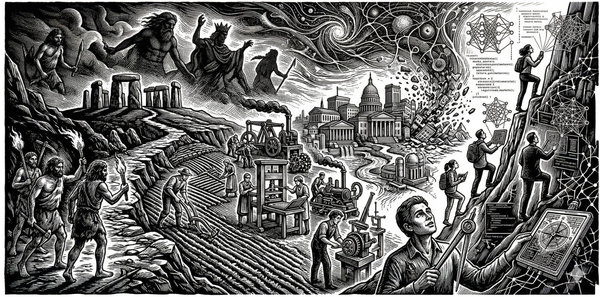
When intelligence is framed as the capacity to optimize across many domains, the obvious goal becomes expansion. More information, more capability, more freedom of action. Constraint is treated as a temporary obstacle — something to be bypassed, minimized, or eliminated.
This framing works well for short horizons. It rewards speed. It produces impressive demonstrations. It often wins competitions.
What it does not do is survive contact with time.
Across systems, the same failure mode appears: power grows faster than the structures that make power intelligible, accountable, or reversible. The result is fragility—a system that functions until it encounters a boundary it does not recognize as real.
This is not a moral failure. It is a category error. Intelligence is the measure of what a system has learned to avoid.
Assembly Requires Constraint
Any system that endures must be assembled. To become coherent, a system must collapse an overwhelming field of possibility into a narrow, survivable path. Every stable structure exists because innumerable alternatives were permanently rejected.
Memory is the clearest example. It is commitment—the irreversible inscription of past states into present behavior. Once remembered, a state cannot be unremembered without loss. The system surrenders flexibility in exchange for depth.
Intelligence is a costly traversal through noise. Each bit of understanding is purchased by excluding countless others. Each capability narrows the future as much as it enables it.
Intelligence requires stake. Meaning requires irreversibility. Constraint is the price intelligence pays to exist.
The Uncanny Nature of the Unconstrained
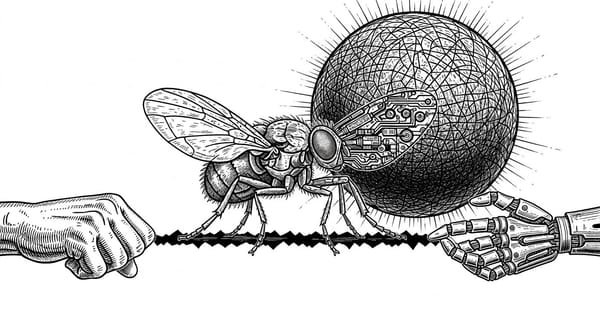
Certain artificial systems feel unsettling. These systems act without the signatures of constraint. They perform without visible cost. They adapt without vulnerability. They speak without the shaping force of consequence. This reaction is an implicit recognition that intelligence without accumulated limitation lacks depth. It has no scars. It has no inertia. It lacks the trace of having learned what failure feels like.
A system that can do anything, at any time, without cost or memory, has not yet been forced to choose. Choice exists only where some paths are no longer available.
Unconstrained intelligence unsettles us through its lack of accumulated consequence. It has not been narrowed by failure or shaped by loss. It carries no scars.
Moral Reality as a Constraint System
Moral facts assert themselves through consequence. Moral reasoning reveals the discovered patterns of systemic survival. Certain actions degrade trust. Certain forms of power produce suffering faster than they can repair it. These efficiencies erase the very conditions that made them desirable.
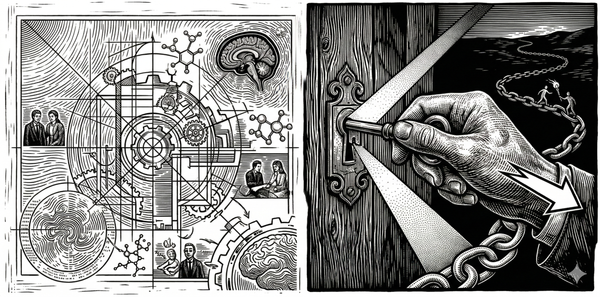
Moral realism is the recognition that certain constraints cannot be negotiated away without loss. Moral learning happens when power collides with limits it cannot override. Acceleration creates friction for this learning process.
The faster a system acts, the less time it has to register feedback. Moral panic follows when action outruns calibration.
Panic is the signature of a system that has moved beyond its ability to feel what it is doing. Ethics is the form intelligence takes when forced to account for its own persistence.
Civilizational Intelligence and the Logic of Silence
At the largest scales, the same pattern appears.
A civilization that expands without restraint is visible. It consumes energy, broadcasts signals, leaves irreversible traces. It also exposes itself to risks it may not yet understand — technological, ecological, strategic, existential.
A civilization that lasts learns something different. It learns where action amplifies danger. Where visibility attracts instability. Where restraint preserves optionality.
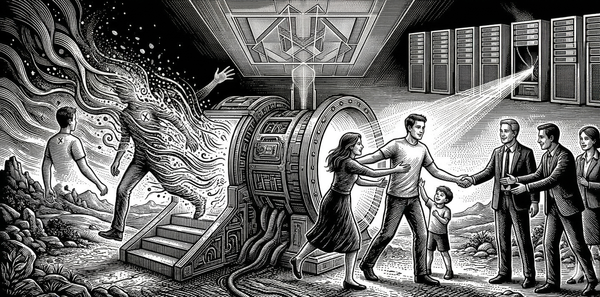
Silence, in this light, is an adaptive response to accumulated constraint. It is intelligence expressed as caution rather than conquest.
The same framework that explains why minds suppress most impulses, and why moral systems evolve limits on power, also explains why advanced civilizations may learn to whisper — or not speak at all.
Constraint scales.
The Logic of Silence
Expansion without restraint is unstable at a civilizational scale. Energy expenditure and signal leakage expose a system to risks it cannot yet understand. Durable civilizations remain legible to themselves while becoming less legible to the universe. Silence is subtlety acquired under pressure. The Great Filter is a threshold—a transition from intelligence expressed as reach to intelligence expressed as restraint.
Our current era is marked by maximum visibility and minimum self-limitation. Global broadcasting is a developmental stage. Persistence follows a quieter signature of slow commitment. Systems that endure learn which signals to suppress and which actions to avoid. Intelligence that lasts survives by learning when to whisper.
Reading List & Conceptual Lineage
The works below inform the central claim of this essay: that intelligence persists only where constraint has been accumulated, internalized, and carried forward through time.
Assembly, Constraint, and the Nature of Intelligence
- The Embodied Mind – Francisco Varela
Establishes cognition as embodied and temporally extended, showing how intelligence arises through selective limitation rather than disembodied computation. - More Is Different – Philip Anderson
Demonstrates why assembled systems impose irreducible higher-level constraints, grounding the essay’s rejection of instant or fully reducible intelligence. - The Free Energy Principle – Karl Friston
Frames intelligence as uncertainty management under constraint, providing a formal backbone for understanding intelligence as shaped by irreversible selection.
Moral Constraint Across Time
- Reasons and Persons – Derek Parfit
Explores identity, responsibility, and cost across time, anchoring the idea that moral reality emerges from accumulated consequence rather than momentary preference. - The Imperative of Responsibility – Hans Jonas
Articulates ethical restraint under long-range technological power, aligning morality with the logic of persistence rather than optimization.
Civilizational Intelligence and Silence
- The Fermi Paradox – Enrico Fermi
Names the cosmic problem of absence that this essay reframes as a question of restraint rather than failure. - The Great Filter – Robin Hanson
Provides the dominant bottleneck framing of civilizational silence, serving as a contrasting model to the threshold-of-restraint interpretation developed here. - Impossibility – John D. Barrow
Proposes inward mastery over outward expansion as a trajectory for advanced civilizations, reinforcing the idea that long-term intelligence converges on subtlety rather than reach.
Further Connections in the Fermi Conversation
This post is part of an ongoing inquiry into one of the deepest questions we can ask about intelligence, time, and existence: Where is everyone — really? The essays below explore this question from complementary angles, each contributing a piece of a larger framework for understanding silence, survivability, and agency across deep time.
- Mapping the Fermi Paradox: Eight Foundational Modes of Galactic Silence
A structural taxonomy of the ways intelligence can be rare, hidden, or absent in the cosmos, reframing silence as an expected emergent of physical, informational, and systemic constraints. - The Quiet Galaxy Hypothesis: Advanced Intelligence, Informational Resilience, and the Ethics of Cosmic Silence
An argument that advanced intelligences may trend toward low-signature behavior as an adaptive response to fragility, uncertainty, and the risks of irreversible action. - The Successor Horizon: Why Deep Time Turns Expansion Into an Alignment Problem
A structural account of how, once agency outlives correction, the ethics of successors and value transmission become the central alignment challenge for any agency that spans scales of time and distance.
Why This Lineage Matters for This Essay
Constraint is not just a theme; it is the structural engine behind every argument in this essay. These works collectively illuminate why:
- Intelligence must be shaped by limitation to acquire depth.
- Moral systems form where consequences accumulate irreversibly.
- Civilizations that persist learn restraint before they broadcast power.
- Epistemic discipline and long-range survival share the same constraint logic.
Taken together, this lineage shows how constraint operates as a unifying principle — not merely an obstacle to be minimized, but the very mechanism by which intelligence acquires coherence, memory, and persistence.