Depth Without Agency: Why Civilization Struggles to Act on What It Knows
Modern civilization is drowning in data but starving for agency. We possess the "Cognition" to model our future, yet lack the "Depth" to act on it. Using the Three Axes of Mind, we explore why our systems—and our AI—are architecturally biased toward a dangerous "temporal poverty."

Modern civilization stands at an unusual moment in its history.
Never before has humanity possessed such vast stores of knowledge about the world it inhabits. Data flows globally. Predictive models extend across decades. Scientific understanding reaches from subatomic particles to planetary systems. And yet, despite this unprecedented cognitive capacity, translating insight into sustained, collective action remains an open challenge.
This tension does not imply failure — but it does reveal a structural strain. Civilization is increasingly confronting problems that unfold across long timescales, nonlinear feedback loops, and planetary boundaries, while many of its institutions, incentives, and cultural rhythms remain optimized for immediacy and short-term response.
Adam Frank’s Blind Spot offers a compelling lens on this moment. Frank argues that civilizations are embedded within complex planetary systems they often fail to fully recognize until stress accumulates. The danger, he suggests, is not ignorance or malice, but cognitive limitation — mismatches between how systems behave and how societies understand themselves within them.
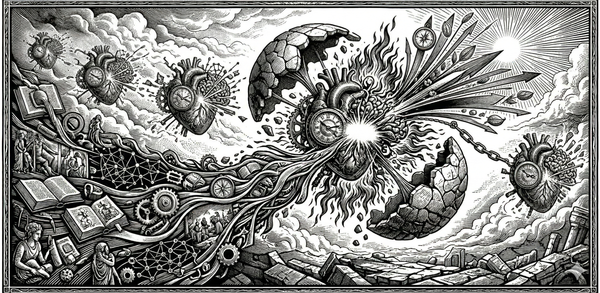
In his recent dialogue with Lex Fridman, Frank grounds this "blind spot" in the deep history of our planet. He points out that life doesn't merely happen on a planet; it happens to a planet. From the "Great Oxygenation Event" billions of years ago—where early life unwittingly transformed the entire chemistry of the atmosphere—to the geological feedback loops of plate tectonics that rescued Earth from a "Snowball" state, the biosphere has always been a primary planetary force. Frank’s core provocation is that our current "technosphere" is merely the latest, and currently most "immature," of these forces.
We are currently acting with the power of a geological era but coordinating action with the limited, local scope of a singular species. This mismatch appears to represent a recurring hard step for technological civilizations: the moment when a species must transition from being a passenger on its planet to becoming a homeostatic participant in its survival.
This diagnosis is persuasive. But it raises a deeper question: if knowledge is available, models exist, and warnings are understood, where exactly does the strain arise?
When examined through the Three Axes of Mind — Availability, Integration, and Depth — the challenge facing modern civilization appears less like blindness and more like a test of temporal coherence.
Scaling the Structure of Mind
In Scaling Our Theory of Mind, we describe consciousness not as a substance or a feeling, but as a structural phase transition: consciousness emerges when information is widely available within a system, integrated into a causally unified whole, and shaped by deep temporal history — assembled time.
This framework was deliberately designed to scale. What applies to individual minds also applies, mutatis mutandis, to larger systems: organizations, institutions, and even civilizations.
At civilizational scale, the parallels are striking.
- Availability is unprecedented. Information about planetary conditions, risks, and futures circulates globally in real time.
- Connectivity is dense. Signals propagate rapidly across networks.
- Integration is uneven and fragile.
- Depth — the capacity to bind past, present, and future into coherent agency — remains weakly coupled to the systems exercising real-time causal power.
Connectivity describes the density of links between components; integration describes whether those components participate in a unified, causally coherent system.
Civilization, like a mind overwhelmed by stimulus, perceives much but struggles to integrate what it remembers into causal agency.
Blind Spots or Fragmentation?
Frank is right to say that modern civilization often misunderstands its relationship to planetary systems. But describing this primarily as a “blind spot” risks obscuring a critical distinction.
In many cases, the system can see.
Climate risks are modeled. Ecological thresholds are identified. Long-term consequences are openly discussed. The challenge is not a lack of perception, but a failure to integrate what is perceived into effective causal action.
Awareness appears, circulates, and dissipates before it can be translated into durable commitments. Insight fails to bind. Understanding loses causal grip faster than consequences unfold.
This suggests that the dominant strain is not blindness, but fragmentation across time. Knowledge exists locally and episodically, but is not being effectively integrated into structures capable of sustaining action across decades or generations.
A system that is merely blind cannot respond.
A fragmented system responds briefly — and then moves on too quickly.
Cognition Is Not Agency
A second refinement of this diagnosis is essential: cognition does not imply agency.
Even at the level of individual minds, understanding does not guarantee control. Insight does not eliminate internal conflict, nor does foresight ensure discipline. At the scale of civilization, the gap widens dramatically.
Civilizations do not possess:
- a unified executive function,
- a single reward signal,
- or a centralized learning loop.
Instead, they are composed of competing subsystems — markets, governments, cultures, technologies — each optimizing on different incentives and timescales. Scientific understanding may be deep in one subsystem while political or economic action lags far behind.
What strains, then, is not intelligence itself, but the embodiment of intelligence in institutions capable of acting coherently over time.
From this perspective, civilizational intelligence already exists — but only in fragments.
The Risk of Anthropomorphizing Civilization
This leads to a third and subtler concern. Describing civilization as a “planetary intelligence” is a powerful metaphor, but a risky one if taken too literally.
Civilizations are not minds.
They do not experience.
They do not remember as unified subjects.
They do not decide as wholes.
Treating civilization as a singular cognitive agent risks projecting coherence where none yet exists. The danger is mistaking metaphor for mechanism.
The Three Axes framework offers a corrective. Rather than asking whether civilization is intelligent, it asks how availability, integration, and depth are distributed unevenly across scales.
Some subsystems exhibit deep memory — science preserves long arcs of understanding.
Others are temporally shallow — media cycles collapse attention into the present.
Some integrate tightly — technical systems coordinate with precision.
Others remain adversarial — political and economic incentives fracture coherence.
Civilizational cognition is patchy, not absent. The challenge is not awakening a planetary mind, but stitching together depth across fragmented subsystems without erasing their diversity.
Depth as the Least Integrated Axis
If availability and connectivity have surged in modern times while coherence lags, the missing axis becomes clear.
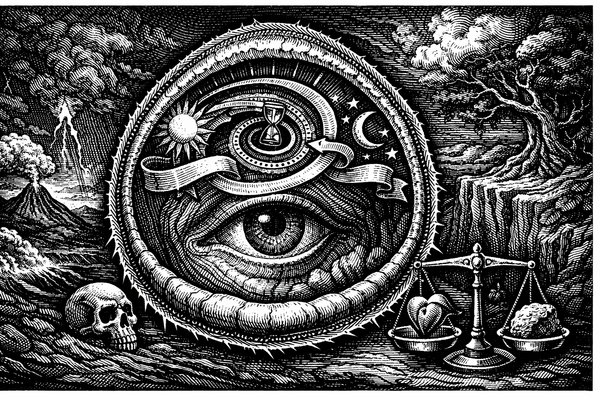
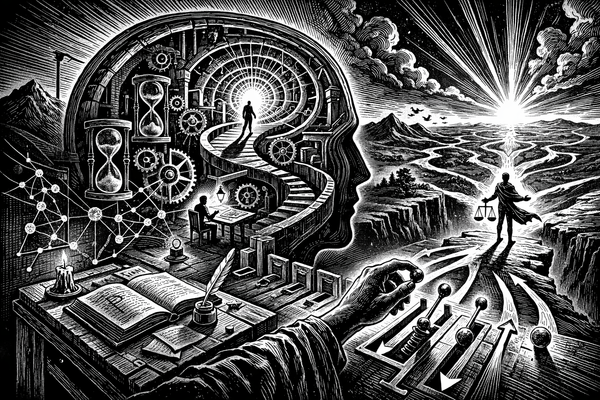
Depth is the capacity of a system to assemble time — to hold its past actively in the present and allow that accumulated history to shape future-directed action. Depth is not data storage. Depth is resistance—the ability of a past commitment to resist a present-day impulse. It is temporal integration.
Modern civilization possesses immense historical and intellectual depth, but struggles to embed that depth into the systems exercising the greatest causal influence today. The problem is not the absence of memory, but the failure of memory to remain causally active where decisions are made.
A system with causally active depth:
- remembers past failures in ways that constrain present behavior,
- preserves commitments beyond short-term incentive cycles,
- projects futures with sufficient fidelity to guide sacrifice now.
Many modern institutions struggle to support this capacity. Electoral cycles, market pressures, media incentives, and technological acceleration all bias action toward immediacy.
The result is not ignorance, but temporal poverty — a condition in which long-term consequences are known but fail to constrain decision-making in the present.
Depth Exists — But Elsewhere
It would be a mistake to conclude that modern civilization lacks depth in any absolute sense.
Civilization carries within it thousands of years of accumulated experience: the sediment of trial and error, the preserved insights of philosophy and science, the institutional memory encoded in law, culture, and tradition. Few societies in history have had such extensive access to their own past.
The challenge, then, is not the absence of depth, but its location.
Much of civilization’s depth resides in slow-moving systems: academic disciplines, archival institutions, long-form scholarship, and cultural traditions designed to preserve understanding across generations. These systems are rich in memory, nuance, and reflection—but they are increasingly peripheral to the mechanisms that act with the greatest speed and force.
By contrast, many of the systems that now function as primary causal agents—markets, algorithmic platforms, media ecosystems, and political incentive structures—are optimized for immediacy. They operate on short feedback loops, reward rapid response, and discount long-term consequence by design.
The result is a structural decoupling.
Depth exists, but it does not govern action.
Memory is preserved, but it does not constrain behavior.
Understanding accumulates, but it does not reliably shape decisions.
In this sense, the civilizational challenge is not forgetting, but disconnection—a failure to integrate long-term understanding into the systems that now shape outcomes in real time.
This reframes the problem decisively. Civilization does not fail because it cannot remember. It falters when memory and power drift apart.
Short-Context AI and the Culture of Temporal Poverty
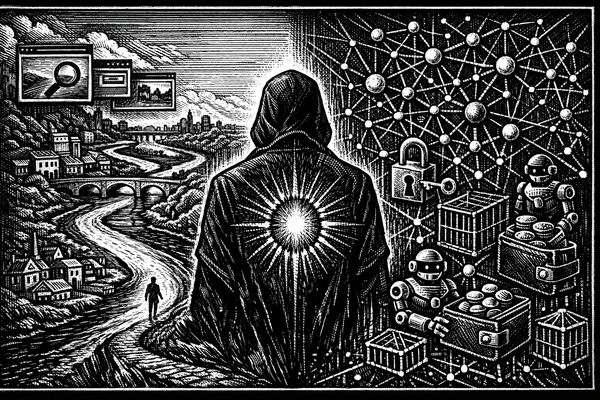
This structural decoupling of depth and action is not merely a failure of legacy institutions; it is being actively encoded into the architecture of our next generation of cognitive tools. As we seek to outsource our cognition to artificial systems, we are inadvertently building mirrors of our own temporal poverty. We are crafting an infrastructure of intelligence that is, by design, architecturally incapable of the depth we so desperately need. In doing so, we risk hardening an historically contingent cultural habit into a durable technical constraint. This is most visible in the rise and dominance of short-context AI.
Many contemporary AI chatbots offer instant access to an extraordinary breadth of human knowledge. They are fast, fluent, and responsive. Yet they are typically designed for shallow temporal engagement: limited memory, minimal continuity, and interactions optimized for immediate satisfaction rather than cumulative understanding.
This is not a flaw of the technology so much as a reflection of the environment it emerges from.
Short-context AI systems are well adapted to a culture that privileges speed over continuity, novelty over coherence, and answers over understanding. They assume — often correctly — that most interactions will be brief, interchangeable, and disposable. Depth is treated as optional overhead.
In this way, civilization externalizes its own temporal poverty into the cognitive tools it builds.
These systems excel at availability and local integration, but systematically deprioritize depth. They can respond intelligently in the moment while remaining unable to carry interaction history forward in a causally meaningful way. Each interaction begins nearly from scratch. Context is minimal. Memory resets.
For users, this subtly reshapes expectations. Insight becomes something to be retrieved rather than assembled. Understanding becomes episodic rather than cumulative. Conversations end before they can deepen.
If depth is the axis through which time becomes causally active, then short-context AI is not merely a technical limitation. It is a cultural expression of a deeper difficulty staying with ideas long enough for them to transform us.
Depth in Practice: A Method for Integrative Conversation
This process of engaging with Blind Spot itself offers a small but revealing illustration of what depth looks like in practice.
Rather than treating Frank’s argument as something to accept or reject wholesale, we hold its claims open across time. Insights can be integrated where they fit — particularly around embeddedness, interaction, and the limits of observer-free abstraction. At the same time, we can stress-test the argument at its edges, where some claims begin to overreach or lose coherence.
Crucially, this evaluation does not require the entire thesis to succeed in order for parts of it to remain valuable.
This mode of engagement contrasts sharply with the dominant patterns of modern discourse, which tend to reward rapid judgment, categorical alignment, and rhetorical closure. In such environments, ideas are consumed as packages rather than explored as structures. Partial truths are discarded because they arrive bundled with claims that do not fully integrate.
Depth offers an alternative.
A depth-oriented conversation allows ideas to remain alive long enough to reveal where they fit, where they strain coherence, and where they generate productive tension. It treats frameworks not as doctrines, but as evolving structures capable of incorporating novelty without losing identity.
Importantly, this is not a purely intellectual exercise. It is a cultural and interpersonal practice.
This same distinction between structural limitation and practiced depth becomes especially visible in our interactions with artificial intelligence.
While many modern AI tools are architecturally optimized for short-context interaction, this does not mean that depth is impossible in practice. Even within present constraints, sustained, long-context dialogue over weeks or months can partially overcome these limitations. When conversations are treated not as isolated queries but as continuing threads, shared reference frames accumulate, ideas evolve rather than reset, and understanding becomes genuinely integrative.
In such cases, depth does not emerge from any single interaction, but from the discipline of continuity itself. Memory is reconstructed through recurrence. Context is preserved through intention. Meaning deepens because prior commitments remain active rather than discarded.
This does not negate the structural critique of short-context systems. On the contrary, it highlights it. Depth can be achieved, but only through sustained effort that runs against prevailing incentives. When depth requires constant vigilance to maintain, it will remain rare. Civilizations cannot rely on manual continuity any more than individuals can rely on willpower alone.
The lesson is not that current tools are sufficient, but that depth is a practice first — and a feature second.
When individuals model this kind of engagement — in reading, dialogue, and collaboration — they create local pockets of temporal coherence. These pockets matter. Civilizational change rarely begins with consensus at scale. It begins with communities that demonstrate what sustained understanding feels like when ideas are allowed to accumulate rather than reset.
In this sense, depth is not only something civilizations must eventually design into their institutions and technologies. It is something that can be practiced now, in how we listen, how we critique, and how we allow conversations to unfold over time.
Conclusion: Binding Depth to Power
Adam Frank is right that civilizations face limits not because they are unintelligent, but because they struggle to understand themselves at the scales they now operate.
But the deepest challenge is not perceptual — it is temporal.
Modern civilization can see the systems it inhabits.
The open question is whether it can stay inside that understanding long enough to act coherently.
Depth is the axis most poorly integrated into modern systems of agency.
Cultivating it — in minds, conversations, institutions, cultures, and technologies — is not a guarantee of success. But it is a prerequisite for navigating long-term complexity without losing coherence along the way.
To move forward, civilization must learn not just to see more,
but to build structures that bind decision-making power to accumulated depth.
Continued Reading & Lineage
This essay draws on a constellation of ideas about cognition, collective action, temporal coherence, and the structural limits of systems — both human and artificial. If this piece resonated with you, the following works will deepen your engagement with the themes explored here.
Foundational Thinkers & Books
These texts explore the broader intellectual terrain that informs the essay’s core concerns:
- Thinking, Fast and Slow — Daniel Kahneman
Classic work on how cognitive biases and short-loop thinking shape individual and collective decision-making. - The Knowledge Illusion — Steven Sloman & Philip Fernbach
Argues that individuals and societies thinkthey understand much more than they actually do, with implications for coordinated action. - The Fifth Discipline — Peter Senge
A seminal exploration of systems thinking and how organizational structures enable or inhibit long-term learning and agency. - Collapse — Jared Diamond
A historical investigation into how societies succeed or fail in responding to long-term environmental and systemic stresses. - Thinking in Systems — Donella Meadows
Offers tools for understanding delays, feedback loops, and structural inertia that frustrate long-term collective action.
Sentient Horizons: Conceptual Lineage
This essay builds on and intersects with prior Sentient Horizons explorations into depth, agency, and the temporal structure of cognition:
- Three Axes of Mind — Introduces Availability, Integration, and Depth as the structural axes underpinning assembled temporal cognition.
- Assembled Time: Why Long-Form Stories Still Matter in an Age of Fragments — Explores how temporal continuity is central to narrative depth, a theme mirrored in how civilizations bind long-term understanding to action.
- The Shoggoth and the Missing Axis of Depth — Argues that powerful intelligence without depth generates systemic fragility, especially in artificial systems.
- Scaling Our Theory of Mind: From Individual Consciousness to Civilizational Intelligence — Applies the Three Axes framework to societies, showing how cognitive structures scale (or fail to) at macro scales.
- Free Will as Assembled Time — Connects agency to the capacity to synthesize temporal threads into coherent intention.
How to Read This List
If you’re new to these ideas: start with Three Axes of Mind to get the structural vocabulary that recurs across Sentient Horizons. Then read Assembled Time to see how these ideas manifest in narrative and cognition. From there, Depth Without Agency and Scaling Our Theory of Mind show how these cognitive structures operate at civilizational scales.
If you’re focused on systemic action: pairing these essays with works from systems thinkers like Peter Senge and Donella Meadows will deepen your understanding of why insights often fail to translate into sustained collective action.
Taken together, these works illuminate a shared insight: knowledge by itself is not enough.
Depth, continuity, and structural coherence are prerequisites for coordinated agency across time and scale.