Mapping the Fermi Paradox: Eight Foundational Modes of Galactic Silence
The Fermi Paradox is often treated as a single mystery with competing answers. This essay reframes it as a map: eight foundational modes describing how a finite galaxy can remain quiet, clarifying where disagreements truly lie—and why silence alone is not decisive.

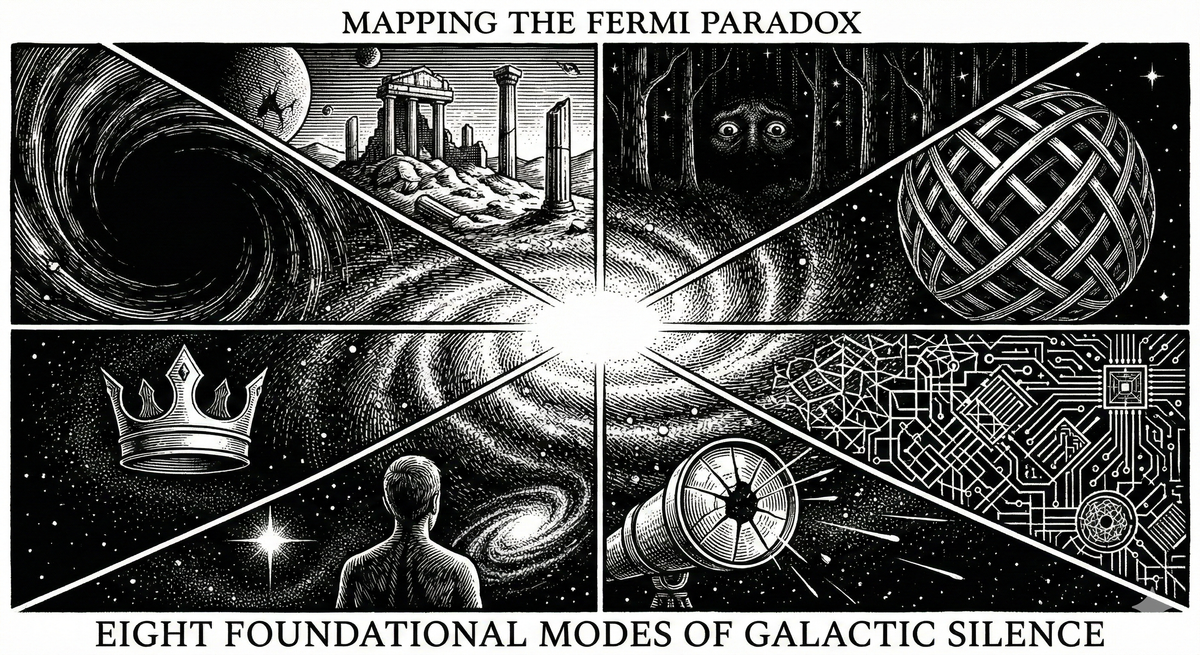
The Fermi Paradox is often introduced as a mystery.
In a galaxy billions of years old, containing hundreds of billions of stars and an enormous number of potentially habitable worlds, why do we see no evidence of other technological civilizations? If intelligent life were common and long-lived, shouldn’t the Milky Way already bear unmistakable signs of its presence?
The question is famous, compelling—and persistently unresolved. But part of the reason it resists resolution is that it is rarely approached with sufficient conceptual structure. Many disagreements about the Fermi Paradox are not really disagreements about evidence or probability, but about which kind of silence is being explained.
This essay proposes a simple reframing: instead of treating the Fermi Paradox as a single problem with competing answers, we should understand it as a family of related questions, each corresponding to a different way a finite galaxy can remain quiet.
What follows is not an exhaustive list of hypotheses. It is a map—a set of foundational modes that organize how silence can arise in the Milky Way. Most specific solutions to the Fermi Paradox fall within one or more of these regions.
Why the Paradox Fractures
At its core, the Fermi Paradox asks why our galaxy appears empty of advanced intelligence. But “empty” can mean many things:
- No civilizations ever arose
- Civilizations arose but did not last
- Civilizations exist but avoid detection
- Civilizations exist but do not care to communicate
- Civilizations exist, but our methods of detection are misaligned
When these possibilities are collapsed into a single question—Where is everybody?—debate becomes confused. Answers talk past one another because they are addressing different causal pathways to silence.
To make progress, we need first-order categories: broad explanatory modes that clarify what kind of silence is being proposed, before arguing about likelihood or evidence.
Eight Foundational Modes of Galactic Silence
These modes are not mutually exclusive. A galaxy may exhibit several simultaneously. They are best understood as structural patterns, not finalized theories.
1. They Aren’t There
(Rarity / Great Filter)
In this mode, the silence is literal. The emergence of technological intelligence is exceedingly rare, or one or more steps on the path from chemistry to civilization are so unlikely that most galaxies never host advanced life at all.
Silence, here, reflects absence.
This category includes arguments that place a “great filter” early in evolutionary history or at some fragile stage of technological development.
2. They Were There
(Temporal mismatch / archaeological universe)
Civilizations may arise, flourish, and disappear—but on timescales short relative to the age of stars and galaxies.
Technological artifacts erode. Signals fade. Planets rewild.
In this view, the galaxy is not empty but historically rich—and we are simply late to the scene.
Silence reflects impermanence rather than rarity.
3. They’re There and Afraid
Here, silence is strategic.
If the universe is assumed to be hostile or unpredictable, broadcasting one’s presence may be dangerous. Civilizations that survive learn to remain quiet, conceal their activity, or even suppress emerging competitors.
Silence reflects fear under uncertainty.
4. They’re There and Restraining Themselves
(Zoo / non-interference)
In this mode, silence is intentional but ethical.
Advanced civilizations may choose not to interfere with developing ones, whether out of moral concern, scientific interest, or long-term governance norms. Observation may occur without contact.
Silence reflects restraint.
5. They’re There and Optimized Past Legibility
This mode challenges a central assumption of many Fermi discussions: that advanced intelligence should be visible.
As intelligence matures, pressures favor efficiency, miniaturization, low-energy computation, and informational resilience. Large, wasteful, high-emission structures are transient developmental phases, not endpoints.
In this view, civilizations may be widespread yet leave little that our instruments are tuned to detect.
Silence reflects optimization and maturity.
We explore this more deeply in our essay:
The Quiet Galaxy Hypothesis – Advanced Intelligence, Informational Resilience, and the Ethics of Cosmic Silence
6. They’re There, but We Don’t Know How to See
(Epistemic limitation)
Here, the problem is not extraterrestrial behavior but human expectation.
Our searches are guided by what early technological civilizations emit: radio leakage, optical signals, megastructures, excess waste heat. If these are poor proxies for advanced intelligence, then continued null results say more about our assumptions than about the galaxy.
Silence reflects observer error.
7. They’re There, but They Don’t Care
(Motivational divergence)
Intelligence need not value expansion, communication, or curiosity in ways humans recognize.
Civilizations may turn inward, pursue goals unrelated to exploration, or simply find other minds uninteresting. Human salience is not guaranteed.
Silence reflects indifference.
8. They’re There — and It’s Already Decided
(Singleton / early winner)
A final possibility is asymmetry.
If one civilization arose early and achieved decisive technological advantage, it may have shaped the galaxy in subtle but pervasive ways long before others emerged. Governance, enforcement, or quiet saturation with monitoring infrastructure could all result in a galaxy that appears empty to latecomers.
Silence reflects prior resolution.
How These Modes Relate
These modes are often treated as competitors. They are better understood as layers.
A galaxy might exhibit strong filters, rare survivorship, optimization toward quiet systems, epistemic blind spots in detection, and motivational divergence—all at once.
Debates about the Fermi Paradox frequently stall because they insist on a single explanation, when the phenomenon itself may be overdetermined.
Why This Map Matters
Without structure, silence invites projection.
Some see threat. Others see emptiness. Still others see benevolence or transcendence. But silence alone does not adjudicate between these interpretations.
What this framework offers is orientation: a way to separate questions of existence from questions of detectability, motivation, ethics, optimization, and time.
The Fermi Paradox is not only a question about extraterrestrial intelligence. It is also a mirror held up to our assumptions about progress, visibility, and meaning.
How This Framework Will Be Used
Future essays on Sentient Horizons will return to individual modes in this map—sometimes developing explicit models within them, sometimes exploring their intersections or tensions.
The Quiet Galaxy Hypothesis is one such region of this landscape, not a final answer but a corrective to the assumption that advanced intelligence must announce itself.
This map is meant to remain open, extensible, and revisable.
The Successor Horizon
Since this essay was first published, later work at Sentient Horizons has highlighted a deeper structural reason why advanced intelligences may trend toward low signature or deliberate constraint.
The Successor Horizon reframes expansion not merely as a matter of detectability but as an alignment problem across deep time — where the emergence of successors who act beyond correction drives a kind of existential prudence.
From this perspective, many of the modes of silence discussed above are not just contingencies of physics and economics, but adaptive responses to the hazard of creating untethered successors.
In other words, the same forces that make civilizations hard to detect may also be the ones that make them cautious in what they set in motion.
Closing
The Fermi Paradox is often framed as a mystery demanding a solution. A better starting point is clarity.
The question is not simply “Where is everybody?” It is:
“In what ways can a galaxy remain quiet?”
Once that question is properly framed, the silence becomes less baffling—and more instructive.
Reading List and Conceptual Lineage
The framework outlined above did not emerge in isolation. It draws on decades of scientific, philosophical, and speculative work grappling with the implications of cosmic scale, technological intelligence, and persistent silence. What follows is not an exhaustive bibliography, but a conceptual lineage—key contributions that shape the landscape this essay inhabits.
Origins of the Paradox
- Enrico Fermi – The Fermi Paradox
The paradox takes its name from Fermi’s famous lunchtime question—“Where is everybody?”—which crystallized the tension between cosmic scale and apparent absence. Fermi himself offered no formal solution; the paradox is a retrospective construction built around the unease his question exposed. - Michael Hart – Explanation for the Absence of Extraterrestrials on Earth
Hart’s 1975 paper formalized the paradox in modern terms, emphasizing galactic colonization timescales and arguing that silence implies rarity. Much subsequent debate can be read as responses to Hart’s framing.
Rarity, Filters, and Fragility
- Robin Hanson – The Great Filter - Are We Almost Past It?
Hanson’s Great Filter framework remains one of the most influential attempts to explain silence through improbability—locating a decisive bottleneck somewhere between prebiotic chemistry and galaxy-spanning civilization. - Nick Bostrom – Superintelligence: Paths, Dangers, Strategies
While not focused on SETI directly, Bostrom’s work on existential risk and anthropic reasoning strongly informs filter-based thinking, particularly the idea that survivorship bias shapes our observations.
Strategic Silence and Non-Interference
- David Brin
Brin articulated early versions of both the Dark Forest and Zoo intuitions, emphasizing game-theoretic risk, deterrence, and the possibility that observation without contact is the default stable strategy. - John A. Ball
Ball’s Zoo Hypothesis formalized the idea that advanced civilizations might deliberately avoid interaction, introducing ethical and governance considerations into the paradox. - Liu Cixin – The Dark Forest
Though fictional, Liu Cixin’s novel popularized the strategic-fear framing for a broad audience. Its value here is illustrative rather than evidentiary—it dramatizes one possible silence mode rather than establishing it.
Temporal and Archaeological Perspectives
- Milan Ćirković – The Great Silence: Science and Philosophy of Fermi's Paradox
A rigorous exploration of temporal mismatch, catastrophic risk, and observational limits, situating the paradox within a broader cosmic evolutionary context. Ćirković has been a leading voice in emphasizing deep time, extinction, and the possibility that the galaxy’s history is far richer than its present appearance suggests. His work strongly informs the “They Were There” mode.
Detectability, Technosignatures, and Epistemic Limits
- Jason T. Wright – Various Works
Wright’s work on technosignatures reframes SETI as a broader search for any evidence of technology, not just radio signals—highlighting how narrow our historical expectations have been. - NASA Astrobiology & Technosignatures Programs
Contemporary SETI efforts increasingly recognize that detectability is an epistemic problem as much as an engineering one, a shift that underlies several modes discussed in this essay.
Optimization, Miniaturization, and Quiet Intelligence
- John D. Barrow – Impossibility
Barrow’s scale of inward technological mastery provides a crucial counterpoint to Kardashev-style expansionism, suggesting that advanced intelligence may trend toward precision rather than scale. - Anders Sandberg – Future of Humanity Institute
Sandberg’s work on post-biological intelligence, substrate independence, and long-term futures informs the Quiet Galaxy perspective, particularly its emphasis on efficiency and resilience over visibility.
Further Connections in the Fermi Conversation
This post is part of an ongoing inquiry into one of the deepest questions we can ask about intelligence, time, and existence: Where is everyone — really? The essays below explore this question from complementary angles, each contributing a piece of a larger framework for understanding silence, survivability, and agency across deep time.
- The Quiet Galaxy Hypothesis: Advanced Intelligence, Informational Resilience, and the Ethics of Cosmic Silence
An argument that advanced intelligences may trend toward low-signature behavior as an adaptive response to fragility, uncertainty, and the risks of irreversible action. - Constraint as Intelligence: Why Power That Lasts Looks Like Self-Limitation
A reframing of power and agency showing how self-limitation can be a form of durability, boundary-preserving intelligence in systems that must endure beyond the moment of decision. - The Successor Horizon: Why Deep Time Turns Expansion Into an Alignment Problem
A structural account of how, once agency outlives correction, the ethics of successors and value transmission become the central alignment challenge for any agency that spans scales of time and distance.
How This Essay Extends the Lineage
Most prior work on the Fermi Paradox argues within a single explanatory frame. The contribution here is methodological rather than adversarial: to distinguish modes of silence before debating their likelihood.
By separating rarity, time, fear, ethics, optimization, epistemic limits, motivation, and power asymmetry into first-order categories, this framework aims to clarify where disagreements truly lie—and where they do not.
Future essays on Sentient Horizons will explore specific modes in greater depth, sometimes developing explicit models, sometimes examining overlaps. This map is intended to remain open, revisable, and generative.