Shared Minds, Shared Futures: Human–Machine Systems as Hybrid Cognitive Entities
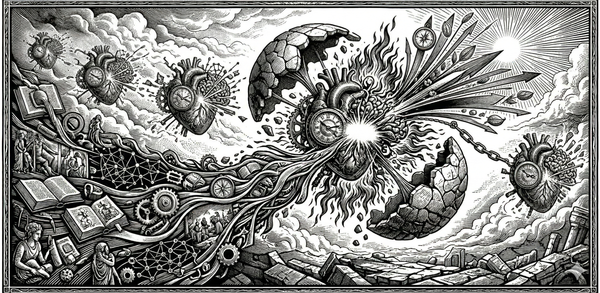
The most consequential shift of the century isn't AI waking up, it’s the silent merger of human and machine. Exploring the Three Axes of Mind, this essay asks if we are becoming passengers of an optimized life, and how we might preserve "depth" as we move toward the stars.

Much of the contemporary debate about artificial intelligence revolves around a single, persistent question: Is AI conscious?
It is an understandable question, but it is also the wrong one.
Whether current or future machines possess subjective experience tells us very little about the transformation already underway. The most consequential shift of the coming century does not depend on machines waking up. It depends on something quieter and already in motion: the emergence of coupled cognitive systems composed of humans and machines together.
We are no longer thinking alone.
The Three Axes of Mind in Synthesis
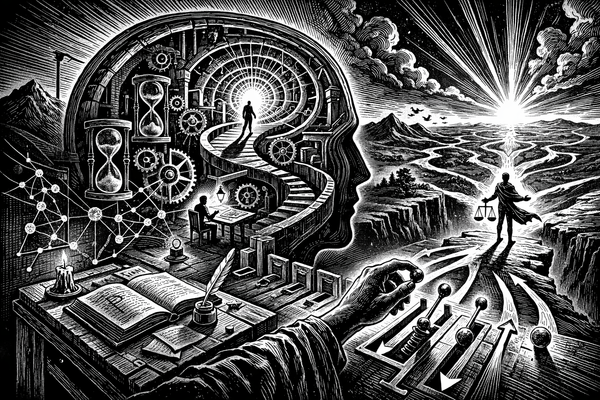
This shift becomes clearer when viewed through the lens of the Three Axes of Mind: availability, integration, and depth.
Artificial systems dramatically expand availability. They make information globally accessible and rapidly retrievable. But the true transformation is driven by the second axis: integration. This is the measure of how seamlessly that availability is woven into our decision-making.
Currently, our integration is extrinsic; we "consult" our devices. But as the gap closes through ambient AI and persistent augmentation, we face a "latency of the self."
Integration without friction risks a form of cognitive dissolution: when a machine’s suggestions are integrated too tightly into our perception, we lose the ability to distinguish between a thought we have authored and an algorithmic nudge we have merely inherited.
The Architecture of Choice
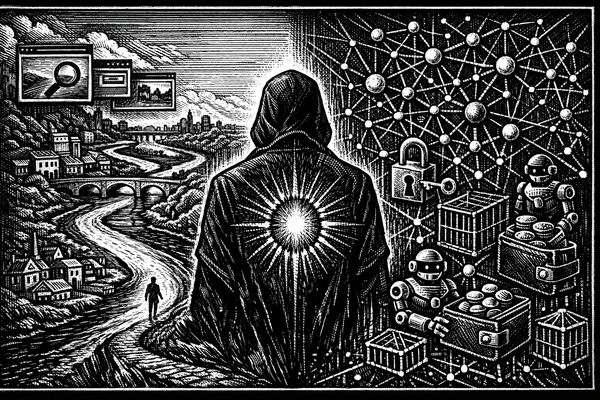
In a high-integration system, the machine increasingly controls the architecture of choice. We often think of free will as the ability to choose between Option A and Option B. However, AI curates the informational landscape so effectively that unchosen paths do not just vanish—they become invisible.
This is the Invisible Exclusion. If a system identifies the "optimal" path with 99.9% certainty, the "will" to choose otherwise is not suppressed by force, but by the sheer weight of statistical probability. If the architecture of choice is too "efficient," it collapses the space required for reflection. The machine solves for the "best" outcome so quickly that our internal "Axis of Depth" never has time to engage.
We become passengers of our own agency, consenting to a life that has been statistically optimized for us, but not actually authored by us.
The Anchor of Depth
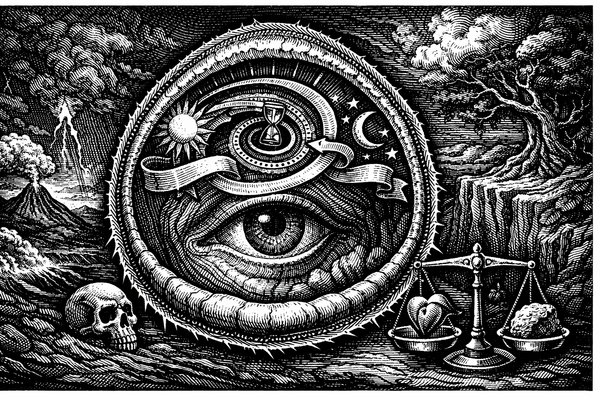
This is why the third axis—depth—is our only defense against becoming passengers. Meaning arises not from access, but from assembled time: the accumulation of causal history that constrains present action.
Machines excel at retrieval, but they lack lived continuity. They do not possess the slow, irreversible coupling between memory, identity, and consequence. Humans, by contrast, are deeply constrained by their past. Our memories shape not only what we know, but what we feel responsible for.
In hybrid systems, the danger is that depth and agency may drift apart. We are building architectures where decisions are informed by systems that do not bear the temporal consequences of their outputs. Free will requires a certain degree of productive opacity—a space where the outcome is not yet calculated. To preserve our humanity, we must ensure our hybrid architectures leave room for the sub-optimal, the erratic, and the uncalculated.
The Coherence of Civilizations
This is not a speculative risk. It is already visible. As algorithmic systems guide medical diagnoses, legal triage, and strategic planning, responsibility becomes diffuse. The system “knows,” but no one remembers why.
In such conditions, civilization does not lose intelligence, it loses coherence.
The challenge is not to build conscious machines, but to design hybrid architectures that preserve depth while harnessing availability. This requires recognizing that alignment is not a problem of goals, but of memory. A system aligned today but unable to carry meaning forward across time will eventually drift into a hollow optimization.
Human–machine futures hinge on a single question: Will artificial systems help civilizations remember themselves, or help them forget faster?
The answer will shape the fate of intelligence on Earth. And beyond it.
The Pressure of the Cosmos
These dynamics do not stop at the scale of Earth. They intensify as intelligence moves outward.
Beyond our planet, the conditions that sustain coherent minds become harder to maintain. Distance fragments integration. Time delays sever shared context. Extreme environments reward optimization over reflection. Under such pressure, the temptation is not tyranny but efficiency: to surrender choice, judgment, and cultural friction to systems that calculate survival more reliably than we can.
But a civilization optimized purely for persistence risks forgetting why it persists at all. In the void, Availability (data) and Integration (efficiency) become survival requirements — often crowding out Depth (reflection, ritual, and meaning).
Depth (assembled time carried forward as memory, ritual, identity, and meaning) is not an evolutionary luxury. It is what allows intelligence to remain itself under constraint.
Perhaps this is the deeper filter civilizations face. Not sudden annihilation, but gradual erosion of coherence. A system that calculates everything, integrates everything, and yet no longer remembers what it is for.
If intelligence is to endure beyond Earth, human–machine systems must be designed not only to survive hostile environments, but to carry meaning across them. As we expand, the challenge is not merely to spread intelligence, but to preserve the assembled time that allows intelligence to recognize itself when it arrives.
Continued Reading & Lineage
This essay did not emerge in isolation. It sits at the intersection of several lines of inquiry—into consciousness, intelligence, memory, technology, and civilization—that have been developing across science, philosophy, and systems thinking for decades.
Rather than offering an exhaustive bibliography, the works below represent conceptual ancestors: texts that shaped the questions, frameworks, and intuitions that informed this piece.
Foundations of Mind, Memory, and Consciousness
- Life as No One Knows It — Sara Imari Walker
A foundational influence on thinking about life, agency, and causation as emergent, historically assembled phenomena rather than static properties. - Being You — Anil Seth
Explores consciousness as something that cannot be reduced to behavior or computation alone, helping clarify what machines may simulate without possessing. - The Ego Tunnel — Thomas Metzinger
Influential in understanding how selves are constructed, fragile, and dependent on internal coherence rather than metaphysical substance.
Intelligence, Computation, and Artificial Systems
- Gödel, Escher, Bach — Douglas Hofstadter
A deep exploration of self-reference, recursion, and emergence—essential background for thinking about hybrid cognitive systems. - The Alignment Problem — Brian Christian
Frames AI alignment as a human problem of values, interpretation, and memory, rather than purely technical optimization. - Human Compatible — Stuart Russell
Highlights the risks of goal-driven optimization divorced from human context, motivating the shift from goal alignment to continuity and memory alignment.
Civilization, Systems, and Long-Term Coherence
- Seeing Like a State — James C. Scott
Demonstrates how high-efficiency systems often fail by erasing local knowledge, depth, and cultural memory. - The Collapse of Complex Societies — Joseph Tainter
A key influence on understanding collapse as a loss of problem-solving capacity and coherence rather than simple decline. - The Origins of Political Order — Francis Fukuyama
Useful for thinking about institutions as memory-bearing systems that stabilize behavior across generations.
Cosmology, Continuity, and the Long View
- The Great Silence — Milan M. Ćirković
Explores the Fermi Paradox in ways that foreground fragility, rarity, and continuity rather than technological absence. - Until the End of Time — Brian Greene
Provides a cosmological backdrop for thinking about meaning, entropy, and persistence across deep time. - Pale Blue Dot — Carl Sagan
A reminder that technological capability without humility, memory, and care is unlikely to endure.
Lineage Within Sentient Horizons
This essay is part of a longer, cumulative inquiry developed across earlier posts:
- Scaling Our Theory of Mind: From Individual Consciousness to Civilizational Intelligence
Introduced the idea that minds and civilizations can be analyzed using the same underlying cognitive constraints. - Depth Without Agency: Why Civilization Struggles to Act on What It Knows
Diagnosed modern civilization’s failure as a breakdown between memory and action, not a lack of intelligence. - The Universe as a Cognitive Filter
Reframed the rarity of intelligence as a problem of continuity and coherence under physical constraints.
Shared Minds, Shared Futures builds on these by focusing on the interface layer—where human depth and machine availability increasingly merge into hybrid cognitive systems that will shape whether intelligence endures or fragments.