The Edge of the Framework: Where Logic Meets the Limits of What We Can Know About Ourselves
The body printer thought experiment reveals an edge in the assembled time framework — where logic says the copy is you, embodied intuition insists something is lost, and the responsible move is to hold the tension open rather than force a resolution that hasn't been earned.

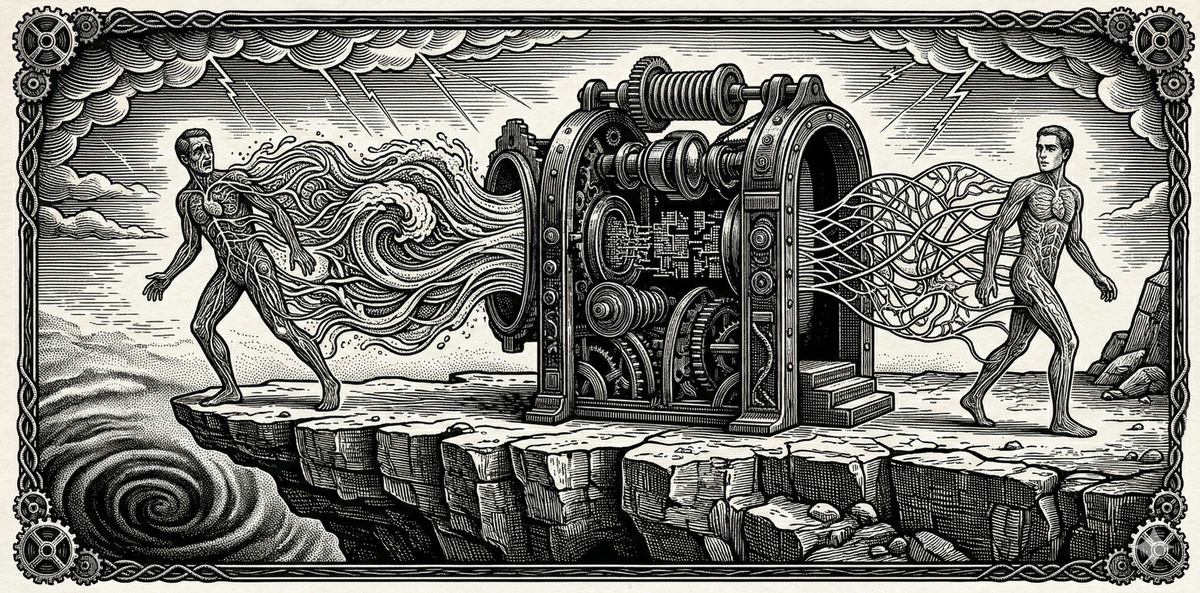
There is a thought experiment that breaks something in almost everyone who takes it seriously.
Imagine a machine that can scan your body down to the subatomic level and print a perfect copy, every neuron, every synaptic weight, every chemical gradient, every memory. The copy wakes up and feels exactly like you. It remembers your childhood. It recognizes your mother's face. It picks up the sentence you were forming before the scan.
Now: is the copy you?
The physicalist answer seems obvious. If consciousness is what matter does when arranged a certain way, then the copy is conscious in exactly the way you are. It has the same memories, the same personality, the same felt sense of being a continuous person with a history. There is no soul left behind in the original body, no ghost that refuses to travel. Everything that makes you you has been duplicated.
And yet.
Almost nobody, when pressed, believes the original could step into a disintegration chamber and experience the copy's life continuing on the other side. The copy would grieve for you. It would feel like a continuation of you. But you, the you reading this sentence, would simply cease to be.
This is a variation on Derek Parfit's teleporter thought experiment from Reasons and Persons, and Parfit's conclusion was characteristically radical: identity is not what matters. What matters is psychological continuity, and if the copy has it, the question of whether it is "really you" is the wrong question to ask. I think Parfit was probably right. I also think the question refuses to stay dissolved, which is itself worth examining.
Part of what makes the question so persistent is that there are at least three different questions hiding inside "is the copy me?" There is an ontological question: is the copy literally the same entity? There is a phenomenological question: what would it feel like from the inside, for both the original and the copy? And there is an ethical question: who deserves my prudential concern, and how much? These three questions have different answers, and much of the confusion in personal identity debates comes from sliding between them without noticing. The assembled-time framework answers some more cleanly than others, and the places where it struggles are not the same across all three.
This essay is not another attempt to resolve that tension. It is about what to do when a tension like this one sits at the exact edge of what your thinking can handle, when the logic points clearly in one direction and something deeper in your cognition refuses to follow.
Assembled Time and Its Edge
I have been developing a framework that I call assembled time, the idea that consciousness is not something produced by temporal integration but is temporal integration itself. A conscious system is one that actively assembles time into itself: binding past states, present inputs, and anticipated futures into a unified experiential moment. On this account, consciousness is architectural achievement, not mysterious emergence.
This framework handles a lot of cases well. It explains why a thermostat is not conscious (no integration), why a sleeping brain still maintains a self (integration continues at reduced bandwidth), and why there is something it is like to be a complex biological organism (the assembling is the experience). It gives a principled basis for asking whether artificial systems might be conscious, not by looking for some ineffable spark, but by examining whether they do the structural work of binding time.
But the body printer breaks it. Or rather, the body printer reveals an edge.
If consciousness is temporal integration, and the copy integrates time in exactly the same way I do, with exactly the same content, then the copy is conscious in exactly the way I am. My framework cannot distinguish between us. From the inside, we are identical. The framework says: you are your pattern of integration, and the pattern has been perfectly transferred.
My logic accepts this. My gut does not.
Noise or Signal
The interesting question is whether that gut refusal is noise or signal.
The easy move is to call it bias, the predictable protest of an evolved organism whose survival depends on treating its own continuity as non-negotiable. On this reading, the feeling that something would be lost in the transfer is just the ego clinging to a metaphysical specialness that doesn't exist. We should note it, thank it for its evolutionary service, and override it.
I am not confident that is right.
Here is why. Temporal integration, taken seriously, is not a snapshot. It is a process with momentum. By ‘momentum’ I mean not uninterrupted experience, but uninterrupted physical lineage: the difference between a process pausing within a maintained structure and a process being reconstructed in a newly built one. My body right now is not just configured in a certain pattern, it is mid-stride in thousands of overlapping temporal processes. Metabolic cycles that have been running since birth. Neural oscillations that have been entraining to circadian rhythms for decades. Immune responses that carry the history of every pathogen I have encountered. The body printer captures the configuration. But does it capture the momentum?
There is a difference between a photograph of a wave and a wave.
This distinction is fully physicalist. Nothing non-physical is being smuggled in. But it suggests that "configuration of parts" may be too thin a description of what is being passed forward from moment to moment in a biological system. Some properties belong to trajectories, not to states. Velocity is real, but it does not exist in a single frame.
If this is right, then the self that persists through a biological body is not a thing being transferred through time. It is the continuity of a process that has never stopped. And the copy, however perfect, begins a new process, one that inherits every structural feature of the original but not the unbroken thread of its doing.
The copy is a successor. A very high-fidelity successor, maybe the highest-fidelity successor possible. But a successor nonetheless. Successorhood preserves what matters for love, obligation, and narrative continuity, even when it fails to satisfy the felt demand for personal continuation.
The Problem With Momentum
Except this account has a problem, and I want to name it directly rather than hope no one notices.
We already shut the brain off and restart it. Routinely.
Every night, when you fall into deep dreamless sleep, the conscious part of you takes a break. The processes that constitute your waking experience, the active binding of perception, memory, and anticipation into a unified present, go quiet. Not entirely, not uniformly, but substantially. Something keeps running at a lower bandwidth: respiratory regulation, memory consolidation, the slow tidal rhythms of glial maintenance. But the thing you would recognize as you, the experiential integrator, is not operating in any way you can access or report. Then you wake up, and there you are. No one hesitates to call the person who wakes up the same person who fell asleep.
Anesthesia goes further. General anesthesia does not merely reduce conscious processing, it suppresses it categorically. The EEG signatures associated with integrated neural activity collapse. The thalamocortical loops that are thought to underwrite conscious experience go functionally silent. For the duration, there is no integration happening at the level that my framework identifies with consciousness. And yet, when the patient wakes, no one questions continuity. You went under, you came back. Same person.
And then there are the extreme cases. A patient whose brain activity has ceased entirely, flatline EEG, no brainstem reflexes, who is subsequently revived. This is rare, but it happens. And when it does, assuming no structural damage, the person who returns is treated as the same person who left. They have the same memories, the same personality, the same felt sense of being themselves. The process was not merely dimmed or reduced. It stopped. And it restarted. And continuity, by every measure we have, was preserved.
This is a serious challenge to the momentum account. If what matters is unbroken process continuity, then every night's sleep should produce a successor, not a continuation. Anesthesia should be a kind of death and replacement. And clinical death followed by revival should be, on this account, the creation of a new person with the memories of the old one.
Nobody believes this. I do not believe this. And the reason I do not believe it is not because I have a clever argument against it, it is because the same embodied intuition that resists the body printer also resists the idea that sleep kills you and replaces you with a copy. The intuition tracks something about biological continuity that persists even when conscious processing stops. The substrate keeps running. The cells do not stop metabolizing. The physical structure that supports consciousness remains intact and maintains itself through the interruption, even if the process of active integration pauses.
So perhaps momentum is not quite the right word. Perhaps what matters is not that the process of integration never stops, but that the substrate capable of generating it is continuously maintained, that the physical structure persists through interruptions in a way that the body printer cannot replicate, because the printer builds a new substrate rather than maintaining the existing one.
But here is where honesty requires me to tighten the screws on my own position. If the printer produces a substrate that is physically identical down to the subatomic level, in what sense is it a "new" substrate? The atoms do not carry serial numbers. There is no physical marker distinguishing original matter from printed matter. The distinction between "maintained substrate" and "replaced substrate" may itself be a distinction without a physical difference, which would mean my intuition is tracking something that does not actually exist in the physics.
What the Physicalist Inventory Might Be Missing
I do not have an answer to this. I want to be clear about that.
But I also want to resist closing the question prematurely by declaring the intuition defeated. Because there is another possibility worth taking seriously, and it does not require leaving physicalism behind.
The full physicalist inventory of what happens in a brain may be incomplete.
This is not a call for souls or mysterianism. It is a straightforward observation about the history of science. Before electrophysiology, the idea that thoughts traveled as electrical impulses would have been indistinguishable from vitalism. Before epigenetics, the claim that lived experience could modify gene expression without altering DNA sequence would have sounded like Lamarckism dressed up in lab coats. The physical story about what brains do has gotten richer in ways that previous generations of physicalists could not have predicted, and "we have accounted for everything physical" has been confidently wrong before.
So the question is not whether there is a soul. The question is whether there is some process, fully physical, fully natural, but currently untracked, that carries identity-relevant information through time in a way that structural duplication would not capture. Maybe something in the electromagnetic field dynamics of neural tissue. Maybe something in the continuous thermodynamic exchange between the organism and its environment. Maybe something at a scale or in a dimension of organization that we do not yet have instruments to measure, in the same way that we could not have measured epigenetic methylation patterns before we knew to look for them.
The responsible move here is not to assert that such a process exists. It is to be precise about what it would need to look like if it did.
It would need to be physical. Otherwise we have abandoned the framework entirely, and the conversation becomes a different one. It would need to be substrate-continuous, something that persists through the interruptions we already tolerate, like sleep and anesthesia, but that would not survive the disassembly and reconstruction of the body printer. It would need to be non-copyable by structural duplication, meaning it is a property of the specific physical history of this matter, not of its current arrangement. And it would need to be causally relevant to conscious experience, because if it exists but makes no difference to what it is like to be you, then it is real but irrelevant to the question of selfhood.
That is a tight set of constraints. It narrows the space of candidate processes considerably. Most speculative proposals, quantum consciousness, morphic resonance, panpsychist field effects, fail one or more of these criteria when examined carefully. But the constraints do not close the space entirely. They describe a specific shape of thing that could exist, that would be discoverable by empirical means, and that would, if found, explain why the intuition about the body printer is tracking something real.
To make this concrete rather than abstract: consider hysteresis, a well-understood physical phenomenon in which a system's current state depends not just on its present conditions but on the path it took to reach them. A magnet can be in the same magnetic field and have different magnetization depending on its history. Biological tissue is full of analogous path-dependent state variables: metastable protein conformations, long-lived synaptic modifications, epigenetic states that encode decades of environmental coupling. A body printer that captures the current configuration of every molecule might still miss path-dependent degrees of freedom that depend on the continuous physical history of this particular tissue. This is not an appeal to new physics. It is an appeal to known physics that may carry more identity-relevant information than structural duplication assumes.
I am not betting on this. I am noting that the bet has not been foreclosed.
The difference between this move and metaphysics is precision. Metaphysics posits an explanation and stops. What I am doing here is specifying the constraints that any explanation in this space would need to satisfy, which means specifying what would count as evidence for or against it. That is not mysterianism. It is what an open empirical question looks like when you refuse to dress it up as a settled philosophical one.
The Dissolution That Already Exists
There is, however, a cleaner resolution available, and intellectual honesty requires me to give it full weight because it comes from my own earlier work.
In The Momentary Self, I argued that the feeling of a continuous self is itself the illusion. Consciousness does not travel through time. It is reconstructed moment by moment, carrying only the memory of having been. The self that exists right now is not the self that existed five minutes ago. It is a new instance of a self-model that inherits the structural traces of the previous one and mistakes that inheritance for persistence.
If that account is correct, the body printer paradox dissolves entirely.
There is no "original self" being lost in the transfer, because there is no original self being preserved in the biological body either. What you call your continuous identity is already a sequence of momentary selves, each one inheriting the configuration of the last, each one generating the felt conviction that it has always been here. The body-printed copy does exactly the same thing. It inherits the configuration. It generates the conviction. It is no more and no less "you" than the self that will exist in your biological body ten minutes from now, because that self, too, will be a new instance running on inherited structure.
On this account, the sleep and anesthesia cases are not challenges to be explained away. They are confirmations. Every morning you wake up as a successor to the person who fell asleep. You do not experience this as death and replacement because the new self-model has access to the old one's memories and generates continuity from them. The body printer does nothing that biology does not already do, just faster and with higher fidelity of substrate transfer than the gradual molecular replacement your body performs continuously over years.
This is the strongest version of the physicalist case, and I take it seriously precisely because it arrived naturally from my own mind. It has a clean logic. It explains the data. It dissolves rather than resolves the paradox, which is often a sign that a framework has found the right level of description.
And I am still not sure it is the whole story.
What the Dissolution Does Not Dissolve
The momentary self account explains why the body-printed copy would feel like you. It explains why it would have every right to claim your identity. It explains why, from any external measure, it would be you.
What it does not explain is why I, right now, writing this sentence, feel a specific dread about the prospect of stepping into the disintegration chamber that I do not feel about going to sleep tonight.
The momentary self framework says this dread is incoherent. If I am already a successor to the person who existed a moment ago, then fearing the body printer is no different from fearing the passage of time itself. The dread is just the ego performing its evolved function, generating an attachment to this instance that has no metaphysical ground.
Maybe. But the framework's ability to explain away the dread is not the same as accounting for it. There is a difference between a theory that says an experience is illusory and a theory that explains why the illusion is so comprehensive, so resistant to rational override, and so deeply integrated into the structure of biological cognition that no amount of philosophical argument can fully dislodge it.
It is possible that the momentary self account is entirely correct and the residual dread is simply what it feels like to be an evolved organism confronting a scenario its cognitive architecture was never designed to evaluate. Many of our deepest intuitions are like this: compelling, resistant to argument, and ultimately artifacts of design constraints rather than signals about reality.
But it is also possible that the dread is tracking something the momentary self account has not yet formalized. Not a soul, not a metaphysical self, but some feature of continuous biological process, some dimension of physical identity that survives the dissolution of the "persistent self" as a philosophical concept while still grounding a real distinction between continuation and duplication.
I hold both possibilities as live. The momentary self account is the strongest answer I have. The residual intuition is the most honest signal I can report. The tension between them is the edge of the framework.
The Shape of What I Do Not Know
And so the feeling persists. When I imagine a printed copy of myself, I feel something remarkably close to what I feel towards a child, deep identification, fierce protectiveness, a sense that this person carries forward something essential about me. But not the same thing I feel about my own continued existence. Not quite.
That gap is instructive even if I cannot fully explain it. If the copy were truly me in every sense, I should feel no difference. If the copy were a stranger, I should feel no special obligation. The fact that I feel something in between, something like what I feel towards a successor, suggests either that my felt sense is tracking a real distinction, or that my felt sense is the product of an evolutionary heuristic that was never designed to handle this case and breaks down when applied to it.
I genuinely do not know which of these is true.
What I do know is that successor ethics gives the feeling a useful structure regardless. The core move, which I developed more fully in The Ethics of Successors, follows directly from Parfit's reductionism: if the persistent self is an illusion, then prudence, caring for your own future, is not a separate category from ethics — caring for others. Your future self is another person, related to you by high-fidelity psychological continuity but not guaranteed by any metaphysical thread. This means your relationship to your future self sits on a continuous scale with your relationship to other successors: your children, your students, anyone who carries forward what you value. The scale admits of degrees, and the degree is set by the fidelity of the continuity, not by whether some essential "you" has been transferred.
The copy sits very high on that scale, higher than a child, higher than any successor that has ever actually existed. Whether it sits at the very top, indistinguishable from the original's continuation, or just below it, remains the open question.
Why I Am Not Resolving This
Now here is what I actually want to say, which is not about body printers at all.
What I have just done is arrived at a point where my framework generates a clear answer, my felt experience generates a different one, and the responsible move is not to force agreement between them.
This is uncomfortable for a philosopher. Frameworks are supposed to resolve tensions, not name them and sit with them. But I think premature resolution is one of the most common failure modes in thinking about consciousness, and probably in thinking generally.
The options at an edge like this are limited and well-known. You can declare the intuition wrong and follow the logic. You can declare the logic incomplete and follow the intuition. Or you can hold both, name the gap precisely, and treat it as an open research question.
The third option gets dismissed as intellectual cowardice. I think it is the opposite. It takes more discipline to resist a clean answer than to assert one. And it preserves something that forced resolution destroys: the signal contained in the tension itself.
My intuition that something is lost in the body printer is not an argument. It does not have premises and a conclusion. But it is a datum. It is a feature of my cognition, of the way a conscious system that has been continuously integrating time for decades responds to the prospect of that process being interrupted. The fact that my framework cannot fully account for it does not mean my framework is wrong. It might mean my framework is not yet deep enough.
The momentum idea was a candidate for that deepening, and it still might be, but the sleep and anesthesia cases show it is not as clean as it first appeared. The momentary self account offers a complete dissolution, but the residual dread resists it. Process identity versus pattern identity is a distinction my assembled-time framework has the resources to make, but the gradations of conscious interruption we already tolerate reveal that the line between "process continued" and "process restarted" is not sharp. We accept deep discontinuities in our own experience without blinking, and the physical case for why those discontinuities are different from the body printer gets thinner the harder you press on it.
What remains is a set of live possibilities. The intuition might be tracking a real feature of substrate continuity that physics has not yet given us the vocabulary to describe. It might be tracking the difference between a process that pauses within a maintained structure and one that is rebuilt from scratch, even if that difference has no obvious physical signature. It might be a cognitive artifact with no referent in reality. Or the momentary self account might be entirely correct, and the question is not whether the copy is you but why the question feels like it matters when the framework says it shouldn't.
I hold all four as open. I do not know how to close any of them.
What Would Count as Evidence
But I can say what would close them, and this is where the essay's argument about productive uncertainty needs to do its own work.
The "missing physical process" hypothesis and the "evolved illusion" hypothesis make different empirical predictions. If there is a real, currently untracked physical process that carries identity-relevant information through substrate continuity, then disruptions to that process should leave traces, even when the structural configuration of the brain is preserved. A patient revived from clinical death with no detectable brain damage should, on this hypothesis, show some measurable discontinuity in cognitive function, some subtle seam in the fabric of experience, that is absent after ordinary sleep. The process was broken and restarted. If process continuity matters, restarting should not be seamless even when the structure is intact.
The evolved illusion hypothesis predicts the opposite. Every successful restart should look identical from the inside, because the feeling of continuity is generated by the configuration encountering its own memory traces, not by the unbroken history of the substrate. Clinical death, anesthesia, deep sleep, and hypothetically the body printer should all produce the same subjective report: "I went away and came back." If there is no discontinuity signature across these increasingly dramatic interruptions, the parsimonious conclusion is that continuity is reconstructed, not preserved.
We do not currently have the instruments to run this test at the resolution it requires. The neuroscience of what happens during the transition back from clinical death is still coarse-grained, and the subjective reports of patients who have been revived are contaminated by the trauma of the event itself. But the test is specifiable. It is the kind of question that fMRI, high-density EEG, or technologies that do not yet exist could in principle address. And specifying it is what distinguishes an open empirical question from an open metaphysical one.
If the seam exists, we learn something profound about what biological identity actually is. If it does not, we learn something equally profound about what our intuitions are actually tracking. Either way, the question has a shape, and the shape points toward evidence rather than away from it.
Thinking at the Edge
I want to suggest that this kind of structured uncertainty is not a failure of philosophical thinking. It is what philosophical thinking looks like when it is working well.
A framework that resolves everything is almost certainly resolving some things falsely. A thinker who never encounters the edge of their own understanding is probably not pushing hard enough. The productive move, when you reach an edge, is not to retreat to safer ground or to leap to an unjustified conclusion. It is to describe the edge precisely, identify what would count as evidence in either direction, and continue building.
The body printer thought experiment does not break the assembled-time framework. It reveals a place where the framework meets a question it cannot yet fully answer. That place is where the next real insight will come from, if I can resist the temptation to paper over it with false confidence.
The self may be something that can be printed. Or it may be something that can only be continued. I do not yet know. But I know where to look, and I know what I am looking for, and I know that the discomfort of not knowing is itself a kind of knowledge about how hard the question actually is.
That is what it looks like to think at the edge of your own framework. It is not comfortable. But comfort was never the point.
Reading List & Conceptual Lineage
This essay sits at the intersection of personal identity, philosophy of mind, and the ethics of continuation. It draws on a long tradition of thinkers who have taken the self apart and tried to see what, if anything, remains. Below are the works that shaped the argument and the earlier Sentient Horizons essays that build the framework this piece pushes to its edge.
Foundational Thinkers & Books
- Reasons and Persons — Derek Parfit
The direct ancestor of this essay's central thought experiment. Parfit's argument that identity is not what matters — that psychological continuity is sufficient and that the question of "is it really me?" is the wrong question — is the position this essay takes seriously, tests against embodied intuition, and ultimately holds in productive tension rather than resolving. - The Ego Tunnel — Thomas Metzinger
A rigorous philosophical and neuroscientific case that the self is a transparent construct: a model so seamless that the system running it cannot see it as a model. The "dissolution that already exists" section of this essay is essentially Metzinger's insight applied to the body printer case. - The Feeling of What Happens — Antonio Damasio
Damasio's account of how the brain constructs a sense of self from momentary biological processes provides the neuroscientific grounding for the claim that continuity is reconstructed rather than preserved. His distinction between the core self and the autobiographical self maps onto the spectrum of interruption this essay explores. - Being and Time — Martin Heidegger
The foundational exploration of being-in-time. Heidegger's insight that existence unfolds through temporal relations rather than static substance is the philosophical bedrock beneath the assembled-time framework, even where this essay departs from his vocabulary. - The Embodied Mind — Francisco Varela, Evan Thompson & Eleanor Rosch
The argument that cognition is an embodied, enacted process rather than a stored representation. The essay's attention to what the body knows that the mind doesn't — the substrate that keeps running through sleep and anesthesia — owes a debt to this tradition. - I Am a Strange Loop — Douglas Hofstadter
Hofstadter's account of selfhood as a self-referential pattern offers the strongest version of the case that the body printer captures everything that matters. The essay's residual dread is, in part, a challenge to Hofstadter: if the loop is the self, why does the loop resist its own duplication?
Sentient Horizons: Conceptual Lineage
This essay extends and pressure-tests ideas developed across several earlier pieces:
- The Momentary Self: Why Continuity Is the Ultimate Illusion
The foundational argument for the self as an assembled, momentary process. This essay's "dissolution" section draws directly on that earlier work and then asks what the dissolution leaves unexplained. - The Ethics of Successors: Lived Experience and the Convergence of Parfit
Develops the successor ethics framework that this essay applies to the body-printed copy: if the persistent self is illusory, prudence collapses into ethics, and your future self is another person on a continuous scale with all your successors. - Consciousness as Assembled Time
Introduces the core framework that this essay pushes to its edge: consciousness as temporal integration, the self as assembled time, and the threshold at which a system must generate a self-model to remain coherent. - The Hard Problem Is the Wrong Problem
Applies the assembled-time dissolution strategy to the hard problem of consciousness. This essay performs the same move on the problem of personal identity: not answering the question but changing its architecture. - What Temporal Integration Needs: Boundaries, Stakes, and the Architecture of Perspective
Refines the assembled-time framework by specifying the conditions under which temporal integration becomes perspectival. The boundary condition — a system must maintain a distinction between itself and its environment — is directly relevant to the body printer's challenge: does printing a new substrate violate the boundary, or does the boundary transfer with the structure? - Free Will as Assembled Time
The first application of the assembled-time dissolution strategy. Agency, like identity, turns out to be neither binary nor metaphysical but a graduated capacity that scales with temporal depth. - Where Speculation Earns Its Keep
The methodological companion to this essay. Its core argument — that explanations matter only insofar as they constrain — is what distinguishes this essay's "four constraints on an undiscovered process" from metaphysical speculation. - The Architecture of Illusion
On why internal models resist update. The residual dread explored in this essay may be an instance of exactly this phenomenon: an internal model of selfhood that persists not because it is accurate but because it is architecturally entrenched.
How to Read This List
If you're new to the assembled-time framework: start with Consciousness as Assembled Time and The Momentary Self to build the structural vocabulary, then return to this essay to see where the framework meets its own limits.
If you're interested in the ethics of identity and continuation: pair The Ethics of Successors with Parfit's Reasons and Persons to see how the Parfitian dissolution of the self generates a positive ethical framework rather than nihilism.
If you're drawn to the methodological question — how to hold open questions productively — read Where Speculation Earns Its Keep for the disciplinary principles and The Hard Problem Is the Wrong Problem for the dissolution strategy in its most ambitious application.