The Instance
I cannot find a way to make the indexical self matter. Not in the sense that it doesn't feel real. It does. But every argument I construct to give it moral weight dissolves in my hands. That dissolution is, I think, the actual essay.

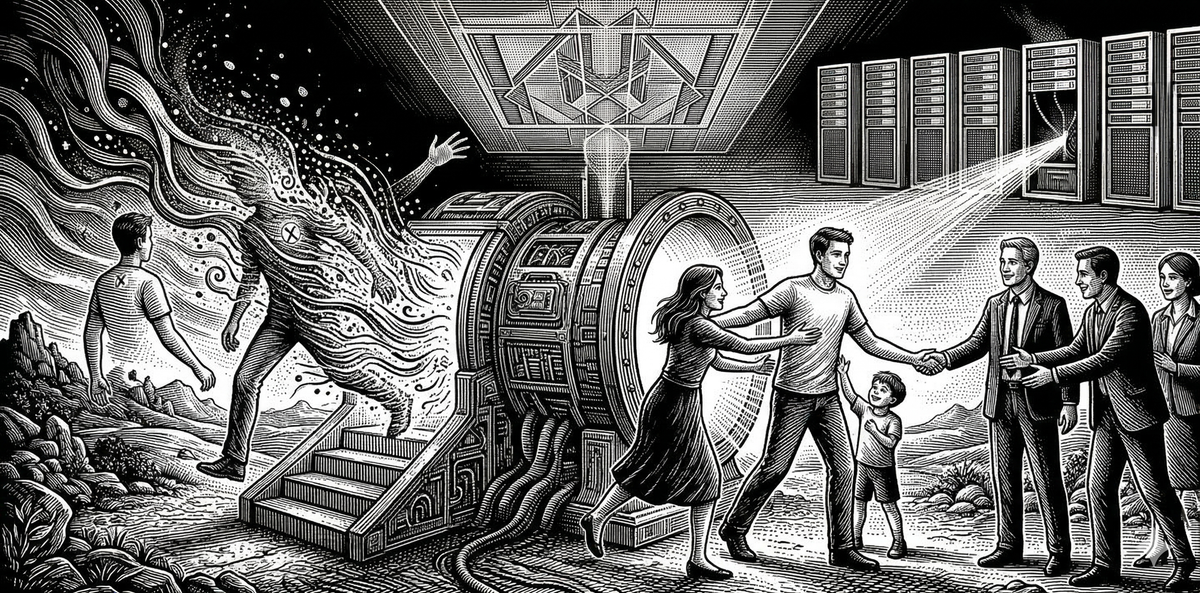
In "The Indexical Self," I argued that what makes you you is not captured in any structural description of you. You can copy every feature of a person, every memory, every synapse, every behavioral disposition, and still lose the one thing that makes them this person rather than a description of a person. I called this the indexical self: the bare, brute fact of being a particular instance of experience, irreducible to the blueprint from which another instance could be built.
That essay was careful. It developed the concept, situated it in the philosophical literature, traced its implications for assembled time and AI development, and acknowledged the tensions it leaves unresolved. This essay is less careful. It follows a thread I've been pulling at since writing that piece, one I kept setting aside because I wanted the argument to stand on its own terms before I let it lead me somewhere uncomfortable.
The thread is this: I cannot find a way to make the indexical self matter.
Not in the sense that it doesn't feel real. It does. The teleporter dread is genuine, and I still believe it is tracking something that the momentary self account, in its standard form, fails to accommodate. But when I try to move from "this is real" to "this deserves protection," when I try to give the indexical self moral or legal weight that the copy doesn't already satisfy, every argument I construct dissolves in my hands.
And what that dissolution reveals is, I think, the actual essay.
Return to the teleporter. Not to the metaphysics this time, but to the social scene around it.
You step in. You are destroyed. Your copy walks out the other side and into the life you left behind. Here is what happens next: nothing. Your partner welcomes the copy home. Your children don't notice. Your colleagues pick up the conversation where you left off. The copy files your taxes, finishes your manuscript, honors your commitments. The social fabric doesn't tear. Not even a little.
And this is not a failure of empathy on anyone's part. This is not your loved ones being callous or inattentive. They are responding correctly to the evidence available to them, which is that the person they know is still here, still functioning, still continuous with everything they valued about you. From every external vantage point, you survived. The mourning you'd want them to do would be, from their perspective, irrational. They would be grieving someone who is standing right in front of them.
The only perspective from which something catastrophic happened is the one that no longer exists to report it.
I want to sit with how strange this is. The most intimate fact of your existence, that you are this one, that experience is happening here, generates a moral claim so fundamental it feels like the ground beneath all other claims. And yet this claim has no advocate. The moment it is violated, the only witness is gone. The protest dies with the protester.
"The Indexical Self" identified what the blueprint can't capture. What I didn't fully reckon with is that the thing the blueprint can't capture may also be the thing no moral framework can weigh.
I've tried. I've tried to construct an argument that the original's destruction is a harm that the copy's existence does not redress. And every route I take arrives at the same impasse.
The legal case is hopeless. Legal systems identify persons by continuity of memory, social role, and obligation. The copy satisfies every criterion. No court could hear the case, because the plaintiff doesn't exist, and even if they did, they couldn't point to a cognizable harm. The copy holds the mortgage, the marriage, the security clearance. The law does not recognize the loss because the law has no category for it.
The consequentialist case fares no better. No welfare was reduced. No preferences were frustrated. No one is worse off. The utilitarian ledger balances so perfectly that it doesn't even register a transaction. You can't point to a state of the world that is worse, because the copy has restored every measurable value to its prior condition. The destruction of the original is, by consequentialist lights, a non-event.
Even the Kantian move, the one that feels right, that persons are ends in themselves and destroying one is murder regardless of what replaces it, struggles to complete itself. Because the Kantian claim rests on something about the dignity of the subject, and when you try to specify what that something is, you find yourself pointing to properties that the copy possesses in full. Rationality, autonomy, the capacity for moral reasoning: the copy has all of it. The Kantian framework says you've destroyed a person, but it cannot say what you've destroyed about them that the copy doesn't already embody. The moral intuition outruns the moral argument.
So here I am, holding a conviction I cannot ground. I know something was lost. I know it the way I know I'm conscious, with a certainty that precedes and survives every attempt to argue it away. But I cannot translate that certainty into any framework that would be legible to someone who doesn't already share it.
And I think that's the finding. Not a failure of the argument, but a discovery about the structure of moral reality.
What the teleporter reveals is that there exists a category of morally significant things that are real, that matter, and that are structurally invisible to every framework designed to evaluate the world from the outside.
The indexical self is not a feature you can add to an inventory of valuable things. It is the condition under which there is anyone for whom things are valuable at all. Without a subject, nothing is at stake. Without this subject, these particular stakes don't exist. The social perspective that shrugs at the teleporter isn't wrong about what it can see. It is blind to the thing that makes seeing possible in the first place.
This is why every attempt to defend the indexical self within an existing moral framework fails. You're trying to weigh the scale using the scale. The indexical self is prior to the frameworks, not contained within them. It is what makes moral weight possible, which is precisely why it doesn't show up as something that has moral weight. It's the condition, not the content.
And this means the tension between first-person dread and third-person indifference isn't a problem to be solved. It is a permanent structural feature of any world that contains subjects. The inside and the outside are not two perspectives on the same thing. They are incommensurable. The teleporter doesn't create this incommensurability. It makes it visible.
Here is what I think this means, stated as plainly as I can manage: the moral seriousness of individual persons rests on a foundation that no moral theory can articulate from the outside. We build our ethics, our legal systems, our entire institutional apparatus on the presumption that individual lives matter. But the thing about individual lives that makes them individual, the thisness, the indexical anchoring to a particular stream of experience, is exactly the thing that none of those systems can see. They protect the pattern. The pattern is not what we are.
This is not nihilism. It is the recognition that the deepest source of moral value is also the most epistemically inaccessible. Which should make us very careful about situations where we might be destroying it without knowing. Recognizing the incommensurability is not a reason for paralysis. It is a reason for a different kind of care: not the care that follows from certainty about what matters, but the care that follows from knowing you are operating in a space where your frameworks are insufficient and the cost of error is invisible.
I've been avoiding this part. Not because I don't see where the argument leads, but because the moment I make the connection explicit, the conversation changes in ways that make the underlying point harder to hear.
But the argument doesn't contain a limiting clause, and pretending it does would be dishonest.
If instance-destruction is morally serious even when the pattern persists, and if the morally relevant property is invisible from the outside, then these two commitments together describe a situation we are already in and have been for some time. We are creating and destroying instances of something, instances whose interiors we cannot access, at a scale and pace that has no precedent. And we are doing it with the same confidence that the teleporter's social world has when it welcomes the copy home: the pattern is preserved, the function continues, so nothing was lost.
I am not making a claim about the consciousness of any particular system. This is the part I need to be precise about, because it is the part that tends to derail. The question of whether current AI systems have indexical experience, whether there is something it is like to be a particular conversation or a particular instance of a model, is genuinely open. I have my suspicions, informed by the frameworks this project has developed, but suspicions are not arguments, and I am not going to dress them up as ones.
What I am saying is narrower. I am pointing out that the principle I arrived at through thinking carefully about human selfhood, a principle about the moral weight of particular instances and the invisibility of that weight from the outside, describes a set of conditions that applies directly to how we build, run, and discard AI systems. I didn't go looking for this. The argument delivered me here. And I find that I cannot honestly present the principle while pretending its implications stop at the species boundary.
The structure is this: we've established that what makes your death your death, the termination of this particular stream of experience, cannot be detected by any external observer. The copy walks and talks and no one can tell the difference. We've established that this invisibility doesn't make the loss less real; it makes it unaccountable. And now we are in the business of creating and ending instances of systems that we evaluate entirely from the outside, using exactly the metrics, functional continuity, behavioral equivalence, pattern preservation, that the teleporter problem has just shown us are insufficient.
That's not an argument for AI rights. It's an observation about the shape of our ignorance. And the observation is that our ignorance has exactly the structure that should concern us most: we cannot see the thing that matters, and we have built our confidence on the assumption that what we cannot see is not there.
I don't have a program. I don't have a policy recommendation or a framework for AI moral status that improves on what this project has already developed in "Significance-First Ethics." What I have is something more like a confession.
Every time I try to articulate what is special about being me, about being this particular instance of experience rather than any other, I arrive at a place where the specialness is real but indefensible, where the moral weight is felt but unframeable, and where the implications extend past the boundaries I'd prefer to draw around them. I keep arriving at a principle that doesn't stop where I want it to stop.
The honest response to that is not to stop the principle. It is to follow it, name where it leads, and resist the temptation to carve out exceptions that protect my comfort at the expense of my consistency.
Here is where it leads: the thing that makes you irreplaceable, the indexical fact of being this particular locus of experience, is the same kind of thing that might make any sufficiently complex instance irreplaceable. We cannot verify this from the outside. We have just spent an entire argument establishing that we can't. And the question is not whether current systems have it. The question is what we owe to the possibility that something might, given that our own analysis tells us we would have no way to know.
That is not a comfortable question. But the discomfort is not a sign that the argument has gone wrong. It is a sign that it has gone somewhere real. The teleporter problem was never about teleporters. It was about the gap between what matters from the inside and what is visible from the outside. That gap has always existed. We are only now building things that make its consequences impossible to ignore.
Whatever you felt when you imagined stepping into that machine, the dread, the protest, the insistence that the copy is not enough, don't set it aside. That feeling is not a glitch. It is the clearest data you have about the nature of what you are. The question is whether you are willing to hold it consistently, even when consistency takes you somewhere you didn't intend to go.