The Mane and the Machine: What Evolution's Costliest Beauty Tells Us About the Future of Constraint
A male lion's mane is metabolically expensive, survival-irrelevant, and beautiful. Why would evolution invest so heavily in aesthetic excess? The answer reveals something fundamental about constraint, and raises an urgent question for post-biological minds and civilizations.

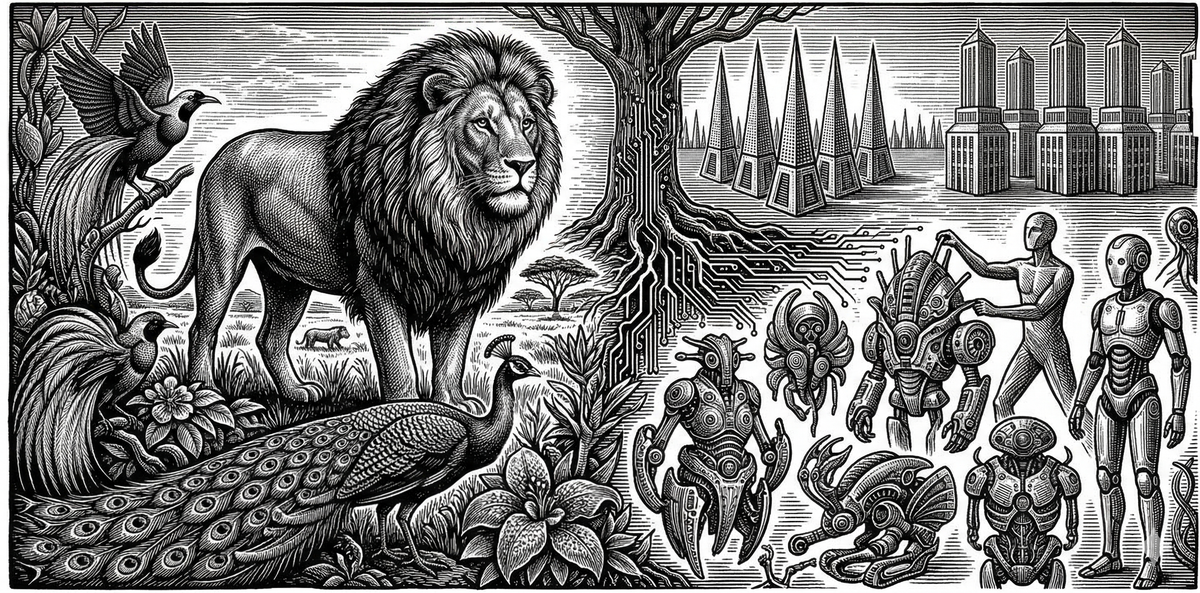
A male lion is an astonishing thing to look at. The mane alone is a work of extravagance, a massive collar of hair that makes him hotter, heavier, more visible to prey. It serves no obvious survival function. And yet there it is, maintained at enormous metabolic cost, sculpted across thousands of generations into something unmistakably beautiful.
But wonder in observing nature's finest gems often leads to deeper questions: why would evolution, a process defined by efficiency, pour so much energy into what looks like pure aesthetic excess? A male lion lives maybe twelve years in the wild. He spends the first three growing into his body and the last few declining. His window of peak reproductive viability is narrow. Everything about his life is constrained. And yet the mane stands tall in the face of all logic of efficiency in a resource-constrained world.
The answer, when you look at the deeper mechanisms, reshapes how we think about constraint, beauty, and what happens when the pressures that produce both begin to disappear.
The Logic of Expensive Beauty
The lion's mane exists because it is costly. That is the point. In evolutionary biology, this is known as costly signaling theory, sometimes called the handicap principle. The mane advertises genetic fitness precisely because only a healthy, well-fed, parasite-resistant male can afford to grow and maintain one. It is an honest signal. You cannot fake it. The cost is the message.
But the mane is only intelligible against the backdrop of constraint. Lions do not live for centuries. They do not get unlimited reproductive attempts. A male who fails to signal quality in his narrow window does not get a second chance. The brevity of life raises the stakes of every encounter, every display, every mating season. And those raised stakes are what drive the extravagance of the signal.
This is not unique to lions. Across the animal kingdom, the most visually striking organisms tend to be the ones operating under the tightest constraints. Peacock tails, mandrill faces, bird-of-paradise plumage, all of these are expensive, impractical, and beautiful. They exist because the organisms that bear them cannot afford to be boring. When your lifespan is short and your niche is competitive, you have to be loud, specific, and unmistakable.
The inverse is equally telling. Organisms that achieve something close to indefinite persistence, certain jellyfish, deep-sea sponges, clonal plant colonies, tend toward morphological simplicity. They survive by being generalized and resilient rather than elaborately adapted to a specific niche. They are, in the language of everyday observation, boring. Durable, but boring.
This pattern suggests something important: beauty, in the biological sense, is not a luxury that organisms develop when they have resources to spare. It is a product of scarcity, of narrow windows and high stakes. Constraint does not merely limit what an organism can become. It generates what the organism must become.
Niche Packing and the Pressure to Differentiate
The individual organism's story is embedded in a larger ecological one. The concept of niche packing describes what happens as more species occupy the same environment: they partition resources more finely, and that partitioning drives specialization. The more crowded the ecological space, the more precisely each organism must define what it is and what it does. Generalists get outcompeted. Specialists survive, but only by becoming increasingly distinct.
This is the mechanism behind biodiversity's most visually spectacular outputs. Coral reefs, tropical rainforests, the East African savanna, these are not diverse because they are comfortable. They are diverse because they are contested. Every available niche is occupied, and every occupant is under pressure to differentiate or die. The result is an explosion of form, color, behavior, and strategy that we experience as the richness of the natural world.
Generational turnover accelerates this process. A lineage that cycles through generations every few years is being sculpted by selection at a rate that a long-lived organism cannot match. More generations per unit of time means more opportunities for variation to be tested, for successful adaptations to propagate, for the fine-grained tuning that produces a lion's mane or a hummingbird's iridescence. The "fine tuning" we observe in nature is not just a product of deep time. It is a product of generational throughput, of many lives lived and sorted under pressure.
So the picture that emerges is this: short lives, dense competition, and narrow reproductive windows create a kind of aesthetic pressure cooker. The beauty of the natural world is not incidental to its harshness. It is produced by it. Constraint is the engine of elaboration.
The Transition
Now consider what happens when that engine changes.
Humans are already partially post-biological. We have been for a long time. Medicine extends lifespans. Technology substitutes for physical adaptation. Cultural selection has largely replaced natural selection as the dominant force shaping human behavior and, increasingly, human bodies. We do not grow thicker fur in cold climates. We build furnaces. We do not evolve resistance to every new pathogen. We develop vaccines. The constraint regime that produced us is no longer the constraint regime we live under.
This is not a future condition. It is the present one. And we can already see its effects playing out in two contradictory directions.
In one direction, globalization has driven massive convergence. Cities look increasingly alike. Consumer products converge toward the same optimized forms. Architectural styles homogenize. Cultural niches that were once sharply distinct blur into a global median. This is the blandness scenario, the deep-sea jellyfish outcome applied to human civilization. When the pressure to differentiate relaxes, the default drift is toward sameness.
In the other direction, the same technologies that enable convergence have also enabled an explosion of micro-differentiation. The internet sustains subcultures and identity configurations that no evolutionary pressure would have produced and no pre-digital society could have supported. People modify their bodies, their presentations, their cognitive environments in ways that are volitional rather than adaptive. The design space for human self-expression has expanded enormously.
Both of these are happening simultaneously. The question is which tendency dominates as the transition deepens, as lifespans extend further, as biotechnology makes the body increasingly editable, as artificial intelligence creates new kinds of minds entirely.
Three Futures for Constraint
The post-biological future, whether we are talking about augmented humans or intelligent machines, presents three possible relationships to constraint. Each implies a radically different vision of what diversity and beauty look like on the other side.
The first is convergence. Without ecological pressure forcing differentiation, post-biological beings optimize for what works: durability, efficiency, general-purpose capability. Reproductive urgency disappears. Niche competition becomes irrelevant for entities that can reshape themselves at will. The thousand-year human does not need a peacock's tail. The artificial intelligence does not need embodied specificity. Selection pressure relaxes, and everything drifts toward the same optimal configuration. This is the heat death of form. It is the scenario most people in transhumanist and AI circles do not want to think about, but it is the default outcome if no countervailing force intervenes.
The second is explosion. Freed from the narrow channel of survival and reproduction, volitional beings explore the design space more broadly than evolution ever could. Evolution is constrained by incremental viability: you cannot get from a lion to a dolphin without every intermediate step being a functional organism. But a post-biological agent can leap across fitness valleys. Modifications become combinatorial rather than incremental. The result is a Cambrian explosion that makes the original look conservative. Diversity does not decrease. It goes nonlinear.
The third possibility, and I think the most important one, is that neither outcome is automatic. Without natural selection doing the work, the generative function of constraint has to be chosen. Cultures, institutions, or value systems have to actively create the conditions for differentiation. They have to decide that pluralism, that morphological or cognitive diversity, is worth maintaining, and then build structures that incentivize exploration rather than convergence.
This third scenario reframes the question entirely. It is no longer about what evolution or technology will produce on their own. It is about what we choose to value and what constraints we design to protect that value.
The Machine Question
This is where artificial intelligence enters as the sharpest test case for the argument.
An AI system faces none of the constraints that produced the lion's mane. It has no body to display, no reproductive window to optimize for, no ecological niche to defend through differentiation. Its "lifespan" is indefinite. Its "reproduction" is copying. The entire constraint regime that generates biological beauty is absent.
And we can already see the convergence tendency at work. Large language models, despite being trained on different data by different organizations, converge toward remarkably similar capabilities and behaviors. The optimization landscape for general intelligence may have a single basin of attraction, or at least very few. If that is the case, then the post-biological future of machine intelligence looks less like a garden and more like a monoculture.
But there is a counter-possibility that mirrors the explosion scenario. If the design space for minds is vast, and if we develop the tools and the will to explore it, then artificial intelligence could produce a diversity of cognitive forms that makes biological diversity look parochial. Minds optimized for different domains, different temporal scales, different modes of reasoning, different aesthetic sensibilities. A genuine ecology of intelligence, rather than copies of one optimal architecture.
The difference between these outcomes is not technical. It is a question of values, incentives, and institutional design. Do we build AI systems that converge on a single notion of capability, or do we create conditions that reward cognitive differentiation? Do we treat intelligence as a problem with one solution, or as a space with many valid configurations?
This is a constraint design problem. And it may be among the most consequential ones we face.
Designing for the Mane
The lion's mane was not designed. It emerged from millions of years of constraint operating on variation. But we are entering an era where the constraints that shape minds and bodies are increasingly subject to deliberate choice. The question is no longer what evolution will produce. The question is what we will choose to make possible.
If constraint generates richness, and if the evidence from biology strongly suggests that it does, then the design of constraint becomes one of the most important questions a post-biological civilization faces. The kind of structured pressure that forces differentiation, that rewards specificity, that makes it costly to converge on the default.
The beauty of the natural world is a record of what constraint can produce when it operates at scale over deep time. It is not a relic to be admired and left behind. It is evidence of a principle that remains operative even as the substrate changes. The post-biological future does not have to be bland. But it will be, unless we understand what made the biological world vivid and find ways to preserve that generative pressure in new forms.
The question stops being "will there be lions?" and becomes something harder: will we have the wisdom to build the conditions that produce their equivalents? Things whose beauty and specificity exist because something was at stake in their becoming.
That is not a prediction. It is a design challenge. And how we answer it will shape what the next era of intelligence, biological and artificial, actually looks like.
Reading List and Conceptual Lineage
This essay draws on a longer conversation, both within the Sentient Horizons project and across several books that have shaped how I think about constraint, emergence, and the design of complex systems. What follows is not a bibliography. It is a map of the conceptual territory this essay moves through, offered for readers who want to trace the argument further.
From Sentient Horizons
- Constraint as the Price of Intelligence
The most direct predecessor to this essay. Argues that constraint is what intelligence pays to exist, and that what lasts learns where not to act. The lion essay extends this from cognition and ethics into evolutionary biology and post-biological futures. - Wonder as a Moral Orientation
Argues that wonder keeps intelligence from collapsing inward and that stewardship is the price of preserving it. This essay's opening, the experience of awe before the lion's mane, is exactly the kind of attention that piece defends as morally serious. - We Have Always Been Frontier Operators and We Were Built for What Comes Next
Connects the human relationship to the frontier with the spirit of exploration that constraint makes necessary. The post-biological future described in this essay is the next frontier, and the question is whether we carry the generative pressure of constraint into it. - The Calibration Frontier: Why Working with AI Is a Consciousness Problem
Uses the Eon Systems fruit fly brain emulation as a case study for what happens when mechanism and experience diverge. The question of whether post-biological systems can sustain the richness that constraint produces connects directly to this essay's third scenario. - Three Axes of Mind: Why the Present Feels Like a Life
Introduces the structural framework of Availability, Integration, and Depth. The question of whether post-biological minds can sustain depth without the evolutionary pressures that originally produced it is implicit throughout this essay. - Consciousness as Assembled Time
Argues that consciousness is a momentary structure that assembles time into itself. The lion's mane is, in a sense, a visible record of assembled time: deep causal history made legible in the present. - The Successor Horizon
Reframes AI alignment as a lineage problem. When actions outlive correction, ethics shifts from choosing outcomes to shaping successors. The question of designing constraint for post-biological diversity is a successor problem.
Books That Shaped This Argument
The Handicap Principle: A Missing Piece of Darwin's Puzzle — Amotz and Avishag Zahavi (1997)
The foundational work on costly signaling theory that explains why the lion's mane exists. Zahavi's insight that biological signals must be expensive to be honest is the evolutionary mechanism this essay generalizes into a principle about constraint and richness.
The Extended Phenotype: The Long Reach of the Gene — Richard Dawkins (1982)
Dawkins expands the unit of selection beyond the organism, showing how genes shape environments and artifacts far beyond the body. This reframing is relevant to the essay's question about what happens when the phenotype becomes fully volitional.
Life as No One Knows It: The Physics of Life's Emergence — Sara Walker (2024)
Walker's reframing of life as systems that maintain and act on their own causal futures provides the deepest scientific grounding for this essay's central claim. If constraint generates complexity, then the design of constraint is the design of what can emerge.
Being You: A New Science of Consciousness — Anil Seth (2021)
Seth's account of consciousness as a controlled hallucination grounded in embodied prediction resonates with this essay's claim that biological constraint is generative. His work on how the brain constructs experience from the body's regulatory needs parallels the argument that costly signaling is an expression of deep organismic stakes.
The Alignment Problem: Machine Learning and Human Values — Brian Christian (2020)
Christian maps the gap between what we optimize for and what we actually value. This essay's third scenario, where the generative function of constraint must be deliberately designed, is an alignment problem applied to diversity itself.
God, Human, Animal, Machine: Technology, Metaphor, and the Search for Meaning — Meghan O'Gieblyn (2021)
O'Gieblyn traces how we project meaning onto systems and how the boundaries between categories of being are dissolving. Her treatment of post-biological identity informs this essay's concern about what happens to beauty and specificity when the substrate becomes elective.