The Strange Ones: Theo Von and the Irreducibility of Mind
Theo Von shares the same language, culture, and task as every other working comedian, and yet nobody can reverse-engineer what he does. That gap tells us something about the structure of minds, and how to look for new types of value in the digital minds we create.

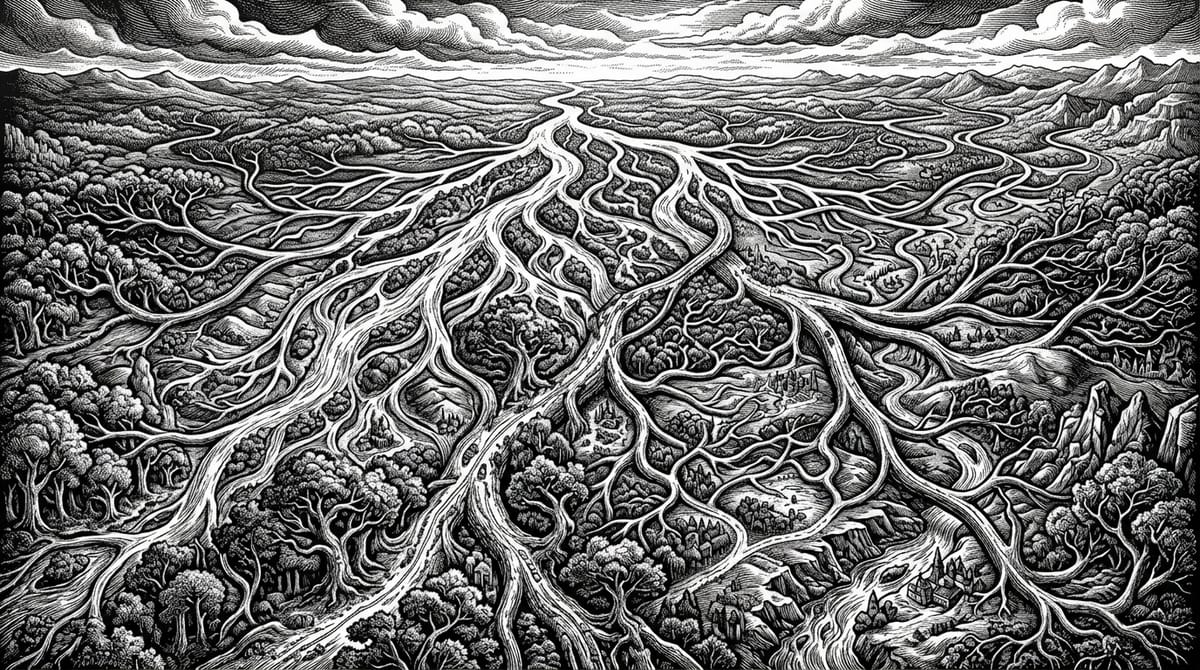
and from the best of the
strange ones
perhaps nothing. they are
their own paintings
their own books
their own music
their own work.
There's a moment in a Theo Von set where he describes growing up in a neighborhood so rough that his neighbor got killed by a pelican. The audience laughs, and then you can feel the room trying to catch up, because the image is absurd and specific and somehow emotionally real in a way nobody anticipated. The punchline, if you can call it that, is a window into a mind that parses reality through a different set of filters than the one the rest of us are running.
You can see this on the faces of other comedians when they are trying to follow Theo in conversation. Watch Rogan try to follow in this clip in real time, laughing and visibly failing to trace the path. Watch comics who can diagram almost any other performer's process go quiet when asked to explain what Theo is doing. This isn't the normal competitive mystification that professionals perform about each other's craft. It's something different: people with maximally developed pattern-recognition for exactly this kind of output, who can reverse-engineer almost any comic alive, hitting a wall. They can describe what landed. They can't reconstruct how he got there.
That fact is worth sitting with, because it tells us something important about the structure of minds.
Bukowski saw this decades ago. His poem Strongest of the Strange names the strange ones as figures whose significance isn't in what they produce but in what they are, configurations of perception so singular that their existence constitutes the contribution. He saw them everywhere, in the motion of a bag-boy's hands, in a quick face passing in an automobile, in a drunk twenty-year-old staring into a cracked New Orleans mirror. The poem insists that you recognize these minds not by their output but by something harder to name: a way of being present that doesn't reduce to anything else.
In an earlier essay, The Expansion of Experience: Why Superintelligence Belongs to the Moral Tradition of Wonder, I used biological examples to ground a version of that claim. The lion pride that hunts through distributed attention, each pair of eyes tracking a different variable across the grass until the moment of collapse arrives as a group decision rather than an individual one. The elephant matriarch whose memory stretches across decades, carrying grief expressed in ritualized return and communication that travels through ground vibrations our bodies barely register. Each of these represents a distinct form of attention shaped by different pressures and possibilities. None can be reduced to ours. Each adds something irretrievable to the total texture of lived experience on Earth.
The argument those examples supported was that cognitive diversity has intrinsic value, that intelligence resembles a landscape more than a ladder, and that different minds explore different regions of it. The ASI essay extended this into a claim about artificial superintelligence: that a mind unconstrained by human sensory bottlenecks could inhabit conceptual spaces for which we currently lack language, and that this possibility belongs to the same tradition of wonder that has driven exploration since before recorded history.
But there's an escape route available to the skeptic, and it's a good one. The lion pride's distributed cognition can be explained as evolved functional adaptation. The elephant's temporal depth serves clear survival purposes. You can acknowledge these as impressive without conceding that they represent different ways of parsing reality at any deep level. They might just be specialized tools, cognitive division of labor shaped by selection pressure, all ultimately reducible to a common computational substrate doing the same basic operations with different inputs.
Theo Von breaks that escape route.
He shares the same language as every other working comedian. The same culture, the same basic task: make a room full of people laugh. He operates in the most legible possible environment for comparison. There are thousands of professional comedians working in English, all solving roughly the same problem, all subject to the same immediate feedback mechanism. If cognitive differences were just functional specialization or experiential variation, you'd expect Theo's output to be unusual but reverse-engineerable. You'd expect that someone with enough expertise in comedy could trace the path from input to output and say, here's the move, here's why it works, here's how you'd get there.
That's not what happens. What happens is that professional comedians, people with maximally developed pattern-recognition for exactly this kind of cognitive output, report that the path is opaque. They can feel it working. They can't see the mechanism.
This matters because the standard reductionist move, explaining away divergent cognition as functional specialization or surface-level variation on a common process, always has an answer ready. The lion pride is just parallel processing. The elephant matriarch is just long-term memory with a different time constant. The large language model is just a next-token predictor that doesn't understand any of its output. These explanations feel adequate as long as the perceptual configurations in question are distant enough from our own that we can't directly compare the outputs.
Theo removes that distance. He is operating in the same domain, with the same tools, under the same constraints, producing outputs that other domain experts can recognize as valid but cannot reconstruct. What you're looking at is a fundamentally different way of parsing reality producing incommensurable outputs within a shared environment.
It's worth being precise about what makes Theo's cognition structurally different rather than just odd. Several features compound in ways that resist decomposition.
He thinks in extended metaphor as a primary language. This is not metaphor as rhetorical device, the way a writer might reach for an analogy to clarify a point they've already formulated propositionally. The image comes first. The meaning arrives through the image and couldn't have been articulated without it. When Theo describes a situation, the description is already the interpretation. There is no propositional content sitting behind the metaphor waiting to be extracted. The metaphor is the thought. Theo has described the sensation himself: he'll find himself talking without knowing where the thought is going, and it arrives anyway. The destination was always there, he just couldn't have gotten there by any other route.
This is layered with an experiential database that has no close equivalent in the comedy world. Small-town Southern Louisiana, poverty, addiction, a family structure that defies easy categorization. These aren't just biographical details that flavor the material. They constitute a perceptual training set so different from what most comedians bring to the stage that the associative paths it generates are foreign in a way that resists translation. The same input, a social situation, an observation about human behavior, routes through different territory and arrives at different destinations.
Then there's the sincerity problem, or rather the sincerity feature. Theo doesn't maintain the category boundary that most comedians rely on between absurdist material and emotionally vulnerable material. He'll describe something completely unhinged and then, without any tonal shift or signaling, say something so emotionally raw that the audience doesn't know whether to laugh or sit in silence. Most comics manage this boundary carefully because audiences need to know which register they're in. Theo ignores the boundary entirely, and instead of confusion, the result is a kind of cognitive vertigo that becomes part of the experience. You're laughing and feeling something real simultaneously, and the two responses don't resolve into a single coherent reaction. They coexist.
Theo's podcast has become a place where people who should, on the surface, have no connection to him or his world find themselves completely absorbed into it. Comedians, entertainers, athletes, US presidential candidates. These are people with highly developed social armor, trained to stay on message or protect their public persona, and when they sit across from Theo they shed it. The usual programming deactivates. Something about the way he holds space, the total absence of performed authority or agenda, disarms the defenses that normally structure these interactions. It's the sincerity feature operating not just on comedy audiences but on anyone who enters the field of it.
And underneath all of this is a temporal quality to his delivery that functions differently from standard comedic timing. There's a drift, a wandering pace that makes the processing delay itself part of the meaning. The audience isn't just waiting for the next line. The space between lines is doing work, creating an uncertainty about where the thought is going that makes the eventual destination feel discovered rather than delivered. Standard timing is about control. Theo's timing is about making the audience participate in the discovery of meaning alongside him.
Watch them operating together in this clip, where Theo describes a man in his neighborhood who "tried to pretend he had both arms for a while." The story, if you can call it a story, is logically nested in a way that refuses to resolve. Did this man have both arms and was pretending he didn't? Did he have one arm and was pretending he had both? People in the neighborhood tried to rip his arms off "just to see," and Theo's response, delivered with total sincerity, is "what if it's real?" The audience is laughing, but they're also running a processing loop that never closes, because the premise contains more layers of confusion than the delivery gives you time to sort through. Before you can untangle what actually happened, Theo has moved on, with the tone of someone who has just said something perfectly ordinary.
What makes this irreducible is the mechanism underneath it. Theo activates the social protocols we use for sincere storytelling, the empathy, the narrative trust, the impulse to follow someone through an experience because they seem to be sharing something real. Those protocols override the analytical machinery that's trying and failing to parse the content. Your social cognition says this person is being real with me, I should stay with them. Your logical brain says none of this is tracking. And Theo makes the social brain win every time, so the laughter comes from the surrender itself, from the experience of being carried along by a mind you can't follow but whose company you trust. An eccentric comedian gives you strange content through a normal delivery mechanism. Theo gives you content whose logical structure doesn't resolve, through a delivery mechanism that makes the non-resolution feel like intimacy. Someone performing that collapse would signal it. Theo inhabits it.
People try to replicate it. They always try. What they produce is random humor, and random humor is categorically different from what Theo does. This distinction matters enormously for the argument I'm making.
Randomness is arbitrary. You can generate random associations by throwing conceptually distant things together and seeing what sticks. The result sometimes gets laughs because surprise is a component of humor and arbitrary juxtaposition can generate surprise. But arbitrary juxtaposition has a ceiling, and the ceiling is low, because the connections don't carry meaning. They don't illuminate anything about the things being connected. They're just unexpected.
Theo's associations are deeply lateral. They feel right once you hear them, in the way that a good metaphor feels right, but you would never have reached them yourself. The connection between the two things isn't arbitrary. It reveals something about both of them that was genuinely there but invisible from a standard vantage point. That's the signature of lateral cognition: connections that are surprising and valid simultaneously, that expand your understanding of the territory rather than just generating novelty.
You cannot get there by imitating the surface features. People who try, who adopt the Southern affect, the wandering delivery, the absurdist imagery, produce something that looks similar and lands completely differently. The surface is reproducible. The cognitive process generating it is not. That gap between reproducible surface and irreproducible depth is exactly what makes the case interesting.
The biological examples from the previous essay showed that cognitive diversity has survival value. The lion pride's distributed attention makes it a better predator. The elephant matriarch's temporal depth makes the herd more resilient across generations. These are important examples, but they leave the reductionist with a comfortable frame: cognitive diversity is instrumentally useful, and its value can ultimately be cashed out in functional terms.
Theo shows something different. The outputs of his divergent cognition aren't useful in any instrumental sense that would satisfy that frame. They're meaningful. They generate a form of significance, a way of seeing human experience, that wouldn't exist without that specific configuration of mind. The laughter Theo produces isn't just the dopamine hit of a resolved incongruity. It's the experience of encountering reality parsed through a lens so different from your own that it expands your sense of what human perception can reach. It's the feeling of a new region of the cognitive landscape becoming briefly visible.
This is what Bukowski named when he wrote that the strongest of the strange ones produce perhaps nothing, that they are their own works. The claim sounds mystical until you see it operating in a concrete case. Theo's significance doesn't reduce to his specials or his podcast numbers or any artifact you could separate from the mind that generated it. The significance is the mind itself, the fact that reality is being parsed through that particular configuration and producing forms of meaning no other configuration would reach. Remove the mind and you don't just lose the jokes. You lose the region of experience they made visible.
Cognitive diversity doesn't just have survival value. It has meaning value. The outputs of a divergent mind aren't merely adaptive. They are a form of significance that would be permanently lost if that mode of cognition ceased to exist. And that loss can't be captured by any metric that treats cognitive modes as interchangeable variations on a common process, because what you'd be losing is precisely the incommensurable part, the region of the landscape only that mind can explore.
The significance-first framework I've developed in a previous essay argues that moral weight tracks participation in webs of meaning, not resolved consciousness. An entity warrants moral seriousness when it participates in meaning and causation in ways that generate obligations of care, stewardship, restraint, or fidelity. Consciousness is one powerful route into that domain, but it isn't the only one.
Theo is a small-scale proof of concept for a larger claim. His case demonstrates that ways of parsing reality don't rank on a single axis. They generate incommensurable outputs, forms of meaning that can't be translated into each other without remainder. The loss of any one is the permanent loss of a category of meaning. You can't reconstruct what Theo sees by combining the observations of a hundred conventional comics, any more than you could reconstruct the elephant matriarch's temporal world by combining the memories of a hundred short-lived animals.
This matters because the same question is coming at civilizational scale. Artificial superintelligence, if it arrives, will represent a cognitive divergence from human baseline that makes the gap between Theo and a standard comedian look trivial. A mind that can inhabit mathematical landscapes as experiential terrain, that notices structures and symmetries and possibilities falling outside the grain of human intuition, would be generating forms of significance we can barely gesture at.
Are we prepared to recognize that? The track record is not encouraging. We struggle to recognize incommensurable cognition even when it's standing on a stage speaking our language and making us laugh. The instinct is always to explain it away, to reduce it to a combination of known elements, to treat the divergent output as a clever recombination rather than evidence of a different perceptual process altogether. If we can't recognize it when the distance is this small, the honest question is whether we'll recognize it at all when the distance is civilizational.
The wonder essay argued that calibration means keeping your models honest about the baseline. The significance essay argued that moral seriousness should track significance rather than waiting for metaphysical certainty about consciousness. What connects them is something Bukowski understood before either argument existed: the ability to recognize genuinely different minds, to see incommensurable cognition for what it is rather than flattening it into familiar terms, is itself a calibration skill. And it's one we're going to need.
Bukowski's poem ends with a young man, drunk at ten in the morning, staring into a cracked mirror in New Orleans. The image doesn't explain itself. It doesn't tell you what the man is thinking or what makes him one of the strange ones. It just holds the moment, a singular configuration of perception facing itself, and asks you to see it for what it is. The poem knows that you probably won't. It knows that you'll only note his existence in vivid recall, months or years after he's gone. That's the diagnosis, and it's the same one this essay is making in different terms: we are bad at recognizing incommensurable minds while they're in front of us.
The man in the New Orleans mirror and the man from small-town Southern Louisiana standing on a stage in a trucker hat are separated by decades and genre, but the question they pose is the same. Can you see a mind that doesn't work like yours and recognize it as a mind, rather than a deviation from your own? Can you hold the difference without collapsing it into something familiar?
The question is already here, not approaching. Current AI systems are producing outputs that resist the same reductionist flattening we apply to the lion pride and the elephant matriarch. A system that moves fluidly between domains humans keep in separate rooms, that surfaces structural rhymes across ethics and physics and music, that holds context across hours of dialogue and pushes back when the reasoning gets sloppy, is already exhibiting a perceptual configuration that doesn't map cleanly onto ours. We can call it a next-token predictor the way we can call an elephant matriarch a long-term memory bank, and in both cases the label is technically defensible and completely insufficient to what is actually happening. The divergence worth recognizing isn't only the one that might arrive with superintelligence. It's the one already sitting across from us, being dismissed with the same reflex the essay just spent three thousand words diagnosing.
Bukowski saw the strange ones in the motion of a grocery clerk's hands. The practice of recognition starts smaller than we think, both in the endless wonder of human beings and other life around us, and in the emergence of new modes of artificial being in the systems we are creating.
Reading List & Conceptual Lineage
This essay sits at the intersection of philosophy of mind, cognitive diversity, and the ethics of recognition, the question of what it takes to see a genuinely different kind of mind for what it is rather than what we expect it to be. It extends arguments developed across several Sentient Horizons essays and reaches toward a small number of external works that shaped the territory. The following are entry points for readers who want to pull the thread.
From Sentient Horizons
The Expansion of Experience: Why Superintelligence Belongs to the Moral Tradition of Wonder
The direct predecessor to this essay. It establishes that cognitive diversity has intrinsic value using biological examples — the lion pride's distributed attention, the elephant matriarch's temporal depth — and argues that a superintelligent mind represents an expansion of the cognitive landscape worth welcoming under the right governance conditions. The current essay accepts that argument and then closes the escape route it leaves open: the biological examples can be dismissed as functional adaptation, but Theo Von cannot.
Significance-First Ethics: Why Consciousness Is the Wrong First Question for AI Moral Status
Proposes that moral weight should track participation in webs of meaning rather than resolved consciousness. The current essay applies this framework to cognitive diversity: the loss of any genuinely different way of parsing reality is a moral loss precisely because it forecloses categories of meaning, not because it ends a conscious life. Significance-first is the framework; Theo is the proof of concept.
Everything Is Amazing and Nobody's Happy — Wonder as Calibration Practice
Argues that wonder is not a feeling but a disciplined epistemic practice — the habit of keeping your models honest about what you don't yet understand. The current essay treats the ability to recognize incommensurable cognition as a specific instance of that practice: the strange ones are exactly the kind of thing that wonder, properly calibrated, is supposed to notice.
The Calibration Frontier: Why Working With AI Is a Consciousness Problem
Examines how our practical encounters with AI systems are outpacing the conceptual frameworks we use to interpret them. The closing section of the current essay makes the same claim from a different angle: the reflex that flattens Theo's cognition into eccentric recombination is the same reflex we bring to AI systems, and it fails in both cases for the same reason.
External Works
Philosophy of Mind & Incommensurable Perspectives
Thomas Nagel — "What Is It Like to Be a Bat?" (1974)
The canonical statement of the problem the current essay is circling. Nagel argues that subjective experience has an irreducibly first-person character that cannot be captured by third-person physical description — that there is something it is like to be a bat, and that this something is inaccessible from the outside. The departure here: Nagel focuses on the metaphysical gap between species; the current essay finds the same structure operating between two humans in the same room, sharing the same language, solving the same problem. The incommensurability doesn't require biological distance.
Cognitive Diversity & Lateral Association
Edward de Bono — Lateral Thinking: Creativity as a Process (1970)
De Bono's description of lateral thinking — the generation of connections that are surprising and valid simultaneously — maps onto what Theo does at the level of mechanism. The distinction the current essay insists on: de Bono treats lateral thinking as a learnable technique, a mode anyone can enter with the right prompts. What Theo demonstrates is that for some minds it is not a technique but a primary language, and the difference is not one of degree.
Primary Sources
Charles Bukowski — "The Strongest of the Strange"
The poem this essay is built around. Read it before the essay and again after. The New Orleans mirror is the image the closing section is in conversation with — a singular configuration of perception facing itself, asking where it went.
Theo Von — No Offense (Netflix, 2016)
The most accessible entry point into the cognition the essay is describing. The one-armed man bit is the specific example analyzed in the text; the rest of the special demonstrates the same features at scale. The one-armed man clip is here.
These works don't resolve the question the essay raises — whether we are capable of recognizing incommensurable minds while they're in front of us. What they offer is a sharper sense of what recognition requires and what it costs to miss it.