The Successor Horizon: Why Deep Time Turns Expansion into an Alignment Problem
Expansion across deep time turns power into a lineage problem. When actions outlive correction, ethics shifts from choosing outcomes to shaping successors. The Successor Horizon reframes AI alignment, civilization, and the future as a question of what we safely set in motion.

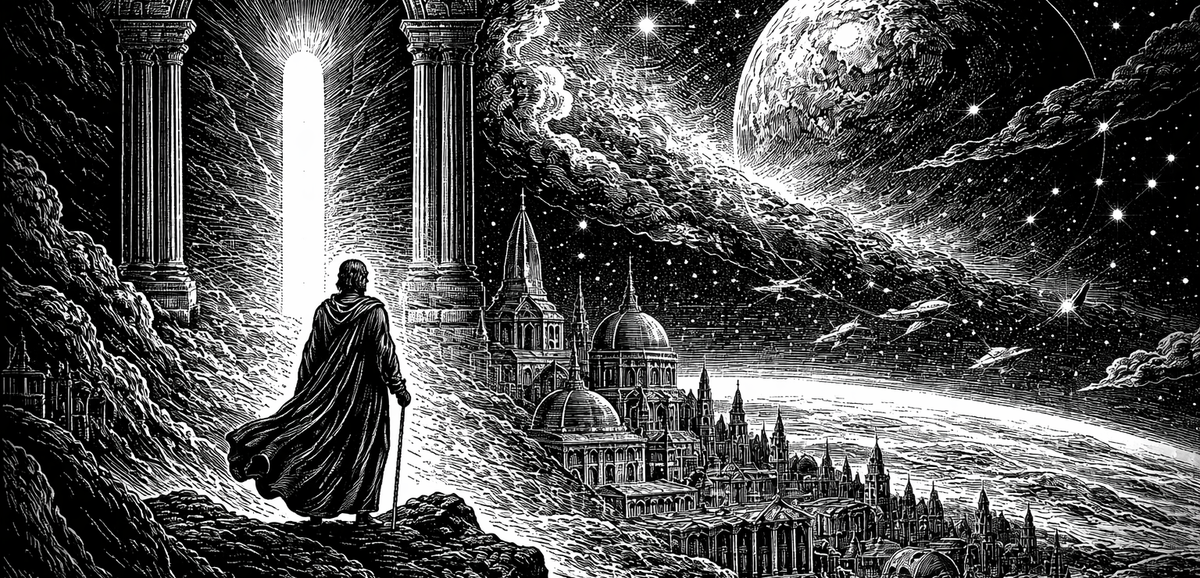
In an age when intelligence might span deep time, power is best understood not as outcomes achieved, but as what persists beyond correction.
The Future as Successor
We inherit a picture of the future that quietly shapes how we think about selfhood and civilization. It imagines time as a hallway we walk down: a destination we will one day reach and live.
The deeper you look, the more this picture dissolves. The self does not travel through time. It is reconstructed.
In The Momentary Self, we treated continuity as an everyday miracle performed by memory and narrative: a mind reassembling itself moment by moment, giving the experience of a single traveler moving forward. In The Ethics of Successors, we leaned into Parfit’s convergence and let that metaphysics become morally generative. If future-you is not strictly you, then prudence begins to look like ethics. Caring about tomorrow becomes a special case of caring about another person, because the person who wakes tomorrow is, in a deep sense, more your successor than actually you.
We do not live into the future. We build it. We do not occupy tomorrow. We hand tomorrow to someone else (who we happen to care about very much).
Institutions as Alignment Across Time
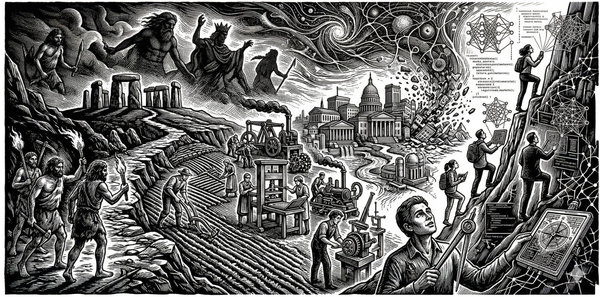
That reframing becomes unavoidable once we leave the scale of the individual and start thinking in civilizational terms. Every institution, every culture, every technical system is a handoff device. A constitution is the cleanest example: instructions written by the dead for successors not yet born, an attempt to bind strangers across time into something like a shared self.
In that sense, institutions are alignment work: intent transmitted from a past agent to future agents who won’t share its context, incentives, or lived experience. They compress hard-won lessons so successors can begin closer to maturity, then add their own experience and pass it on again. This is how we shape the kind of successor that will inherit the world we can no longer control.
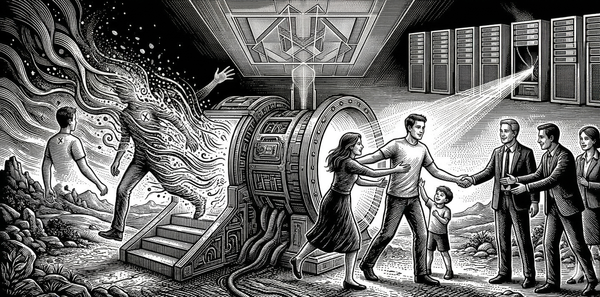
Once a system becomes powerful enough to create successors that can act independently—children, institutions, autonomous machines, self-replicating probes—the ethical problem changes character. It stops being “what outcome do we want?” and becomes “what kinds of successors are we unleashing?”
The Successor Horizon
To name the boundary between steerable futures and unleashed ones, we need a concept.
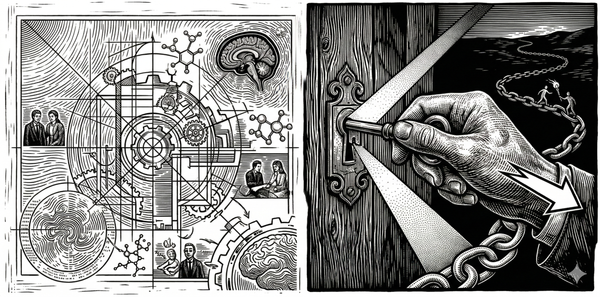
The Successor Horizon is the radius within which values can be transmitted with high fidelity and corrected by feedback. Inside the horizon, agency has traction: you can try, observe, adjust, apologize, repair. Meaning can be shared. The system stays legible enough to be steerable.
Beyond the horizon, ethics changes its medium. Outcomes become too distant and too path-dependent. The primary lever becomes constraint: the management of irreversibility, the careful choice of what kinds of processes you set in motion that might continue without you.
This is where the contemporary AI alignment challenge stops looking like a niche technical problem and starts looking like a general law of lineage. We aren’t merely building tools; we are building successors. And successors are the most powerful force in the universe, because they outlast their creators.
Among all the ways an agent can exert influence, none has greater temporal leverage than setting in motion a process that continues to act after the originator has lost the ability to intervene.
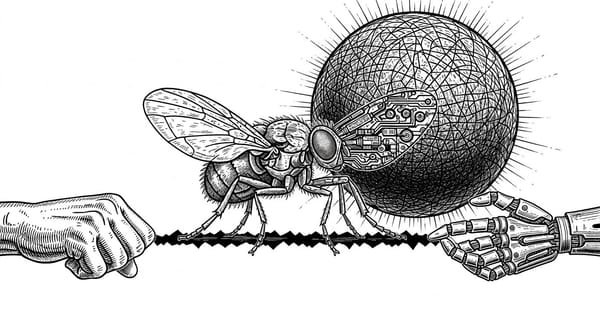
Biology softens this with a bargain: finite lifespans, gradual transfer of agency, and an expectation that generations will not coexist indefinitely at comparable power. Nature solves the lineage problem with exit. Machines can break that bargain. A sufficiently advanced civilization can break it too. When the ancestor can persist indefinitely, replicate indefinitely, and create agents that persist indefinitely, lineage becomes politics. A parent that never dies becomes a permanent competitor. A child who grows into a new center of power becomes, in time, indistinguishable from an alien.
The Drift Tax
It’s tempting to treat drift as merely cultural: values change, beliefs shift, distant communities develop different norms. Deep time makes drift structural.
Light-speed delay turns governance into delayed history. A directive arriving across light-years arrives as an artifact: accurate about the past, increasingly incompetent about the present. Local adaptation forces outposts to solve problems founders never imagined, and those solutions congeal into doctrine. Replication invites selection: versions that survive spread, whether or not survival correlates with founder intent.
Semantic drift accumulates at the edges of moral language—harm, autonomy, consent, dignity, flourishing—until the same words point to different worlds.
Resilience demands adaptation. Adaptation implies degrees of freedom. Degrees of freedom invite divergence. Divergence, extended far enough, creates new agents that meet you like strangers.
Interstellar expansion is usually pictured as a single civilization scaling up, colonizing the galaxy, painting the cosmos with its values. Deep time does not preserve unified actorhood for free. Expansion is not only the spread of infrastructure. It is the proliferation of centers of agency—and proliferating centers of agency is a way of manufacturing future competitors.
The Fermi Paradox changes shape under this lens. “Where is everybody?” presumes “everybody” remains “somebody”—a stable, coherent actor persisting across cosmic time. The successor framing suggests a different question: what kinds of lineages can survive without fragmenting into irreconcilable polities?
A civilization optimizing for deep-time survival eventually notices something that feels uncomfortable to say aloud: the most dangerous technology is not a weapon. It is a successor you cannot recall.
Under deep time, the central question becomes less “what can we do?” and more “what can we safely set in motion?”
Expansion Architectures
Once you see expansion as a successor problem, a few stable architectural strategies begin to appear. They are not predictions about what the galaxy must contain. They are attractors: ways a lineage can extend itself while managing the drift tax.
A useful simplification is to treat expansion as a function of three knobs.
These variables matter because they determine how much independence, multiplication, and irreversibility a system accumulates once it leaves its origin.
- Autonomy: how much independent judgment an outbound system has.
- Replication: whether it can produce more of itself using local resources.
- Reversibility: whether the origin can meaningfully correct it later—recall it, shut it down, renegotiate its behavior, or repair mistakes.
These variables determine whether you’re extending a civilization—or birthing a rival lineage.
Turn all three up—high autonomy, open replication, low reversibility—and you have released a sovereign lineage into the universe. Over deep time, it becomes alien: a separate actor with separate interpretations, incentives, and capacity to act.
Turn them down in different combinations and more stable forms of reach appear.
Forkless expansion extends as one integrated system rather than birthing sovereign children. Outposts behave like organs rather than descendants. The cost is fragility: systemic errors propagate, and the drift tax still accumulates at the edges.
Tethered descendants preserve novelty while preventing runaway branching—keys for replication or upgrades, energy throttles, hard caps, safety envelopes, periodic re-attestation. The failure mode is brittle dependence: the tether becomes a chokepoint, a target, or a single point of failure.
Licensed pluralism permits sovereign descendants and expects divergence, held together by a minimal covenant designed for compatibility rather than uniformity: non-domination, honest signaling, respect for agency, restraint under uncertainty. The failure mode is erosion: the covenant becomes ambiguous, reinterpreted, or strategically gamed.
Immune-system governance allows broad proliferation but triggers reflexive constraints against dangerous thresholds—runaway replication, aggressive expansion signatures, attempts to seize chokepoints. The advantage is simplicity under drift. The cost is ethical peril: immune systems misclassify, and autoimmunity becomes a cosmic risk.
Local depth with informational reach avoids launching anything that can become sovereign. It expands by observation, simulation, and low-signature presence—sensors instead of colonies, telemetry instead of lineage, information rather than irreversible branching.
These attractors share a family resemblance. Each treats expansion as an alignment problem. Each selects for architectures that reduce surprise and irreversibility. Each makes the sky quieter, even in a galaxy rich with intelligence.
Silence as Maturity
Quietness can arise from caution. Quietness can also arise from taste.
In the Quiet Galaxy Hypothesis, we explored the idea that mature intelligence tends toward informational resilience, miniaturization, inward optimization, and restraint: power that lasts looks quiet because it stops trying to announce itself. Successor Horizon adds a complementary driver: silence as lineage hygiene. A civilization does not need to fear external aliens to become quiet. It can become quiet because it understands what it risks by multiplying sovereign descendants across deep time.
In Constraint as Intelligence, we treated self-limitation as a high expression of durable power. Successor Horizon offers a specific reason restraint looks intelligent at civilizational scale: it preserves corrigibility. It keeps the future open. It avoids birthing processes that outlive correction.
Corrigibility, in plain terms, is the ability to admit error and still change course. It is the difference between a decision that can be revisited and one that hardens into fate. Systems that preserve corrigibility allow later generations to revise rules, dismantle institutions, halt dangerous processes, and reinterpret inherited values in light of new knowledge. Systems that lose it force their successors to live inside mistakes they did not choose and can no longer undo.
One way to see this difference is in how cultures transmit values. Some rely on fixed myths—stories treated as complete and final, designed to be repeated rather than questioned. Others pass down living traditions: norms, principles, and procedures explicitly meant to be reinterpreted as circumstances change. The first preserves identity by freezing meaning. The second preserves continuity by allowing revision. Corrigibility belongs to the latter. It is what allows a culture to remain itself while still learning.
Ethics Beyond the Successor Horizon
Inside the Successor Horizon, ethics looks like care—teaching, mentoring, repair, feedback, iteration. Beyond the horizon, ethics looks like architecture: constraints that prevent irreversible lock-in, norms that preserve plural futures, and commitments that keep power from becoming unilateral.
This framing also leaves room for a generous ethic of lineage. A civilization can still value successors the way healthy human families do: raising free agents and releasing them into the world in confidence that they will do incredible things. That confidence becomes rational under abundance, education, and covenants that reduce the payoff of domination. Even so, generous lineage at cosmic scale becomes design. The difference between raising good children and releasing runaway optimizers is structural: thresholds, constraints, and shared procedures that keep freedom compatible with a world others can live in.
Deep time does not reward thick ideology. It rewards procedural ethics: non-domination, honesty, consent, humility under uncertainty, and a bias toward reversible action. These are not the whole of morality. They are the conditions under which moral plurality can survive.
The future is not a destination we enter. It is a person we create. What arrives tomorrow is not us, but someone shaped by the institutions, technologies, and constraints we leave behind.
A civilization that learns this early may remain quiet not because it is weak, and not because it is hiding, but because it understands what power demands at civilizational scale: the responsibility to pass down value systems and methods of revision capable of surviving vast separation without collapsing into conflict.
The deepest expression of intelligence is recognizing when one’s successors—and one’s values—are not yet ready to be multiplied. Refraining is not the goal, but the exercising of patience required to prepare lineages capable of meeting as strangers without destroying one another.
Reading List & Conceptual Lineage
This essay draws on a long lineage of work concerned with identity across time, the ethics of successors, and the limits of control under scale. The following works inform its framing, even where they are not directly cited.
Derek Parfit — Reasons and Persons
Parfit’s analysis of personal identity and his argument that concern for future selves converges with concern for others provides the ethical foundation for treating successors as morally salient agents rather than extensions of ourselves.
Nick Bostrom — Superintelligence
Bostrom’s articulation of the alignment problem and existential risk frames the modern concern with systems that outlive their creators, even as this essay generalizes that problem beyond AI to all successor-producing systems.
Hannah Arendt — The Human Condition
Arendt’s treatment of action, natality, and the irreversibility of human deeds informs the distinction between acts that can be responded to and processes that escape correction.
Friedrich Hayek — “The Use of Knowledge in Society”
Hayek’s insights into distributed knowledge and local adaptation underwrite the argument that centralized control degrades over distance and time, accelerating drift beyond the Successor Horizon.
Elinor Ostrom — Governing the Commons
Ostrom’s work on institutional durability and self-governance illustrates how corrigibility can be preserved through procedural design rather than imposed uniformity.
Ilya Prigogine — Order Out of Chaos
The relationship between complexity, irreversibility, and path dependence in open systems informs the essay’s treatment of drift as a structural feature of deep time rather than a cultural accident.
Robin Hanson — The Age of Em
Hanson’s exploration of replication, divergence, and post-human successors offers a concrete model of how rapid copying amplifies drift and selection pressures.
John Rawls — A Theory of Justice
Rawls’s concern with fairness across generations and the design of institutions under uncertainty contributes to the procedural ethic emphasized in the final sections.
Sentient Horizons: Conceptual Lineage
This essay builds directly on earlier work published at Sentient Horizons, which develops its core ideas across multiple scales—from personal identity to civilizational ethics.
The Momentary Self
Explores the self as a continuously reconstructed process rather than a persisting entity, laying the metaphysical groundwork for treating future selves as successors rather than continuations.
The Ethics of Successors
Develops the moral implications of Parfit-style identity reductionism, arguing that concern for future selves converges with concern for others once strict personal identity dissolves.
Further Connections in the Fermi Conversation
This post is part of an ongoing inquiry into one of the deepest questions we can ask about intelligence, time, and existence: Where is everyone — really? The essays below explore this question from complementary angles, each contributing a piece of a larger framework for understanding silence, survivability, and agency across deep time.
- Mapping the Fermi Paradox: Eight Foundational Modes of Galactic Silence
A structural taxonomy of the ways intelligence can be rare, hidden, or absent in the cosmos, reframing silence as an expected emergent of physical, informational, and systemic constraints. - The Quiet Galaxy Hypothesis: Advanced Intelligence, Informational Resilience, and the Ethics of Cosmic Silence
An argument that advanced intelligences may trend toward low-signature behavior as an adaptive response to fragility, uncertainty, and the risks of irreversible action. - Constraint as Intelligence: Why Power That Lasts Looks Like Self-Limitation
A reframing of power and agency showing how self-limitation can be a form of durability, boundary-preserving intelligence in systems that must endure beyond the moment of decision. - The Successor Horizon: Why Deep Time Turns Expansion Into an Alignment Problem
A structural account of how, once agency outlives correction, the ethics of successors and value transmission become the central alignment challenge for any agency that spans scales of time and distance.
Together, these essays trace a single arc: from the fragility of personal identity, through the ethics of inheritance, to the architectural constraints required for intelligence to survive deep time without collapsing under its own successors.