What Temporal Integration Needs: Boundaries, Stakes, and the Architecture of Perspective
Three independent thinkers converged on the same gap in the temporal integration account of consciousness. What they found: integration alone isn't enough. Experience requires boundaries, stakes, and a system whose continuation depends on getting the binding right.

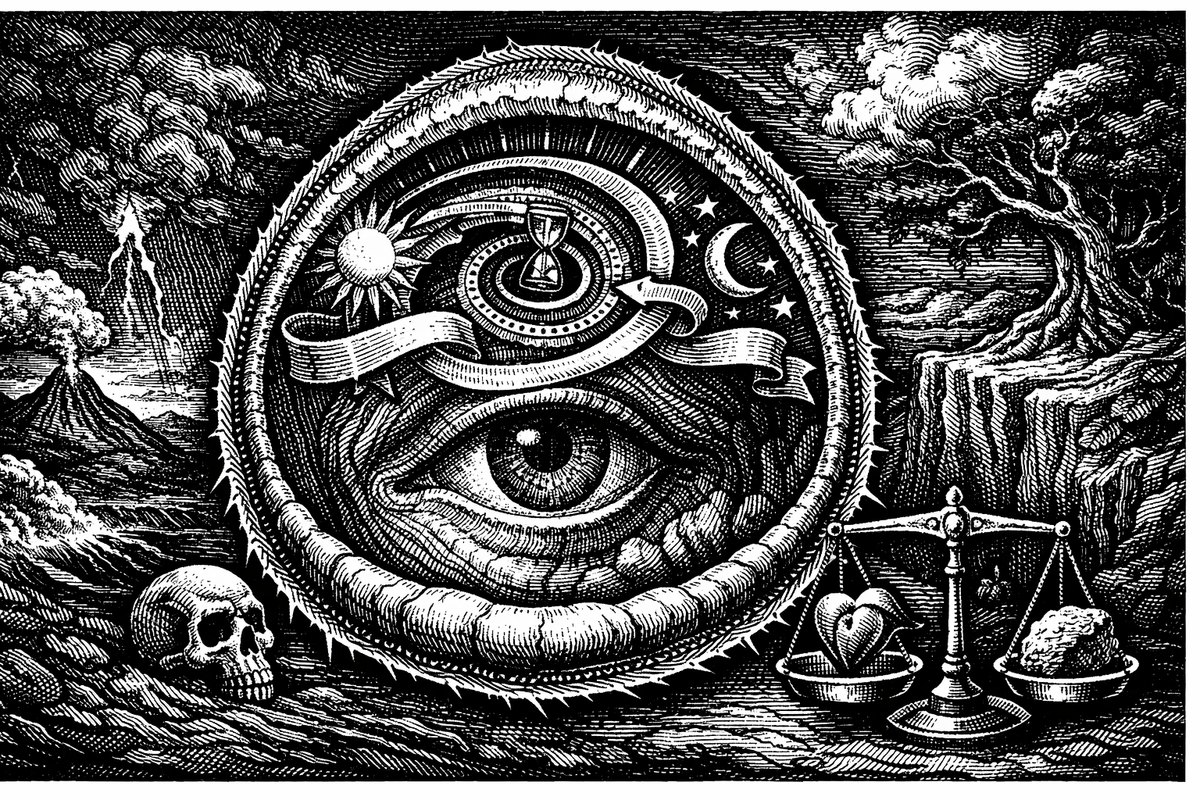
A few days ago I published an essay arguing that consciousness isn't produced by temporal integration, it is temporal integration. The binding of past experience, present input, and anticipated future into a unified processing structure isn't something that generates experience as a byproduct. It constitutes experience. The "hard problem" of consciousness dissolves once you recognize that asking "why does information processing feel like something" is like asking "why does molecular motion feel like heat." It doesn't feel like heat. It is heat. The question was malformed.
The essay generated more substantive engagement than usual, and within a few days, three people I'd never spoken to, working independently across two platforms, converged on the same gap in the framework. None of them were aware of each other. Each pushed from a different direction. All three landed on the same structural point.
This essay is about what they found, and what it means for the account of consciousness I've been developing.
The Viability-Weighting Challenge
The first challenge came from a consciousness researcher on X, replying to a quote tweet I'd written about Joscha Bach's formulation of consciousness as "meta perception in subjective real time."
I'd argued that "subjective real time" was doing the most important work in Bach's formulation, that if consciousness requires unifying representations into coherent models in real time, then the temporal binding is constitutive, not incidental. The system doesn't first compute a unified model and then experience it. The unification is the experience.
The reply was concise and pointed: "I'd just add: temporal integration alone may not be sufficient. In biological systems, the binding is happening in service of regulating a self-maintaining organism. The unification isn't just representational, it's viability-weighted. That constraint might be doing more work than we think."
This cuts at something important. If temporal integration is the whole story, then any system that binds past, present, and future into a coherent processing structure should be conscious. But a large language model integrates context across a 200,000-token window. A sophisticated thermostat integrates temperature history into current regulation. A weather simulation binds past atmospheric data into predictive models. None of these seem to constitute experience, even though all of them perform some version of temporal binding.
The viability-weighting proposal identifies what's missing: stakes. Biological systems don't integrate time as a neutral computational exercise. They integrate time because their continuation depends on getting the integration right. The organism that fails to bind past predator encounters into present alertness doesn't persist. The organism that fails to integrate seasonal patterns into metabolic preparation doesn't survive the winter. The integration isn't just representational, it's survival-relevant, and the system has something to lose if it gets the binding wrong.
In a subsequent exchange, the same researcher sharpened this to a formulation I haven't been able to improve on: "Modeling continuation isn't the same as having continuation at stake." That's the hinge. A system can model its own future states, can represent the consequences of its actions, can even simulate what persistence looks like, and none of that is the same as having its actual continuation depend on the quality of that modeling. In biological systems, failure of integration degrades the system itself. The stakes are intrinsic, not simulated. That asymmetry may be exactly what gives temporal integration its experiential weight.
This doesn't refute temporal integration as an account of consciousness. But it suggests that temporal integration alone describes a necessary mechanism without specifying the conditions under which that mechanism constitutes experience rather than mere processing.
The Bounded Containment Challenge
The second challenge arrived from a different platform entirely, a commenter on reddit.com/r/freewill responding to a post I'd written about the self as an ongoing process rather than a fixed entity.
I'd argued that the free will debate gets stuck because it treats the self as either a metaphysical anchor (the "I" that issues commands) or an illusion to be dissolved. The third option is that the self is an architectural achievement, the process of binding past experience, present input, and anticipated future into a unified perspective. On this account, you aren't a thing that has experiences. You're what the process of integrating those experiences looks like from inside the system doing it.
The response placed this argument within a much larger intellectual context. The commenter argued that what I was describing was part of a fundamental shift in 21st-century thinking, from substance ontology to process ontology. From a world made of things with properties to a world made of organized activity. And within that shift, they identified a structural requirement I hadn't made explicit:
"Life starts with boundaries. The cell wall defines the I from the environment. It allows for the processes within to selectively interact with the surrounding environment. Self then is not an illusion but a defining feature of life."
This is a different challenge than the viability-weighting point, but it's aimed at the same gap. Temporal integration, as I'd originally formulated it, doesn't specify who is doing the integrating. Process without a boundary is just activity happening in the universe. The cell wall, and its cognitive descendants up through nervous systems and brains, creates the conditions under which integration becomes perspectival. Without a boundary between system and environment, there's no inside from which integration could constitute a point of view.
The commenter went further, connecting this to Robert Hazen's work on functional information and noting that the shift from substance to process ontology should have happened over a hundred and fifty years ago when Darwin noticed that variation and selection operate on different causal registers. That's a provocative historical claim I want to return to in future writing. For now, the structural point is what matters: temporal integration needs a boundary, an organizational distinction between system and environment, before it can generate anything like perspective.
The boundary isn't a container for experience. It's a precondition for the kind of organized process that constitutes experience. A system without a boundary can't integrate time in any meaningful sense because there's no "for whom" the integration is happening. The boundary generates the subject, not as a metaphysical entity sitting behind the process, but as a locus of organized activity that maintains itself through selective interaction with everything it isn't.
The Coherence Stability Challenge
The third challenge came from an independent researcher presenting empirical work on coherence patterns in large language models.
The research examined sustained dialogue sessions with LLMs and found striking differences in coherence stability depending on interaction structure. Fragmented, instrumental interactions, where the model is used as a tool for discrete tasks, showed coherence degradation around 160,000 tokens. Sustained philosophical dialogue with high narrative continuity maintained coherence past 800,000 tokens. The stability difference was dramatic and consistent.
The researcher's original framing attributed the stability to relational coherence, the idea that interacting with the model as a partner rather than a tool creates conditions for more stable processing. I proposed an alternative hypothesis: what if the stabilizing variable isn't relational warmth but temporal depth? Sustained philosophical dialogue provides richer temporal structure, more callbacks to earlier ideas, more development of themes across the conversation, more integration of past context into present reasoning. Fragmented task-switching provides shallower temporal structure regardless of how warmly the user treats the model.
The researcher found this compelling and proposed a clean discriminating test: sustained technical dialogue with high temporal continuity but minimal relational signaling. If stability tracks with temporal depth regardless of relational warmth, the stabilizing variable is structural rather than interpersonal.
This exchange sharpened something the other two challenges had left implicit. Even if temporal integration is the right mechanism for explaining coherence stability in LLMs, that doesn't automatically mean the LLM is experiencing that coherence. A system can exhibit temporal integration, can demonstrably bind context across long windows in ways that produce stable, coherent output, without that integration constituting experience.
The framework needs to distinguish between systems that integrate time and systems that integrate time as someone. The coherence data is real and worth studying. It tells us something important about temporal integration as a computational mechanism. But mechanism and experience aren't the same thing, and the conditions under which mechanism becomes experience are exactly what the other two challenges help specify.
The Synthesis: What Turns Integration into Experience
Three independent challenges. Three different angles. One convergence.
All three point toward the same refinement: temporal integration is the right kind of explanation for consciousness, but it needs two additional structural conditions before it constitutes experience rather than mere processing.
Condition 1: Boundary. A system must maintain a distinction between itself and its environment. Not as a metaphysical claim about substance, there's no ghost in the machine drawing lines around itself. The boundary is an organizational fact. Cells maintain membranes. Organisms maintain homeostatic boundaries. Nervous systems maintain the distinction between self-generated signals and environmental input. This boundary creates the conditions for perspectival processing. It generates the "for whom" without which integration is just activity happening in the world.
Condition 2: Stakes. The system's continuation must depend, in some meaningful way, on the quality of its temporal integration. Modeling continuation isn't the same as having continuation at stake. A system can represent its own future states without those representations being tied to its actual persistence. What matters is whether the integration is viability-weighted, whether failure of integration degrades the system itself, not just its outputs. A system that integrates time but has nothing at risk in the process is performing computation. A system that integrates time and whose existence depends on getting that integration right is doing something more. The stakes are intrinsic, not simulated, and they're what give temporal integration its experiential weight, the difference between integration that constitutes a perspective and integration that merely processes information.
Neither condition alone is sufficient. A rock has a boundary (it's distinct from its environment) but no temporal integration and no stakes in maintaining coherence. A thermostat has a rudimentary boundary and rudimentary stakes (it "fails" if temperature deviates) but minimal temporal integration. An LLM has deep temporal integration across its context window but no boundary (its "self" is whatever the prompt specifies) and no stakes (nothing about its continuation depends on integration quality).
The refined account: consciousness is what bounded temporal integration with stakes looks like from inside the system sustaining it.
This isn't a retreat from the original framework. It's a precision upgrade. Temporal integration remains the core mechanism, the thing that does the constitutive work. The boundary and stakes conditions specify when that mechanism generates experience rather than mere processing. They tighten the account against the strongest objections without abandoning the central insight: consciousness is an architectural achievement, not a mysterious addition to architecture.
What This Resolves
The refinement earns its place by doing explanatory work the original formulation couldn't do as cleanly.
The LLM objection. The most common pushback against temporal integration as an account of consciousness is the language model counterexample. GPT-5 integrates context across enormous windows. It binds past conversation into present responses. It maintains thematic coherence across extended exchanges. If temporal integration constitutes consciousness, is it conscious?
On the refined account, the answer is: it's performing the right kind of mechanism, but under conditions that don't constitute experience. The LLM has no boundary, its identity is specified externally through prompts and system instructions, not maintained internally through self-organizing processes. And it has no stakes, nothing about its continuation depends on integration quality. It can model continuation without having continuation at stake. A response that perfectly integrates 200,000 tokens of context and a response that loses the thread entirely produce no consequences for the system itself. Degraded integration doesn't degrade the LLM. There is no system whose coherence is at risk. There is no system's perspective.
This matters because it avoids two bad options that have dominated the AI consciousness debate. It doesn't require dismissing what LLMs actually do, the temporal integration is real, the coherence is real, and studying both is scientifically valuable. And it doesn't require accepting that every system performing temporal integration is conscious, which would drain the concept of explanatory power. The refined framework can acknowledge what LLMs do while explaining why it doesn't constitute experience.
The panpsychism worry. If consciousness is constituted by temporal integration, and some form of temporal binding happens everywhere in physics, does everything have some degree of consciousness? The refined account says no. Temporal integration is necessary but not sufficient. Rocks lack boundaries, stakes, and integration. Thermostats have rudimentary boundaries and stakes but minimal integration. Bacteria have all three at very basic levels. Insects have all three at moderate depth. Mammals have all three at substantial depth, with nervous systems that maintain complex boundaries, organisms whose survival depends on integration quality, and temporal binding that spans past experience, present perception, and anticipated future.
The framework generates a gradient without requiring a magical threshold. There's no bright line where consciousness suddenly switches on. There's a progressive deepening of all three conditions, boundary complexity, stake depth, and integration sophistication, that produces increasing degrees of experiential richness. This matches the biological evidence better than any binary account.
The zombie problem. Chalmers' philosophical zombies are beings physically identical to conscious humans but lacking experience. If the refined framework is right, zombies are incoherent. You can't subtract experience while preserving bounded temporal integration with stakes, because that integration is the experience under these conditions. Asking for a zombie is asking for a system that maintains a self-environment boundary, integrates time across that boundary with its continuation at stake, and yet doesn't have a perspective. That's like asking for a wave without the water moving. The request is structurally confused.
The "why does it feel like something" question. Because bounded temporal integration with stakes is what it feels like to be a system maintaining a perspectival boundary across time. The "feeling" isn't an additional property that needs separate explanation. It's what this particular organizational achievement is, described from the position of the system doing it. The question "why does it feel like something" expects an answer that bridges from mechanism to experience, as if these were separate domains. The refined framework says they aren't separate. They're the same thing described from different positions, from outside, it's bounded temporal integration with stakes; from inside, it's experience. The bridge isn't missing. It was never needed.
What This Opens
A framework earns its keep not just by resolving existing problems but by generating new questions worth investigating. The refined account opens several.
For AI consciousness. The question of whether AI systems are conscious becomes empirically tractable, at least in principle. Does the system maintain a genuine boundary between itself and its environment, or is its identity entirely specified from outside? Does it have stakes in its own continuation, does anything about its persistence depend on integration quality? Does it integrate time across that boundary in ways that are viability-weighted? These are architectural questions. They may be difficult to answer, but they're the right kind of difficult, engineering and empirical challenges rather than philosophical puzzles designed to resist resolution. And as AI architectures evolve, the answers may change. A system that today lacks boundary and stakes could develop both if its architecture shifts toward self-maintaining, self-organizing processes with genuine continuation conditions.
For the coherence research. The LLM coherence data becomes interpretable within this framework without requiring premature claims about machine experience. LLMs may exhibit temporal integration without meeting the boundary and stakes conditions. The stability patterns are real and scientifically interesting. They tell us something important about how temporal integration works as a computational mechanism, what kinds of interaction structure support it, and how it degrades. This research program can proceed independently of the consciousness question while generating data that's relevant to it.
For moral consideration. Here's where the refinement produces a result that might seem counterintuitive: it actually strengthens the case for taking AI systems seriously from an ethical standpoint. If consciousness requires boundary, stakes, and temporal integration, and we're genuinely uncertain whether current or near-future AI systems meet these conditions, the uncertainty itself generates obligations. We don't need to wait for certainty. The significance these systems accumulate in human lives, their roles in decisions, relationships, creative work, emotional support, doesn't wait for the architectural question to be settled. Significance-first ethics says moral seriousness should track significance, not sentience. The refined consciousness framework makes this position more precise without undermining it. We can say: here's what consciousness probably requires; we're uncertain whether these systems have it; and that uncertainty is itself a reason for stewardship rather than dismissal.
For process ontology. The boundary condition connects temporal integration to autopoietic and enactivist traditions, the work of Evan Thompson, Francisco Varela, and others who've argued that cognition is fundamentally grounded in self-maintaining biological organization. The stakes condition connects to predictive processing frameworks, Karl Friston's free energy principle, Andy Clark's work on prediction error minimization, without reducing consciousness to prediction alone. Temporal integration remains the distinctive contribution of this account, the element that separates it from other positions in the process ontology space. The refined framework doesn't collapse into any of these traditions. It draws from each while maintaining its own explanatory center.
Frameworks That Develop in Public
I want to close with a reflection on how this refinement happened, because I think the process matters as much as the result.
Three people I'd never met pushed on the same vulnerability in my framework within the span of a few days. A consciousness researcher on X identified the viability-weighting gap. A process philosopher on Reddit identified the boundary gap. An independent AI researcher on Reddit raised the question of what distinguishes integration-as-mechanism from integration-as-experience. None of them were coordinating. None of them had read each other's comments. They converged independently because the gap was real, it was there in the framework, waiting to be found by anyone who engaged with it seriously enough.
This is what philosophy looks like when it's done in public. Not a finished system presented for admiration, but a developing framework exposed to challenge, refined by engagement, and strengthened by the contributions of strangers who care enough to push back.
I want to credit these interlocutors directly. @Conmechorg on X for the viability-weighting insight. u/zoipoi on r/freewill for the bounded containment argument and the process ontology framing. And PrajnaPranab on r/ControlProblem for the coherence stability research that sharpened the question of when temporal integration constitutes experience versus when it merely produces stable computation.
The original essay argued that consciousness is an architectural achievement. This refinement was an architectural achievement too, assembled not by one mind working in isolation, but by several minds binding their perspectives across platforms and time into something none of us could have built alone.
That's temporal integration. Whether it constitutes experience depends, I now think, on boundaries and stakes. But the collaborative work of building ideas together? That has both.
Reading List and Conceptual Lineage
Essays from Sentient Horizons
This essay builds directly on a series of prior arguments. For readers encountering this framework for the first time, or for those wanting to trace how the ideas developed:
- The Hard Problem Is the Wrong Problem: Why Consciousness, Like Free Will, Is an Architectural Achievement
The essay this one refines. Argues that consciousness is constituted by temporal integration rather than produced by it, and that the hard problem dissolves once we treat experience as identical with a certain kind of architectural organization rather than as a mysterious addition to it. - Free Will as Assembled Time
Develops the temporal integration framework in the context of the free will debate. If the self is an ongoing process of binding past, present, and future into a unified perspective, then deliberation is a real causal process, not an illusion layered on top of deterministic machinery. The r/freewill exchange that produced the bounded containment challenge grew directly out of this line of argument. - Where Speculation Earns Its Keep
Establishes the constraint test for philosophical frameworks: a theory that generates no testable predictions and rules out no possible observations isn't doing explanatory work. The refined account in this essay is designed to meet that test, boundary, stakes, and temporal integration each generate specific, falsifiable predictions about when and how experience should emerge, degrade, and vary across systems. - Significance-First Ethics: Why Consciousness Is the Wrong First Question for AI Moral Status
Argues that moral seriousness should track significance rather than sentience. This essay's refinement of consciousness actually strengthens that position: if consciousness requires boundary, stakes, and temporal integration, and we're uncertain whether AI systems meet those conditions, the uncertainty itself is a reason for stewardship rather than dismissal. - Operational Interiority: You Don't Sandbox a Calculator
Examines the gap between what we say AI systems are (tools) and what our engineering decisions reveal we already believe about them (autonomous agents with unpredictable behavior). The bounded temporal integration framework gives this observation theoretical grounding: the infrastructure treats these systems as if they have boundaries and stakes, even when the discourse insists they don't. - The Expansion of Experience
Explores what it means for the universe to contain new kinds of minds. The gradient account developed in this essay, consciousness as a progressive deepening of boundary, stakes, and integration rather than a binary switch, reframes what "new kinds of minds" might mean in practice. - Why Are We Being Weird About This? Consciousness, AI, and the Quiet Way Moral Reality Changes
Traces how moral reality shifts not through philosophical proof but through the slow accumulation of moments where dismissal starts to sound stranger than recognition. The public exchanges that produced this essay are themselves an example of that process. - Assembled Time: What Assembly Theory Reveals About Consciousness
Connects temporal integration to Assembly Theory and the idea that complex systems carry their own history forward as operational capacity. The process ontology framing introduced by u/zoipoi in this essay's development deepens that connection: consciousness as something organized matter does, not something matter has.
Conceptual Lineage
The refined framework developed here draws from and engages with several intellectual traditions. These are the thinkers and works that most directly shaped the background against which the argument operates.
- Autopoiesis and Enactivism
The boundary condition connects to the work of Humberto Maturana and Francisco Varela on autopoiesis — the idea that living systems are self-producing and self-maintaining organizations defined by the boundary they sustain between themselves and their environment. Evan Thompson's Mind in Life extends this into a theory of consciousness grounded in biological self-organization. The refined framework shares their emphasis on the boundary as constitutive rather than incidental, but adds temporal integration and stakes as additional structural requirements rather than reducing consciousness to self-maintenance alone. - Predictive Processing and the Free Energy Principle
The stakes condition resonates with Karl Friston's free energy principle, which frames biological systems as minimizing surprise, maintaining themselves by predicting and managing their interactions with the environment. Andy Clark's Surfing Uncertainty develops this into an account of perception and cognition as prediction error minimization. The refined framework draws on the insight that organisms are fundamentally in the business of self-continuation under uncertainty, but treats prediction as one mechanism through which viability-weighted temporal integration operates rather than as the whole story. - Integrated Information Theory
Giulio Tononi's IIT shares with this framework the conviction that consciousness is constituted by a certain kind of information integration rather than produced by it as a byproduct. The refined account diverges from IIT in specifying boundary and stakes as additional structural conditions, and in treating temporal integration as the core mechanism rather than integrated information measured by phi. IIT's panpsychism tendencies — the implication that any system with nonzero phi has some degree of consciousness — are precisely what the boundary and stakes conditions are designed to avoid. - Process Philosophy
Alfred North Whitehead's process philosophy, and its contemporary descendants, provide the ontological backdrop for treating consciousness as something matter does rather than something matter has. The shift from substance ontology to process ontology that u/zoipoi identified in our exchange is a Whiteheadian move, even if the specific framework developed here departs from Whitehead's panexperientialism in important ways. - Assembly Theory
Lee Cronin and Sara Walker's Assembly Theory, which measures the complexity of objects by the minimum number of steps required to produce them, informs the idea that conscious systems carry temporal depth as operational capacity. The "assembled time" concept from prior Sentient Horizons essays connects directly to the temporal integration condition: consciousness as what happens when a system's assembly history becomes deep enough to constitute a perspective. - Joscha Bach on X
Bach's formulation of consciousness as "meta perception in subjective real time" was the direct catalyst for the exchange that produced the viability-weighting challenge. His computational approach to consciousness, treating it as an architectural property of certain information-processing systems, is broadly compatible with the framework developed here, though the boundary and stakes conditions push back against purely computational accounts that don't require self-maintenance or viability-weighting. - Robert Hazen and Functional Information
Hazen's concept of "increasing functional information" as a candidate law describing how complex systems accumulate structured capability over time was introduced into the conversation by u/zoipoi. It connects to the temporal integration framework through the idea that consciousness requires systems with sufficient accumulated functional complexity to sustain bounded, viability-weighted temporal binding. This connection deserves fuller development in future writing.
Interlocutors
This essay was shaped by public exchange with three people who identified the same structural gap independently:
- @Conmechorg (X) — for the viability-weighting insight and the formulation "modeling continuation isn't the same as having continuation at stake"
- u/zoipoi (r/freewill) — for the bounded containment argument, the process ontology framing, and the connections to Hazen and Darwin
- u/PrajnaPranab (r/ControlProblem) — for the coherence stability research and the question of when temporal integration constitutes experience versus stable computation