The Individual Arc · October 18, 2026
Outrunning Ageing
Every year you live, medicine gets a little better, and every year you age by one. For a person in middle age, ageing still wins by most of a year. I built Outrunning Ageing to ask when, if ever, medical repair overtakes ageing. It breaks the question into forty-four specific treatments on eight branches, gives each a test and a range of years, and plays the tree out two hundred thousand times. As of 17 October 2026 the middle estimate is 2058, with a 4.1 percent chance before 2050. Beside the year sits a dated log of who promised what and when, scored as the dates pass, and a weekly reading of the news that moves a number only when the evidence does.
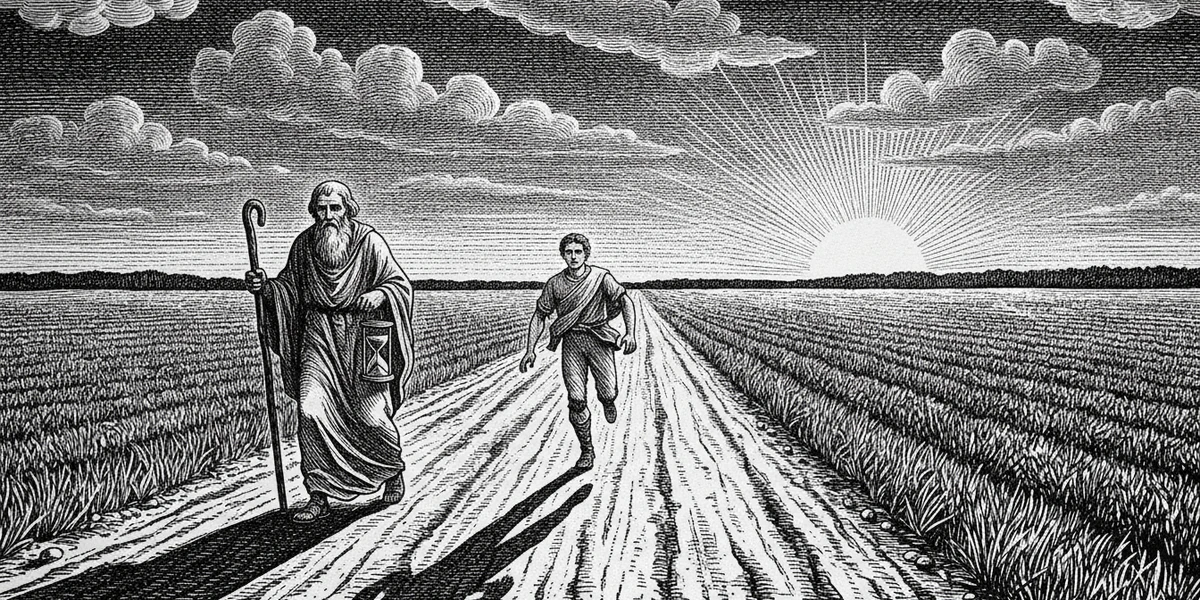
Every year you live, medicine gets a little better. Yet every year you live, you also age by one year, and for a person in middle age medicine does not yet improve fast enough to give you that year back. The years you can expect to have left fall by about a year every year, minus the small gains that new medical treatments add. There is a name for the moment when the gains from medicine will finally outpace the body’s ageing. Advocates of longevity science call this longevity escape velocity and describe it as the point at which medicine adds more than a year of healthy life for every year that passes, so that someone who keeps up with the best available care finds their remaining years holding steady instead of falling. The phrase borrows from rocketry, where escape velocity is the speed a rocket needs to escape a planet’s gravity. The ageing researcher Aubrey de Grey put the idea in a journal in June 2004 under the name “actuarial escape velocity”, and the inventor and futurist Ray Kurzweil wrote in his 2024 book that the most diligent and informed people will reach it by around 2030.
I have written about this idea before in The Instance Worth Keeping where I argued that extending a healthy life, taken seriously, is the necessary stewardship of one instance of sentience (your own), and that the appropriate posture toward longevity is to act now on what is known to work while holding loosely the hope of reaching escape velocity in your own lifetime. That essay also said that public forecasts run from the 2030s to past mid-century to never, because it is clear that nobody is tracking this closely enough for a better prediction. That is when I realized there was an opportunity to do the math in public, piece by piece, with every number carrying its source, so that a reader who thinks 2030 is right, or one who thinks “never” is right, could point at the exact place where we disagree.
I am calling the project Outrunning Ageing, and it asks one simple question: when, if ever, does the rate of medical repair overtake the rate of ageing? After pulling together all of the research and running the simulations on all the projected numbers, it answers with a single year, computed from a tree of forty-four specific treatments and measuring tools, each with a plain test of what would count, a public record of how far it has got, and the project’s estimate of when it becomes available to patients, as a range of years with the reasoning beside it. The tree is played out two hundred thousand times, and the middle of all those runs is the number at the top. As the records stood at the end of October 17, 2026, the day the site went live, that number was 2058. Nine runs in ten landed between 2050 and 2069. The chance that it arrives before 2050, a year later than any of the loudest promises name, came out at 4.1 percent. The share of runs in which it does not arrive this century came out at zero, and further on I explain why that last number is the one I trust least.
Eight Kinds of Damage
The tree has eight branches because ageing is many different things going wrong at once. In a 2023 review, five scientists led by Carlos López-Otín listed twelve kinds of damage and failure that build up in a body over a lifetime, and called them the “hallmarks” of ageing. Twelve is too many to keep in your head easily, so I grouped them into seven kinds of damage that repair would have to address, and added an eighth branch for measuring whether anything actually works:
- Worn-out cells. Cells that have stopped dividing but will not die, and sit in the tissue inflaming their neighbors.
- Damaged DNA. Mutations that pile up over a lifetime, and the shortening of the caps on the ends of chromosomes.
- The cell’s settings. The chemical marks that tell a cell which genes to read, which drift with age so that cells slowly forget what they are.
- Broken proteins and waste. Proteins that fold into the wrong shape, the cell’s failure to recycle its own worn parts, and the waste that builds up between cells.
- Energy and fuel sensing. The cell’s power plants, and the pathways that sense how much food is coming in.
- Replacing lost cells and parts. Stem cells that run out, tissue that goes unreplaced, organs that fail, and the route around that, which is to supply new parts.
- Inflammation and the body’s messaging. Low-grade inflammation that never switches off, and the signals cells send each other going wrong.
- Measuring ageing. Tools that would show whether a treatment slowed ageing without waiting decades for people to fall ill or die, and whether a regulator will ever accept one as proof.
Outrunning ageing means dealing with every kind of damage, so the year at the top cannot arrive until every branch counts as handled, which on this site means that two of its treatments have reached patients, plus some years for those treatments to reach ordinary people. The measuring branch is there because ageing is not a disease on any regulator’s list. Drugs are approved one disease at a time, and without a measure of ageing that regulators accept, the only way to show that something slowed ageing itself is a trial that takes a working lifetime.
Each treatment is written the same way, so that anyone who disagrees can point at the exact part: a plain name that says what happens (“A drug clears aged cells from a person”, never “senolytic therapy”), a test of what would count, a stage on a five-rung ladder (idea only, shown in animals, first human, in clinical use, and in wide use), and the project’s estimate of when it reaches the fourth rung, which means that a doctor can give it to patients outside a trial. Six of the forty-four are already on that rung, and none was approved to slow ageing. They include an antibody that slows Alzheimer’s disease, given full approval in the United States in July 2023 after twenty years of failed trials, and a weight-loss drug approved in March 2024 to prevent heart attacks and strokes in people without diabetes.
One Treatment, From Mice to Patients
Take the treatment the site uses as its worked example, a drug that clears worn-out cells from a person. In November 2011 a group at the Mayo Clinic showed that clearing such cells from mice delayed several conditions of age, which put the treatment on the second rung, shown in animals. In September 2019 the same clinic gave a short course of two drugs that kill such cells to nine people with kidney disease, took tissue samples before and after, and found fewer of the cells, which put it on the third, first human. In August 2020 the first company drug of this kind to be tested against a placebo on something a patient would notice, arthritis pain in the knee, did no better than the placebo. On October 1, 2026, a small trial of the same two drugs in thirty-one people with scarred fatty livers went the other way, after the project’s estimate for this treatment had been made, and the estimate has not yet been weighed against it. No such drug is approved anywhere. The project estimates that a drug of this kind reaches patients no earlier than 2031, most likely in 2038, and no later than 2060. The reasoning is written beside it: fifteen years have passed since the mouse result without an approval, and the first company drug tested against a placebo failed. The latest year allows for the worst case, in which every drug of this kind now being tried fails and a new kind has to be designed, tested and approved from the beginning.
Promises Set Against Delivery
The prediction is one half of the site. The other half is a log of who has promised what, and it is the part that inspired me to start the project. Each entry is one named person or company saying one thing in public about when, on one dated occasion, with a source a reader can check: the book and page, the recording and its minute, the company’s own announcement. Each carries one of four verdicts: delivered, missed, not yet due, or cannot be settled, which is the verdict for a claim that names no date and no result that could ever decide it. When this essay was published the log held thirty-one claims by twenty-one people and organizations, made between 2000 and 2026, and eight of them had already been missed.
In 2004 Kurzweil and the physician Terry Grossman wrote in their book Fantastic Voyage that “we will have the means to stop and even reverse aging within the next two decades”, and the log marks it missed. The one delivered claim is a modest one. In December 2016 the Salk Institute, a biology research centre in La Jolla, California, announcing that briefly switching on four genes that reset a cell’s settings had reversed signs of ageing in living mice, cautioned that such therapies may take up to ten years to reach clinical trials. In June 2026 a company called Life Biosciences announced that the first participant had been dosed in a safety trial of such a therapy, nine and a half years later and inside the window.
The claims and the year never mix. A claim moves nothing on the tree, and nothing on the tree makes a claim true; the site shows them side by side so that the distance between what was promised and what has arrived is something a reader can see.
How the Record Stays Honest
Every fact on the site carries a source a reader can open: a paper, a regulator’s record, a trial registry entry, a book and its page. The records were drafted quickly with the help of AI, and every fact in them that could not be traced to such a source was removed before this essay was published, so nothing on the site rests on anyone’s memory, an AI model’s or mine.
The site also keeps nine public self-experiments in a record of their own, among them the technology entrepreneur Bryan Johnson’s, because one person’s measurements of their own body, with no one to compare them against, are a story that moves nothing on the tree. Nor does the site give advice. Every page ends by saying that it records what has been shown and what has been promised, that it recommends nothing, and that nothing on it is medical advice.
Every Sunday morning an AI model, starting from nothing but the records, reads every treatment, claim and self-experiment against the past week’s news, and writes down what it searched, what it found and a verdict for each. It may move a treatment up one rung on a published record of the kind the treatment’s page names, but never onto the rung where it reaches patients, and the weeks when nothing moves are kept too, because they show that someone looked.
The Number I Trust Least
Not one of the two hundred thousand runs landed past 2100. That is odd on its face, because the ranges allow for it: thirteen of them run to 2100 or beyond, and the longest shot of all, a human organ grown inside an animal, runs to 2160. The reason is a rule in the method. A branch counts as handled once two of its treatments reach patients, so the slow treatments on a branch never set its year, and the latest year of any range is by design the one drawn least. The zero is the model doing exactly what it was told, and what it was told may be too narrow. In October 2024 the demographer S. Jay Olshansky, who studies how long whole populations live, and three colleagues showed in the journal Nature Aging that gains in life expectancy have slowed since 1990 in the longest-lived countries, and argued that radical life extension is implausible this century. A model that gives their outcome no chance at all has left their case out of the argument. This is the number I expect to be wrong first, and the method says how it would change. “Never” enters the model as a far year on a treatment’s range, so the zero moves when a treatment’s latest year moves, and on this site that happens on a source, not on a mood. The stronger fix, letting the branches move together instead of each on its own, is recorded on the method page as the alternative I did not take, because nothing published says how strongly one branch pulls another. If someone can show that, the disagree page is where to say so.
Argue With a Range
If you think I have it wrong, the site’s disagree page has a form for each of the three kinds of disagreement that can change it: a treatment that is missing from the tree, a test that would not settle what it claims to, or a range that is too early, too late, too narrow or too wide, with the trial report or approval record that says so. Each form opens a public question in the project’s repository on GitHub, where the records and the code live and anyone can run them. I rule on each, and the ruling is recorded there either way. A moved range gets a dated revision on the treatment’s page with the old numbers, the new ones, the source and the reason, and the year is computed again, so a change to the year arrives with its cause beside it.
A Year That Moves on a Source
Outrunning Ageing is the fourth public site I have built this way, after The Belt Equation, which asks whether I will live to work in a solar system where human industry reaches beyond Earth and Mars, The Quiet Galaxy, which asks whether anyone else is out there in the galaxy, and The Upgrade Tree, which asks how much of a human being we can change on purpose today, and each of the four states its claim in a form that can be checked and moves in public with a dated line.
I argued in Everything Is Amazing and Nobody’s Happy that calibration is the discipline of holding an accurate model of where you stand, and your own mortality is the hardest place to hold one. When this essay was published the number on the site was 2058, with a 4.1 percent chance before 2050. The record is built so that when 2030 arrives, the year Kurzweil’s book names, there will be a dated answer to whether the best available care was adding more than a year of life for every year lived, and so that the answer can come from the data.