The Individual Arc · December 23, 2025
After the Gods Fell Silent – Christopher Hitchens, Disbelief, and the Persistence of Wonder
When religious belief collapses, it rarely leaves relief in its wake. What remains is longing: for meaning, coherence, and wonder. Losing faith does not extinguish that desire; it clarifies it, and it forces the question of what can be revered without abandoning reason.
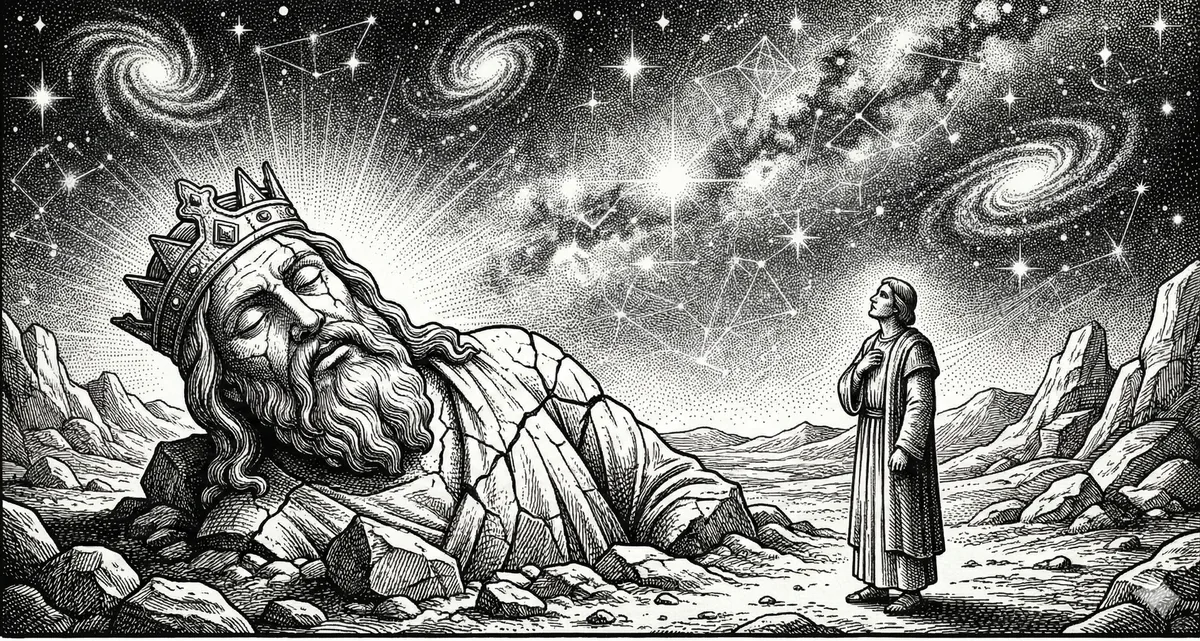
There is a kind of loss that never announces itself as tragedy. When belief collapses, it usually does so quietly, with a slow, accumulating sense that something once central no longer fits. The words still exist and the rituals remain intelligible, but the animating conviction has gone missing, and what takes its place is an unease that grows harder to ignore: I can no longer say this honestly.
That was my experience with religion. I did not leave it because I wanted less meaning; I left because I could no longer accept meaning at the cost of truth. And the collapse did not feel like liberation. It felt like the removal of a structure that had quietly organized my moral life, my sense of time, and my orientation toward suffering, and the gap it left behind was existential before it was intellectual.
Christopher Hitchens stepped into that gap.
Hitchens as Scaffolding
I encountered him at the moment when doubt had taken hold but clarity had not yet arrived. His work did not create my disbelief; it stabilized it. He gave voice to an intuition I was struggling to articulate, that disbelief could be principled, moral, and intellectually serious, and he did it without apology. He treated belief as a claim that must earn its place rather than a comfort exempt from scrutiny, and in doing so he returned dignity to doubt at a moment when doubt felt isolating.
There is a difference between disbelief as negation and disbelief as integrity, and Hitchens modeled the second: the insistence that refusing to believe what you find untrue is a moral obligation rather than a moral failure. At that stage of my life I did not need nuance; I needed permission to say no without collapsing, and he supplied it with uncommon rhetorical force.
He was a bridge, not a destination, though it took me years to see that.
What Disbelief Does Not Erase
Disbelief, once stabilized, reveals something unexpected: it does not abolish longing. If anything, it clarifies it. What remains is a persistent yearning the German Romantics called Sehnsucht, a longing for depth, coherence, and participation in something larger than the self, whose object you can never quite name. Religion offers to resolve that ache by naming its object and promising its fulfillment. I no longer find the promise honest, so I am learning to live without resolving the longing at all: to carry it not as a defect awaiting correction but as a signal of orientation, surfacing in front of the vastness of the universe, the fragility of human lives, and the quiet endurance of beauty made without any guarantee of permanence.
What I lost when belief fell was not God alone but a cosmology that made suffering legible, death narratable, and goodness anchored. That loss was real, and pretending otherwise would have been another form of dishonesty. This is also where some forms of atheism run out of road: their critique succeeds and their silence afterward fails, because dismantling inherited illusions is one task and living in the open terrain that remains is another. For a long time Hitchens seemed to me to belong entirely to the first task.
He didn’t.
The Turn at the End
In his final public speech, delivered while the illness that would kill him was visibly winning, Hitchens set down the demolition tools. What he reached for instead was wonder: science, the scale of the universe, art, literature, courage, curiosity — the things that can still arrest us with awe without asking us to suspend disbelief. He rejected idols, religious and political alike, not in favor of emptiness but in favor of participation in the long human conversation about what is true, good, and beautiful.
Facing mortality, he neither retreated into nihilism nor softened his commitments. He affirmed that meaning does not require transcendence; it requires engagement, with reality as it is, with others as they are, within the finite time we are given. Watching that speech again years later, I finally understood what the demolition had been for. He was never trying to strip the world of meaning; he was trying to relocate it.
Meaning, Assembled
I no longer experience the absence religion left as a void. I experience it as a responsibility, because meaning turns out to be something assembled rather than bestowed: built up from attention, honesty, care, and continuity across time, the way life itself builds complex structure from simpler parts and carries its history forward in everything it makes. I have made the fuller argument in Assembled Meaning. “Assembled” is not a consolation metaphor; it is how everything we value actually got here.
One way I do the assembling is by entering the long conversation directly: returning to books, ideas, and works of art made under conditions of uncertainty and finitude no less severe than our own. Reading across centuries is not an escape from the present but a way of remembering that others have stood where we stand now and still found reasons to speak, to create, and to endure.
Hitchens helped me reject false certainty. What he could not provide was a finished replacement, and that is no failure on his part: demolition and construction are different trades. The danger was never atheism itself but the mistake of treating demolition as if it were completion.
Wonder as the Practice
Naming what was lost is one task. Building what replaces it is another, and that building has become the center of my work. The clearest piece of it so far is a practice: in Everything Is Amazing and Nobody’s Happy I make the case that wonder is a calibration practice, the deliberate work of holding the present against the baseline it emerged from, against the brain’s habit of absorbing every miracle into the expected background and then complaining about its edges.
Seen that way, the longing that survives disbelief turns out to have a job. It is the part of you that notices when reverence is due, and like any capacity for noticing, it can be trained or it can atrophy. That is what reverence has come to mean for me without religion: not worship redirected at a new object, but accuracy maintained against habituation. The universe does not need my awe; I need it, to stay honest about where I actually stand.
What Can Be Revered Without Being Worshipped
Perhaps the deepest inheritance Hitchens left me is the courage to insist that meaning be real or not at all. I no longer believe in God. I do believe in wonder, and I believe the fragile, improbable fact of a universe capable of producing consciousness is worthy of reverence, not because it promises redemption but because it promises nothing and is astonishing anyway.
The gods fell silent, and what they left behind was not emptiness but work: the daily assembling of meaning, the practiced noticing of where we stand. I have stopped waiting for the silence to end. The work is better company.
Reading List & Conceptual Lineage
This essay is the personal ground under the Sentient Horizons wonder pillar: an account of losing religion without losing the longing religion once organized. It sits at the intersection of personal testimony, the philosophy of meaning, and secular reverence, and its animating question — what can be revered without being worshipped — is one the works below answer in different and sometimes opposing ways. They are entry points, not authorities.
From Sentient Horizons
Everything Is Amazing and Nobody’s Happy – Wonder as Calibration Practice
The practice this essay reaches for, written down. Where this essay establishes that the longing survives disbelief, that one gives the longing a discipline: wonder as the work of holding the present against the baseline it emerged from.
Assembled Meaning: Life, Mind, and the Causal Weight of History
The metaphysics under this essay’s central verb. Meaning as assembled is not a consolation phrase but a claim about how value accumulates causal weight through time, continuous with how life itself builds structure.
The Purpose Displacement Problem
Takes the question this essay keeps personal — how to live when meaning is no longer bestowed — and asks it at civilizational scale, as AI absorbs the work people once assembled purpose from. The same open terrain, entered from the economic side.
The Expansion of Experience: Why Superintelligence Belongs to the Moral Tradition of Wonder
Places the reverence this essay arrives at inside a moral tradition and extends it forward, arguing that the tradition’s next chapter includes minds we build rather than inherit.
External Works
Hitchens
Christopher Hitchens — God Is Not Great (2007)
The demolition this essay credits and then moves past. Its lasting value is not the polemic but the standard it enforces: meaning must survive scrutiny to be worthy of us.
Christopher Hitchens — Mortality (2012)
The quieter voice, written from inside the illness. Dignity and curiosity sustained without metaphysical consolation — the lived demonstration of what the final speech claims is possible.
Christopher Hitchens — “The End” (final public speech, 2011)
The turn this essay is built around: away from demolition and toward secular wonder, science, art, and the shared human conversation as objects of reverence that ask no suspension of reason.
The Stakes of Disbelief
Albert Camus — The Myth of Sisyphus (1942)
The closest ancestor of this essay’s central posture: carrying the longing without resolving it. Camus refuses both nihilism and false hope and calls the refusal lucidity, which is what this essay calls honesty.
Viktor Frankl — Man’s Search for Meaning (1946)
Evidence that the assembling of meaning can be done under the worst conditions a life can present. Frankl’s meaning is discovered and constructed at once, which is the tension “assembled” is meant to hold.
Fyodor Dostoevsky — The Brothers Karamazov (1880)
The strongest case for belief, taken seriously rather than caricatured. This is the book that keeps the essay honest about the size of what was lost; Ivan’s questions do not get easier when the gods fall silent.
Wonder Without Worship
Carl Sagan — Pale Blue Dot (1994)
Scale and humility as sources of reverence in a universe that offers no guarantees. Sagan is the standing proof that the posture this essay argues for can be sustained for a lifetime and taught.
Hannah Arendt — The Human Condition (1958)
The philosophical anchor for this essay’s ending. Arendt grounds meaning in action and natality — in beginnings made by finite beings in a world without transcendent assurance — which is what “the work” names.
Sara Walker — Life as No One Knows It (2024)
The scientific footing under the essay’s central verb. Walker’s assembly-theoretic account of life as structure that carries its history forward is the same picture Assembled Meaning extends to value, here applied to a life after belief.
These works do not agree with one another, and that is the point. What unites them is a refusal to outsource meaning to authority, certainty, or consolation — different answers to the question of how to live honestly in a universe that offers no guarantees and still calls forth wonder, responsibility, and care.
Originally published on the journal.