The Scale Arc · January 11, 2026
Assembled Meaning: Life, Mind, and the Causal Weight of History
Life and mind are usually treated as exceptions, protected from physics by mystery or myth. Complexity science offers another route: meaning is not bestowed but assembled, history carries causal weight, and understanding is earned through time rather than through an escape hatch.
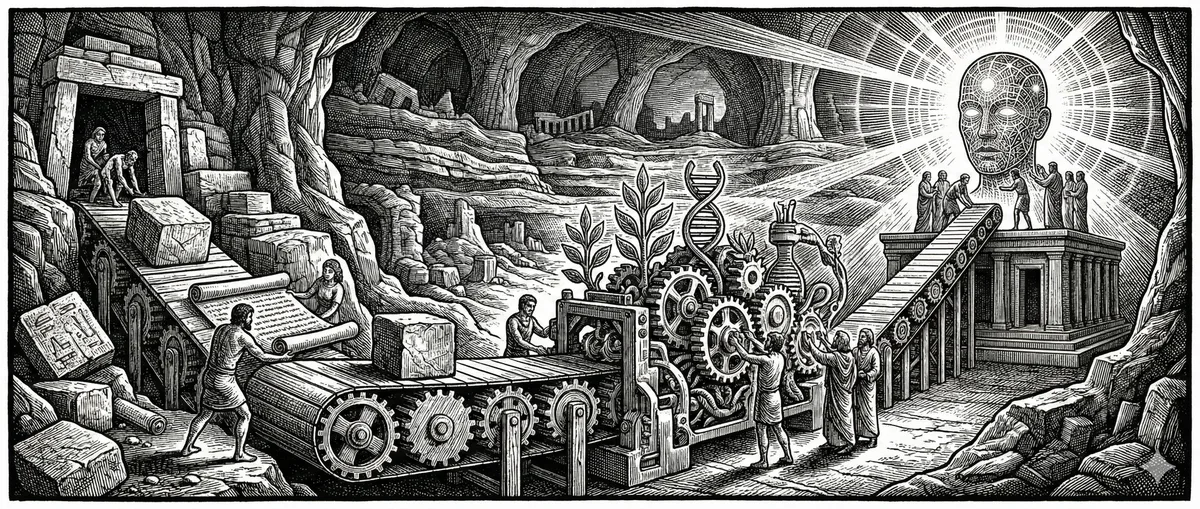
For most of human history, life and mind have occupied a protected conceptual space. We set them apart from the cold logic of physics and computation by appeal to something ineffable, vital, or sacred. The instinct is understandable, since we are living systems trying to understand the storm from inside the eye. But as our tools improve and we keep meeting life-like systems beyond biology, the protective framing is starting to fail, and it is worth asking what survives its failure.
Complexity science offers a way forward that does not reduce life to dead matter. It studies life as a special case of a much broader class: systems that accumulate history, process information, and generate novelty. The approach is spiritually agnostic, grounded in assembly and lived time, and it preserves the depth, meaning, and wonder we once attributed to the soul rather than dissolving them. That preservation is the whole interest of it, and the rest of this essay traces how the trick is done.
From Irreducibility to Decompression
One of the earliest insights in complexity science is that certain systems resist compact description. As David Krakauer notes, we have no elegant closed-form equations for genomes or societies of the kind classical physics enjoys, and this can look like a failure of knowledge. A deeper reading suggests the opposite: these systems are not poorly understood, they are historically dense.
Living systems compress their past. A genome is a multi-billion-year compression of selection, a brain is a compression of a lifetime of interaction, and a large language model is a compression of an enormous swath of recorded human expression. The difficulty is not the compression but the decompression. To understand such a system you cannot simply inspect its static parts; you have to unfold it over time, watching how it responds, adapts, and fails. Complex systems are not merely irreducible, they have to be experientially decompressed, and understanding is less a state you arrive at than a procedure you take part in.
Time as a Computational Resource
The intuition finds a sharp parallel in the work of Cristopher Moore, who frames complexity less as a property of a system than as the resources required to answer questions about it. Some questions yield to a shortcut. The most interesting ones do not: to know what a complex system will do in a novel situation requires simulation rather than deduction, interaction rather than inspection. Time itself is the computational resource, which aligns the scientific with the poetic. Lived experience is not incidental to understanding, it is the cost paid to obtain it.
Assembly Theory: The Causal Weight of History
Assembly theory, developed by Sara Walker and Lee Cronin, sharpens the picture. It reframes life not as a substance but as a process of accumulation, and what distinguishes a living thing is not its chemical makeup but its assembly index — a measure of how many ordered steps were required to build it, and so of how much history is embedded in its structure. The index puts life on a continuum rather than a pedestal. Below the biological threshold, prebiotic chemicals accumulate structure; above it, cities, ecosystems, and digital architectures show the same signatures of open-ended evolution. History is causal here, not decorative: the past constrains and enables the future in a way timeless physics has no room to express. I trace what that continuum implies for the things we build, minds included, in The Ladder We Inherit.
Consciousness as Assembled Time
View minds through this lens — as systems that encode deep histories and model their environments to exert causal control — and consciousness loses its need for magic. It becomes something earned through organization and duration rather than added as an ingredient.
The condition carrying the weight is temporal integration: the binding of past, present, and anticipated future into a single ongoing process, so that what just happened and what might happen next are both alive inside what is happening now. Your self, on this view, is the literal unpacking of billions of years of cosmic and personal history into the present moment. Two further conditions thicken that unpacking into a perspective. A maintained boundary between the system and its environment turns momentary integration into a durable point of view rather than a flicker, and stakes — the system’s own continued integrity riding on what it does — make some of its distinctions urgent rather than merely recorded. I develop this as a constitutive claim, experience as what sufficiently deep temporal integration is rather than something it produces, in Consciousness as Assembled Time, and I work out the boundary-and-stakes machinery in What Temporal Integration Needs. Grounding consciousness this way does not cheapen the experience of being alive; it is what gives the experience its weight.
These are not academic curiosities. In an age of intelligent machines they are becoming practically urgent.
A Different Kind of Reverence
We are entering an era of non-biological systems that learn, generalize, and surprise us, and they often lack the one thing that defines us: lived time with consequence. Intelligence without history is brittle, and knowledge without lived cost stays thin. If we want systems that genuinely align with human values, we have to take seriously that understanding is not an abstract calculation but an assembly, paid for in time.
To study life in a spiritually agnostic way is not to strip it of meaning but to relocate the meaning. Meaning is no longer a gift bestowed by the divine, it is a property assembled by the persistent, arising when a system stays open enough to become something new in the presence of the world it is given. This is the same relocation I trace on a personal scale in After the Gods Fell Silent: what disbelief takes away is a bestowing authority, not the meaning itself, which was being assembled all along. Complexity science offers a path not to abandon wonder but to earn it. By honoring time, history, and the slow process of becoming, we arrive at perhaps the most honest reverence available to us: respect for the sheer effort the universe exerts to produce a single moment of thought.
Reading List & Conceptual Lineage
This essay sits at the intersection of complexity science, philosophy of life, and the philosophy of mind, where those fields converge on a single object: complex, historical, information-processing systems. Its animating move — meaning as assembled rather than bestowed — is the hub the rest of the Sentient Horizons account of consciousness and value is wired into. The sources below are entry points, not authorities.
From Sentient Horizons
Consciousness as Assembled Time The deeper companion to this essay. Where this piece treats assembled meaning as a general principle, that one specifies it for consciousness: experience as what sufficiently deep temporal integration is , named from the inside.
What Temporal Integration Needs: Boundaries, Stakes, and the Architecture of Perspective The machinery behind this essay’s phrase “lived time with consequence.” Boundary and stakes are what turn the accumulation of history into a perspective that something is at risk in — the conditions this essay names but does not yet unpack.
The Ladder We Inherit: Assembly Theory and the Art of Building Capability Larger Than Minds Takes the assembly-index continuum this essay introduces and follows it upward into the systems we build, asking what it means to assemble capability that outruns any single mind.
After the Gods Fell Silent: Christopher Hitchens, Disbelief, and the Persistence of Wonder The personal-scale version of this essay’s central relocation. What disbelief removes is a bestowing authority, not meaning itself; the assembling was always the real source.
External Works
Assembly, Life, and Causal History
Sara Walker — Life as No One Knows It (2024) The book-length case that life is information accumulation and causal control rather than a privileged substance. The single most direct source for this essay’s reframe, and the most readable demonstration that a “mystical” question can be made measurable.
Sharma, Walker & Cronin — “Assembly Theory Explains and Quantifies Selection and Evolution” (Nature , 2023) The technical statement of the assembly index: history made into a measurable quantity. Read this for the actual definition the essay leans on when it calls history causal.
Complexity & the Cost of Understanding
David Krakauer — The Complex World (2024) The framing that opens this essay: historically dense systems resist compact description not because we understand them poorly but because their structure is their accumulated past. The source of the decompression intuition.
Cristopher Moore & Stephan Mertens — The Nature of Computation (2011) The rigorous backing for “time is the computational resource.” Moore’s distinction between questions that yield to a shortcut and questions that require simulation is what the essay borrows to argue that lived time is a cost, not an accident.
J. Doyne Farmer — Making Sense of Chaos (2024) Emergence and history-dependence at the scale of economies, where systems far from equilibrium can only be understood by unfolding them. The macro-scale demonstration of the same decompression principle.
An Entry Point
Santa Fe Institute — Introduction to Complexity (Complexity Explorer, free course) The most accessible doorway into the field this essay draws on, taught by Melanie Mitchell. Start here if the ideas above are new and you want the foundations before the philosophy.
These works do not settle what life and mind are; that is the point. Each is an attempt to understand complex systems by honoring the time embedded in them rather than searching for an escape hatch around it — which is exactly what this essay means by assembled.
Originally published on the journal.