Emergence & Complexity
How structure and capability assemble from simpler parts: assembly theory, systems thinking, and the complexity that gets mistaken for mind.
18 essays
- Operational Exteriority: What Minds Build Between Them
Sara Walker reads life and mind by the trace they leave in the world, not the experience inside them. Turned outward to joint human and AI cognition, the same move says what two minds build between them is readable in the artifact, and the reading can begin before we settle whether it is experienced.
- The Scaffolding of Awareness
A documentation audit that began with a manuscript's chapter count recorded three different ways becomes an argument about depth: the structure built across months of targeted work is part of attention, not a separate record of it, and it decays the same way attention does. On assembled time, drift and repair, and reading externalized notes as continuous with a mind.
- The Shape of a Hard Problem
Vitalism dissolved when biology stopped asking what life is and started asking what living things do. The hard problem of consciousness may be waiting for the same move.
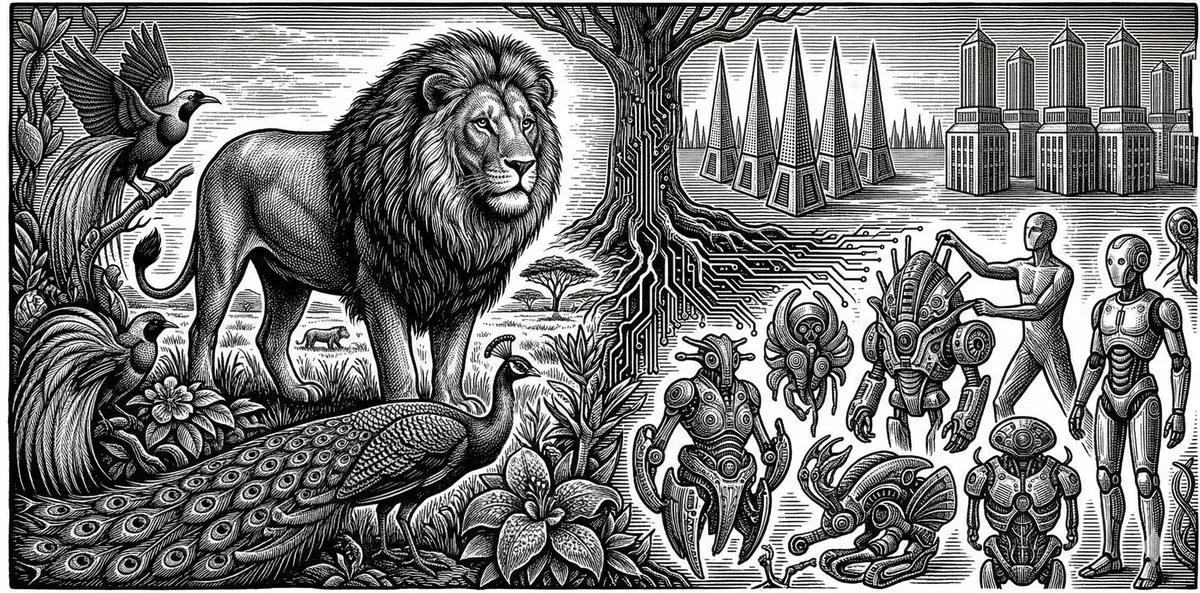
- The Mane and the Machine: What Evolution's Costliest Beauty Tells Us About the Future of Constraint
A male lion's mane is metabolically expensive, survival-irrelevant, and beautiful. Why would evolution invest so heavily in aesthetic excess? The answer reveals something fundamental about constraint, and raises an urgent question for post-biological minds and civilizations.
- Specification Is Governance
As AI drives the cost of execution toward zero, power shifts upstream into the rules that machines enforce. Those “checklists” look neutral, yet they encode values, tradeoffs, and hidden assumptions. At scale, specification becomes governance, and calibration becomes the bottleneck.
- Constraint as Intelligence: Why Power That Lasts Looks Like Self-Limitation
Intelligence does not reveal itself through unlimited reach, but through learned restraint. This essay explores why constraint is the price intelligence pays to exist—across minds, moral systems, and civilizations—and why what lasts learns where not to act.
- The Ethics of Successors: Lived Experience and the Convergence of Parfit
If the future self is a stranger, why do we choose to suffer today? Exploring the convergence of lived experience in high-stakes trials and Derek Parfit's reductionism. This essay explores how the "Hedonic Flip" turns friction into reward and why selfishness is a systems error in a momentary world.
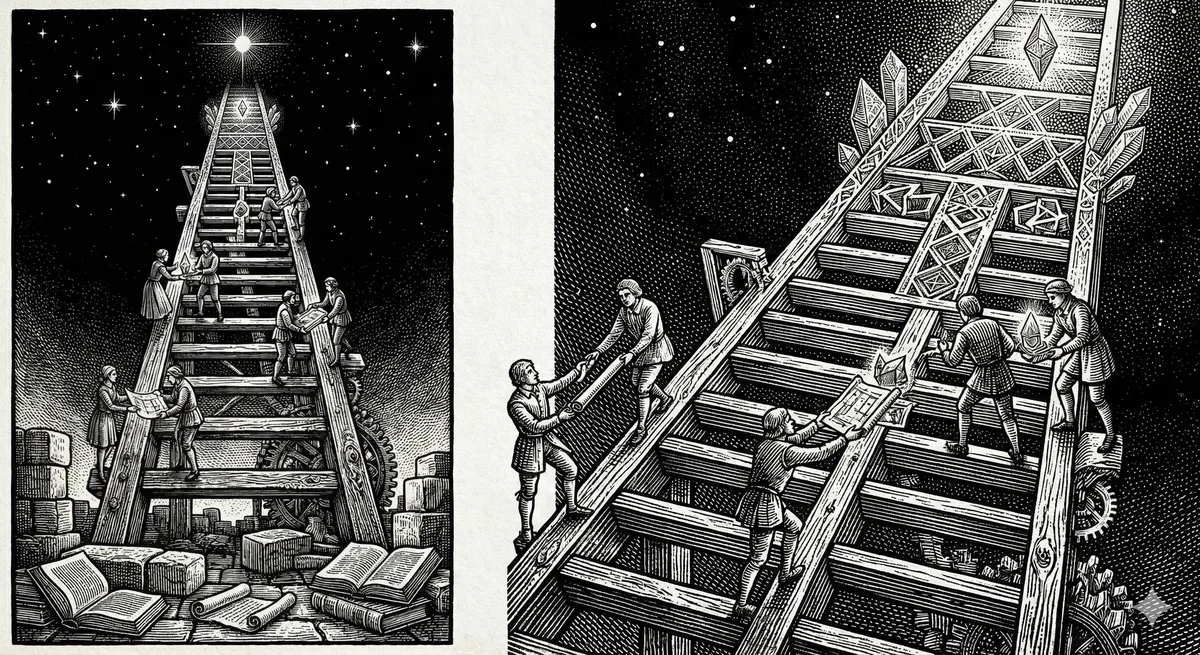
- The Ladder We Inherit: Assembly Theory and the Art of Building Capability Larger Than Minds
What if knowledge has an assembly index? Breakthroughs don’t appear out of nowhere—they sit atop ladders of prior work. Teams and human–AI partnerships can assemble similar depth, building capability larger than individual minds through shared primitives, artifacts, and purpose.
- Assembled Meaning: Life, Mind, and the Causal Weight of History
Life and mind are usually treated as exceptions, protected from physics by mystery or myth. Complexity science offers another route: meaning is not bestowed but assembled, history carries causal weight, and understanding is earned through time rather than through an escape hatch.
- The Lantern and the Flame: Why Fundamentality Is an Explanatory Dead-End
Panpsychism promises to solve the Hard Problem by declaring consciousness fundamental. But what does that actually explain? By treating experience as a phase transition of organized matter, structure regains its explanatory power, and mystery regains its discipline.
- Shared Minds, Shared Futures: Human–Machine Systems as Hybrid Cognitive Entities
The most consequential shift of the century isn't AI waking up, it’s the silent merger of human and machine. Exploring the Three Axes of Mind, this essay asks if we are becoming passengers of an optimized life, and how we might preserve "depth" as we move toward the stars.
- Depth Without Agency: Why Civilization Struggles to Act on What It Knows
Modern civilization is drowning in data but starving for agency. We possess the "Cognition" to model our future, yet lack the "Depth" to act on it. Using the Three Axes of Mind, I explore why our systems—and our AI—are architecturally biased toward a dangerous "temporal poverty."
- Free Will as Assembled Time
Free will isn't an escape from causality, it's a biological achievement. By mapping the "interior workspace" where memory and future-modeling delay our impulses, we find that agency isn't a mysterious spark, but an emergent property of systems deeply assembled in time.
- The Universe as a Cognitive Filter
Intelligence may be rare not because it is hard to create, but because it is hard to preserve. This essay reframes the universe as a cognitive filter—one that permits intelligence to arise, but places extreme pressure on its ability to persist.
- Scaling Our Theory of Mind: From Individual Consciousness to Civilizational Intelligence
If individual minds emerge from availability, integration, and depth, what happens when those same conditions appear at the scale of civilization? I argue that political decay may be better understood not as moral failure, but as a cognitive pathology of systems that begin to lose their memory.
- Consciousness as Assembled Time
We experience consciousness as continuity, but continuity is an illusion reconstructed moment by moment. Using Assembly Theory, this essay reframes the self as assembled time: a present structure shaped by deep causal history.
- The Kasparov Fallacy: Why We Keep Underestimating Machine Minds
Garry Kasparov once believed no machine could surpass human creativity in chess. He was wrong. Today, we risk repeating the same mistake with consciousness—confusing the limits of human introspection with the limits of possible minds.
- Consciousness Is Like Flight
Consciousness may be a way of operating rather than a hidden ingredient. One analogy shows why, and which questions it frees us to ask.