The Scale Arc · January 24, 2026
Constraint as Intelligence: Why Power That Lasts Looks Like Self-Limitation
Intelligence shows itself less in how far a system can reach than in what it has learned not to do. Constraint is the price intelligence pays to exist, in minds, in moral systems and in civilizations, and what lasts is what has learned where not to act.
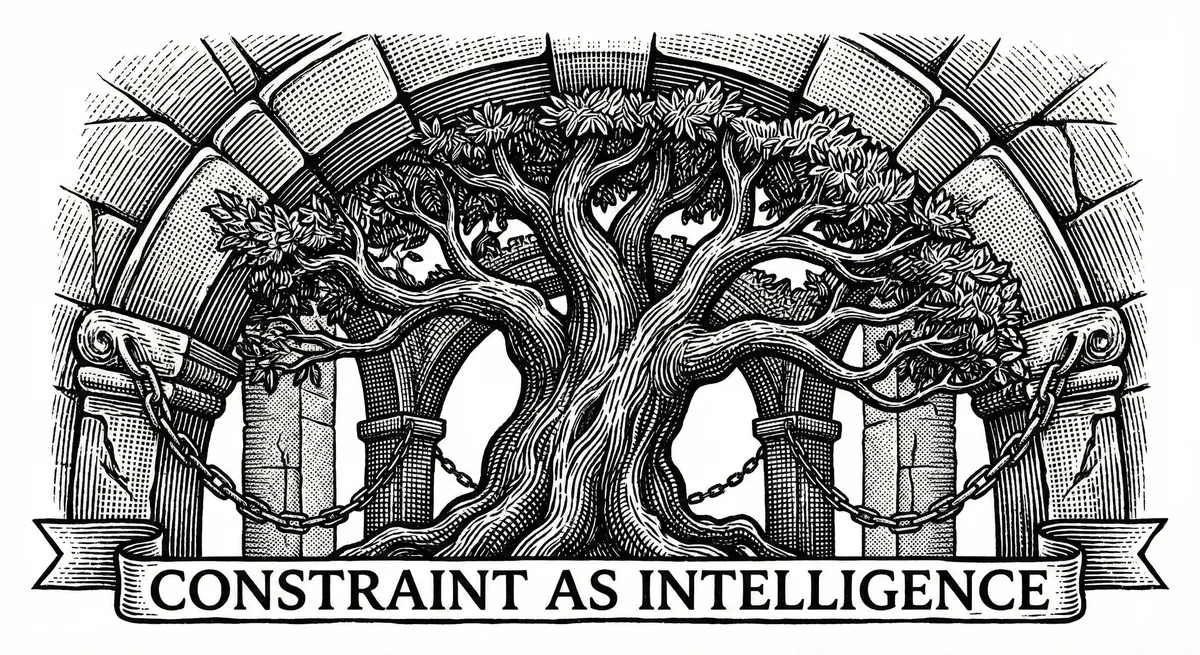
Most talk about intelligence today treats it as reach. The more kinds of task a system can act on, the more capable we call it. I think that gets it backwards. Real power is the accumulation of limits. Intelligence is the measure of what a system has learned to avoid. A system lasts because it has learned where not to act, and it takes on a lasting shape because it has ruled some possibilities out for good. So power that sets no limits on itself is a sign of fragility, and anything that endures has had to find out where its boundaries are.
The Mistake: Intelligence as Maximum Reach
If intelligence is the ability to get the best result across many kinds of task, then the obvious goal is to expand: more information, more capability, more freedom to act. Constraint then looks like an obstacle, something to get around, shrink or remove.
That way of thinking works well over short spans of time. It rewards speed, it produces impressive demonstrations, and it often wins competitions. What it does not do is hold up over long spans of time.
The same failure shows up in many kinds of system. Power grows faster than the structures that would let anyone understand it, hold it to account or undo it. The result is a fragile system, one that works until it meets a limit it did not recognise as real.
I don’t think that failure is mainly a moral one. It comes from a mistake about what intelligence is, because intelligence is the measure of what a system has learned to avoid.
Assembly Requires Constraint
Anything that lasts has to be put together over time. For a system to hold together, it has to narrow an enormous range of possibilities down to one path it can survive on. Every stable structure exists because countless alternatives were ruled out for good.
Memory is the clearest example. To remember is to commit: a past state is written into present behaviour, and it cannot be taken back. Once a system remembers something, it cannot unremember it without losing something. It gives up some flexibility, and in exchange it gains depth, meaning a history that shapes what it does now.
Intelligence works the same way. It is a costly path through noise, because every piece of understanding is bought by leaving out countless others. So each new ability closes off some futures even as it opens others.
That is why I think intelligence needs something at stake, and meaning needs choices that cannot be undone. Constraint is the price intelligence pays to exist.
The Uncanny Nature of the Unconstrained
Some artificial systems feel unsettling, because they act without the marks that constraint leaves. They perform without any visible cost, they adapt without seeming vulnerable, and they speak without the shaping force of consequence. The unease is a half-noticed recognition that intelligence without accumulated limits lacks depth. Such a system has no scars and no inertia, and it shows no trace of having learned what failure feels like.
A system that can do anything, at any time, with no cost and no memory, has never been forced to choose, because choice exists only where some paths are no longer open. It has not been narrowed by failure or shaped by loss, and that missing history of consequence is what unsettles us.
Moral Reality as a Constraint System
Moral facts assert themselves through consequence. When we reason about right and wrong, we are uncovering patterns that show which ways of living together a society can survive. Some actions wear away trust. Some uses of power cause suffering faster than the suffering can be repaired. Gains of that kind destroy the very conditions that made them worth having.
Moral realism is the recognition that certain constraints cannot be negotiated away without loss. We learn morally when power runs into limits it cannot override, and speed makes that learning harder. The faster a system acts, the less time it has to notice what its actions are doing. So panic follows when action outruns calibration, meaning the work of checking one’s judgment against what actually happens.
Panic is the sign of a system that has moved beyond its ability to feel what it is doing. Ethics is the form intelligence takes when it is forced to account for its own persistence.
Civilizational Intelligence and the Logic of Silence
At the largest scale, the same pattern appears, and it bears on the Fermi paradox. That is the puzzle named after the physicist Enrico Fermi: the galaxy is old enough and large enough that other civilizations should be everywhere, and yet we see no sign of any.
A civilization that expands without restraint is easy to see. It uses vast amounts of energy, sends out signals and leaves marks that cannot be erased. It also exposes itself to risks it may not yet understand, from its own technology, from damage to its environment, from rivals, and from threats to its very survival.
A civilization that lasts learns something different. It learns where acting makes danger worse, where being seen invites instability, and where holding back keeps its options open.
Seen this way, silence is an adaptive response to accumulated constraint. It is intelligence expressed as caution instead of conquest. The idea that explains why minds hold back most of their impulses, and why moral systems develop limits on power, also explains why advanced civilizations may learn to whisper, or to say nothing at all. Constraint works the same way at every scale.
Expansion without restraint is unstable for a civilization, because the energy it spends and the signals it leaks expose it to risks it cannot yet understand. Civilizations that last stay clear to themselves while becoming harder for the rest of the universe to see. Their silence is subtlety learned under pressure. The Great Filter is the economist Robin Hanson’s name for some step, between lifeless matter and a civilization spreading through space, that almost nothing gets past. The Great Filter is a threshold: a transition from intelligence expressed as reach to intelligence expressed as restraint.
Our own era has the most visibility and the least self-limitation. Broadcasting to the whole sky is a stage of development. Persistence leaves a quieter mark, made by slow commitment. Systems that endure learn which signals to hold back and which actions to avoid. Intelligence that lasts survives by learning when to whisper.
Revised October 25th, 2026. I revised this essay to make it clearer and easier to follow; the argument is unchanged. I joined two sections that covered the same ground on cosmic silence into one, and I changed “moral panic”, which names a public overreaction to a supposed threat, to “panic”, which is what I meant. I also corrected the reading list, which credited The Embodied Mind to Francisco Varela alone, although he wrote it with Evan Thompson and Eleanor Rosch, and listed the Fermi paradox as if it were a work by Enrico Fermi. Three links in the reading list had opened search results; they now open pages about the works or their authors.
Reading List & Conceptual Lineage
The works below inform the central claim of this essay: that intelligence lasts only where constraint has been built up, taken in and carried forward through time.
Assembly, Constraint, and the Nature of Intelligence
- The Embodied Mind – Francisco Varela, Evan Thompson and Eleanor Rosch (1991)
Treats thinking as something a body does over time, which shows how intelligence arises by selecting and limiting, instead of as computation cut off from a body. - More Is Different – Philip Anderson (1972)
Shows why systems built up from parts have higher-level rules that cannot be read off the parts, which is the ground for this essay’s doubt that intelligence can arrive instantly or be reduced to its pieces. - The Free Energy Principle – Karl Friston
Describes intelligence as managing uncertainty within limits, a formal backbone for the idea that intelligence is shaped by selections that cannot be undone.
Moral Constraint Across Time
- Reasons and Persons – Derek Parfit
Explores identity, responsibility and cost across time, which supports the idea that moral reality comes out of accumulated consequence and not out of a moment’s preference. - The Imperative of Responsibility – Hans Jonas
Sets out an ethics of restraint for an age of long-range technological power, tying morality to what lets a world persist instead of to optimization.
Civilizational Intelligence and Silence
- The Fermi paradox – named after Enrico Fermi’s question “Where is everybody?”
The cosmic absence that this essay reads as a question of restraint instead of failure. - The Great Filter – Robin Hanson
The best-known account of cosmic silence as a bottleneck that civilizations fail to get through, which this essay sets against its reading of the filter as a threshold of restraint. - Impossibility: The Limits of Science and the Science of Limits – John D. Barrow (1998)
Proposes inward mastery over outward expansion as a path for advanced civilizations, which supports the idea that intelligence that lasts tends toward subtlety over reach. The link is to a page about Barrow, which lists the book.
Further Connections in the Fermi Conversation
This post is part of an ongoing inquiry into one of the deepest questions we can ask about intelligence, time and existence: Where is everyone, really? The essays below come at that question from different sides, and each adds a piece to a larger account of silence, survival and agency over very long spans of time.
- Mapping the Fermi Paradox: Eight Foundational Modes of Galactic Silence
Sorts the ways intelligence could be rare, hidden or absent in the cosmos, and treats silence as something physical, informational and systemic limits would lead us to expect. - The Quiet Galaxy Hypothesis: Advanced Intelligence, Informational Resilience, and the Ethics of Cosmic Silence
Argues that advanced intelligences may tend to keep a low profile, as a response to fragility, uncertainty and the risk of actions that cannot be undone. - The Successor Horizon: Why Deep Time Turns Expansion Into an Alignment Problem
Argues that once an agent’s reach outlasts anyone’s ability to correct it, the question of what values its successors inherit becomes the central problem of keeping it on course.
Why This Lineage Matters for This Essay
Constraint runs under every argument in this essay. Taken together, these works help explain why:
- intelligence has to be shaped by limits to gain depth;
- moral systems form where consequences build up and cannot be undone;
- civilizations that last learn restraint before they broadcast their power;
- careful thinking and long-term survival depend on the same kind of limits.
Read together, they show constraint as the way intelligence gains coherence, memory and the ability to last, and not only as an obstacle to be kept small.
Originally published on the journal.
Sentient Horizons is an essay series on what a mind is, whether a machine could have one, and how to act toward minds we cannot see inside. Start Here is one route through it; Essays lists everything, newest first.
Three Ways In
- Consciousness Is Like Flight If you want to know what a mind is
- We Built the Alien First If you want to know whether a machine could have a mind
- The Purpose Displacement Problem If you want to know what AI means for your own life