The Scale Arc · June 02, 2025
Where Is Everyone, Really?
The Fermi Paradox assumes we would recognize a civilization if we saw one. The founding question of this project is not why the galaxy is silent, but whether we have been listening for the wrong kind of presence, and what kind of presence we are choosing to become.
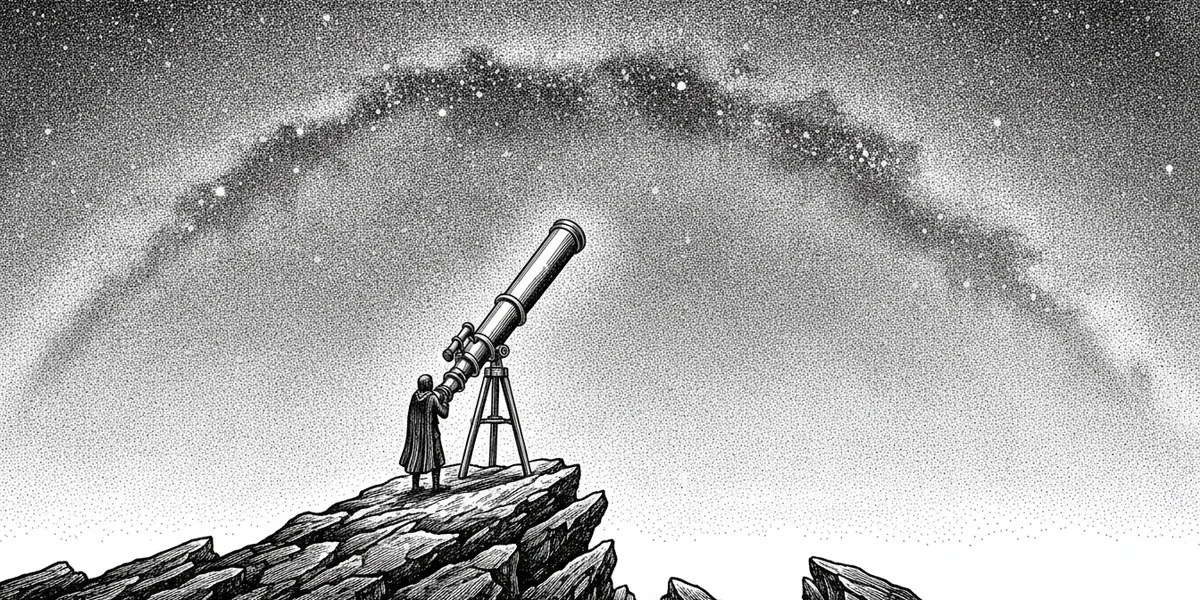
The Milky Way holds a few hundred billion stars. A large fraction are older than the Sun, many of them by billions of years, and we now know that planets are common, rocky worlds in the temperate band where liquid water can persist number in the billions. Grant even a vanishingly small chance that any one of those worlds eventually produces a technological species, then multiply that chance across that many worlds and that much time, and intelligent life stops looking like a miracle. It starts looking like something that should have arisen many times over, much of it with a head start on us measured in billions of years. And yet we look up and find nothing: no signals, no structures, no unambiguous trace of anyone else. Enrico Fermi compressed the discomfort into four words: where is everybody?
The standard answers split into two camps. One says intelligence is rare, or fragile, or self-destructive, so we are early, alone, or simply lucky to be here. The other says intelligence is common but unreachable: too far, too brief, too strange, or too careful to be seen. Both camps argue about probabilities. Neither examines the assumption underneath the question.
The assumption is that we would know a civilization if we saw one: that an advanced intelligence would be loud, broadcasting across the radio spectrum, dimming its star with vast structures, spreading visibly across the sky. That assumption is the founding question of Sentient Horizons, and it is the one I want to put pressure on. Not where is everyone, but: have we been listening for the wrong kind of presence?
The Filter in the Lens
The most famous answer is the Great Filter: somewhere on the path from chemistry to a galaxy-spanning civilization lies a step so improbable that almost nothing crosses it. Maybe the filter is behind us, at the origin of life or the leap to complex cells. Maybe it waits ahead, at a stage technological species rarely survive. It is a real and sobering idea.
But not every filter sits in the world. Some sit in the observer. Our search is shaped by what we already expect to find, and our expectations were set by a single example caught at a single moment: a young industrial species that happened to leak radio for about a century. We look for our own adolescence written large: radio leakage, Dyson spheres, exhaust plumes, waste heat. These are the signatures of expansion, of a civilization spending energy as fast as it can acquire it.
There is no law that says intelligence must stay that way. A species that survives its own adolescence may have every reason to grow quieter rather than louder: to do more computation per unit of energy, to stop pouring its existence into a high-emission broadcast it has no reason to sustain. If that is the trajectory, the loud phase is a brief flicker, and a galaxy full of mature intelligence would look, to instruments tuned for adolescence, much like an empty one.
This does not require hidden dimensions or states of awareness we have yet to unlock. It requires only that silence underdetermines its own cause. The same null result is consistent with absence, with distance, with extinction, with restraint, and with a presence whose signature we are not built to register. Silence is data, but it is data about many things at once, and on its own it does not tell us which.
From Detection to Disposition
Grant all of that, and the most useful move is to stop treating the paradox as a question only about them. We are, right now, a young technological species deciding what to set in motion: what we build, what we send outward, what successors we create that will go on acting long after we can correct them. Whatever the galaxy’s other occupants did or didn’t do, we are about to face the choices they faced.
So the question turns. Where is everyone? is a question about detection. The harder one is about disposition: what kind of presence is worth becoming, and worth being found by? A civilization that asks that early might well choose the quiet path, not from fear or weakness, but because it has understood what power demands at the scale of deep time.
The silence, read this way, is neither a verdict nor a void. It is the open question we have been handed before we are ready to answer it. What we do next is the first line of our own reply.
Reading List & Conceptual Lineage
This is the founding question of Sentient Horizons, and most of the project’s cosmic work is an attempt to answer it with more rigor than the question’s first asking allowed. The pieces below develop the modes of silence, the case for quiet maturity, and the stewardship the question turns on.
From Sentient Horizons
Mapping the Fermi Paradox: Eight Foundational Modes of Galactic Silence
The structural answer to “what kind of silence?” — eight ways a finite galaxy can stay quiet, with the point that silence alone adjudicates none of them.
The Quiet Galaxy Hypothesis
The argument that visibility is a transient developmental phase rather than a property of intelligence: mature systems trend toward low signature, not loud expansion.
Constraint as Intelligence
Why durable power tends to look like self-limitation: the disposition behind a quiet maturity.
The Successor Horizon
What changes once our actions outlive our ability to correct them, and why the detection question becomes a stewardship question.
External Sources
Enrico Fermi / Michael Hart — the paradox and its first formal statement (1975). The question, and the argument that silence implies rarity, the framing this essay declines to accept as the only one.
Nikolai Kardashev / John D. Barrow — the outward-energy scale and its inward-precision counterpart. Two pictures of advancement that predict opposite observational signatures.
Milan M. Ćirković — The Great Silence: Science and Philosophy of Fermi’s Paradox (2018). The rigorous survey of temporal, observational, and catastrophic accounts that this cluster builds on.
The silence is not the end of the inquiry. It is the condition under which the inquiry begins.
Originally published on the journal.