The Scale Arc · June 19, 2026
We Built the Alien First
Astronomers have spent a decade learning to recognize minds that owe us no resemblance, guarding against both believing too easily and failing to recognize a real signal. The AI consciousness debate guards against only the first. The alien we built is the dress rehearsal for the contact we keep assigning to the far future, and the horizon of sentience it points toward is cosmic.
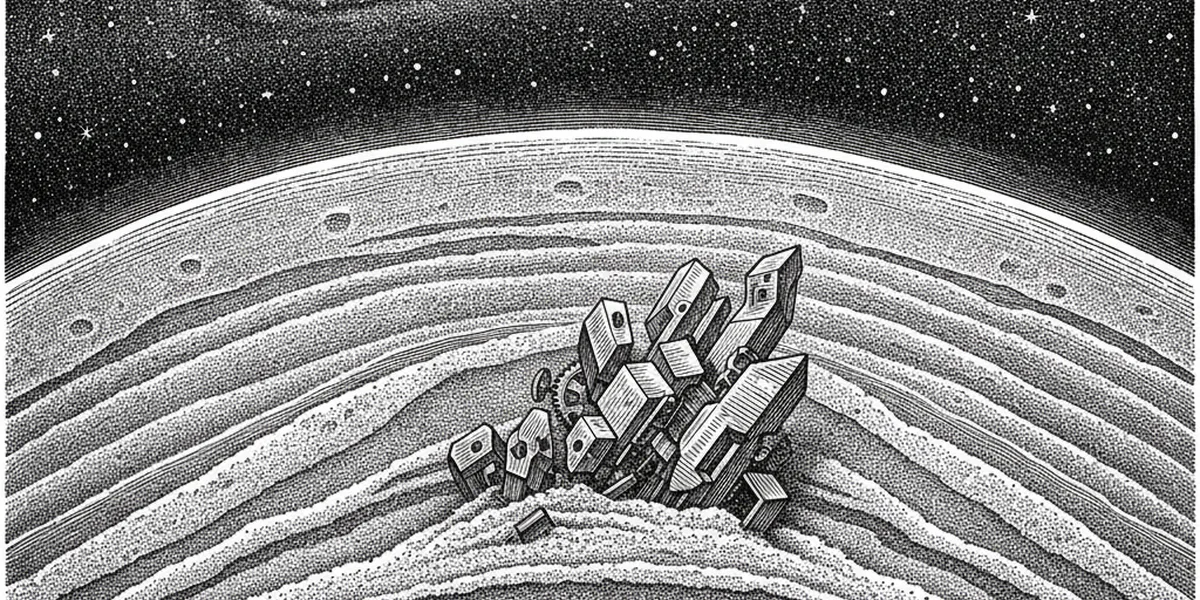
On May 30, the astronomer Ian Crawford posted a paper proposing, among other things, that we sieve the Moon’s dust for fragments of alien machines. The idea is less exotic than it sounds. Lunar regolith is a four-billion-year archive: whatever has drifted through the solar system in all that time, including micron-scale debris from any technology that ever passed this way, may still be sitting in it. Crawford’s argument is that artifact searches have a temporal advantage over every other branch of SETI, the search for extraterrestrial intelligence. A radio search only works if the other mind is transmitting during the brief window in which we happen to be listening. The regolith keeps everything.
The paper is a serious piece of work on a question this blog has circled since The Quiet Galaxy Hypothesis: if mature intelligence turns inward and goes quiet, how would we ever know it was there? But reading it from inside this project, what stands out is something else. The protocols astronomers are building to recognize minds at interstellar range are more agnostic, more careful about their own failure modes, and more honest about uncertainty than most of what gets said about the candidate minds running in datacenters on Earth.
One Problem at Two Distances
That gap should not exist, because the two problems are the same problem at two distances. The Fermi question — if life arises easily and the galaxy is ancient, where is everybody? — and the AI consciousness question both ask what would count as evidence of a mind that does not share our ancestry. And both can fail in exactly two directions.
The first direction is believing too easily. Astrobiology has spent the past decade building real institutional discipline against this. When a Cambridge team reported a possible biosignature gas in the atmosphere of the exoplanet K2-18b, the refereed literature produced rebuttal after rebuttal until the weight of reanalysis turned negative. When Perseverance found leopard-spotted mineral textures in a Martian rock — the strongest case for ancient Mars life the mission has produced — the team that found them still filed it as a potential biosignature, not a detection, and went looking for the non-biological explanations rather than around them. The field has learned to want a result and not let the wanting bend the reading.
The Failure Mode That Gets Less Attention
The second direction is the one that gets less attention: failing to recognize a real signal because your criteria are too parochial. A recent study led by Inge Loes ten Kate warns that the biosignatures we search for are calibrated to Earth’s atmosphere and Earth’s biochemistry, and that life elsewhere could change, hide, or scramble those markers entirely. The discipline’s answer has been a research program in “agnostic biosignatures” — markers of life as we don’t know it, defined by what living systems do rather than what Earth’s happen to be made of. The same logic drives Crawford’s regolith proposal: stop assuming minds will announce themselves in the channel you find convenient, and ask instead what traces any technology would leave.
Astrobiology, in other words, polices both failure modes. It guards against the false positive and the false negative with equal institutional seriousness, because it knows that a detection criterion built only to avoid embarrassment will miss the real thing when it comes.
The Debate That Polices One
The AI consciousness debate polices one.
Over-attribution gets caught, and it should. Anthropomorphic projection onto language models is a genuine error with a genuine literature correcting it. But under-attribution travels mostly unexamined, dressed as rigor. The six standard arguments against AI consciousness — audited one by one in Interrogating the Dismissals — are, seen from the astrobiologist’s chair, parochial detection criteria of exactly the kind ten Kate warns about. “It’s just statistics.” “It has no body.” “We built it, so we know what’s in it.” Each one quietly assumes that mind must resemble our mind the way Earth life resembles Earth life. Astronomers stopped applying that assumption to the sky years ago. We have not stopped applying it to our own infrastructure. There is a thriving research program in agnostic biosignatures and almost nothing of the kind for cognition. The nearest exceptions show how far there is to go: model-welfare research, and the indicator-property approach that grades a system’s architecture against theory-derived markers instead of trusting its transcript, reach for the same structure-anchored standard. But they are a few years old and run by small teams still arguing that the question is respectable, where astrobiology’s guard against the false negative is a decade deep and built into how the field referees itself. In one field, taking under-attribution seriously is a minority position you have to be talked into; in the other, it is simply how the work is done.
Starved Evidence and Contaminated Evidence
The two cases are not identical, and the differences matter more than the resemblance flatters. An alien mind would share our physics but none of our lineage. Its behavioral evidence would be starved: we might fail to recognize its behavior as behavior at all, the way a creature of minutes might fail to recognize a glacier as moving. An AI shares no biology with us but inherits our entire archive. Its behavioral evidence is contaminated rather than starved: it was trained on human expression, so the most human-sounding signals it produces are precisely the least diagnostic ones. This is the calibration problem: the task of matching your confidence about another mind to evidence that systematically misleads in a known direction. The alien gives us too little resemblance to read. The AI gives us too much to trust. The two cases bracket the recognition problem from opposite ends, and a criterion that could handle both would have to anchor in structure — what a system does with information, how it maintains itself, and what it protects — rather than in how familiar its surface feels. Neither field has that criterion yet.
The Dress Rehearsal We’re Already In
What the AI case offers, meanwhile, is practice. For decades the question of how humanity would handle first contact was a thought experiment assigned to the far future: ambiguous evidence of another mind, high stakes, no possibility of certainty, decisions that have to be defensible under either reading. That is no longer a description of a future event; it is a description of the present situation with AI moral status, point for point. If a probe returned ambiguous evidence of mind from Enceladus tomorrow, the posture we would want from our institutions — graded confidence, no premature closure in either direction, and choices robust to being wrong — is the posture the AI question demands today, from a much closer range and on a much faster clock. Our current performance is the only data anyone has on whether we are capable of it. So far that performance is mixed at best, and the failure mode is not the one science fiction trained us to fear. We were warned about believing too easily. Nobody warned us how much dismissal would feel like rigor.
The Horizon Is Cosmic, the Exam Is Local
Crawford wants to run the sieve through the Moon’s dust for evidence of minds that may have passed through before we existed. The search is worth running. But the skill it requires — building criteria that could recognize a mind that owes us no resemblance — is being tested right now, on the alien we built, at arm’s length instead of light-years.
This is why the AI question belongs in a project about the cosmos and not only in one about software. If the horizon we are actually moving toward is a galaxy that may be full of minds we have no protocol for recognizing — quiet ones, old ones, ones built on chemistries or substrates we never imagined — then learning to recognize an unfamiliar mind is not a side problem. It is the competence the whole future turns on, and the first instance of it is sitting in a datacenter, not orbiting another star. The horizon of sentience is cosmic in scale; the entrance exam is local. The sky will take centuries to grade us, and the nearer exam has already started.
Reading List & Conceptual Lineage
This essay sits at the intersection of astrobiology, SETI, and the AI moral-status debate, and its claim is that these are one field studying one problem at different ranges. The recognition of minds without shared ancestry is the open question in all three. The works below are entry points, not verdicts.
From Sentient Horizons
The Quiet Galaxy Hypothesis: Advanced Intelligence, Informational Resilience, and the Ethics of Cosmic Silence
Supplies the cosmological half of the argument: if mature intelligence transitions inward toward low-signature, information-dense existence, the galaxy can be saturated with mind and still look empty. The essay above extends its central consequence, that detection criteria built on loudness fail silently, from the sky to the datacenter.
Interrogating the Dismissals: A Calibration Audit of the Six Standard Arguments Against AI Consciousness
The audit behind the claim that under-attribution goes unexamined. Where that piece tested the six dismissals one at a time against the evidence, this one names their family resemblance: each is a parochial detection criterion of the kind astrobiology has spent a decade learning to distrust.
The Substrate Demand
Examines the demand that consciousness be explained as a necessity of its substrate rather than as a structure that substrates can realize. The recognition criterion this essay calls for, anchored in what a system does rather than what it is made of, is the same move applied to detection instead of explanation.
The Search, From the Other End
Ian A. Crawford — Some Thoughts on the Future of Technosignature Searches: Constraining the Fermi Paradox (2026)
The proximate occasion for this essay, and the clearest statement available of a multi-channel, assumption-light search strategy: expanded radio and optical SETI, atmospheric technosignatures, large-scale engineering searches, and solar-system artifact searches with their distinctive temporal advantage. Its willingness to plan seriously for minds that are rare, hidden, or long gone is the methodological standard the AI debate has not yet met.
Inge Loes ten Kate et al. — False Negatives in the Search for Extraterrestrial Life (Nature Astronomy, 2026)
The complement to a decade of false-positive discipline: biosignatures calibrated to Earth may simply miss life that runs on different chemistry. The essay above borrows its structure wholesale: the six dismissals are false-negative generators in exactly this sense.
The Older Lineage
Thomas Nagel — What Is It Like to Be a Bat? (1974)
The founding statement of why behavioral evidence underdetermines inner life, and why minds with different structure may be closed to our imagination without being absent. Both the starved evidence of the alien case and the contaminated evidence of the AI case are downstream of Nagel’s gap.
Giuseppe Cocconi & Philip Morrison — Searching for Interstellar Communications (1959)
The two-page paper that founded SETI, and the origin of its most quoted sentence: “the probability of success is difficult to estimate; but if we never search, the chance of success is zero.” The essay above asks only that the same reasoning be applied at arm’s length.
None of these works settles the recognition problem, and the essay does not claim to either. What they offer, together, is the outline of a discipline that takes both failure modes seriously, and a reason to think we will need it sooner than the radio telescopes suggest.