The Scale Arc · June 07, 2026
The Substrate Demand
Anil Seth refuses the demand for a special explanation of consciousness at the level of structure, then lets it back in at the level of substrate. On fading qualia, the biology bet, and why the case against silicon consciousness has the same shape as the case against mechanical flight.
What Counts as Explaining Consciousness, the companion essay to this one, argued that the consciousness debate is stuck because participants disagree about what kind of explanation consciousness requires, and that the productive move is to refuse the modal demand — the request that consciousness, alone among the phenomena of nature, be explained in terms of why it must accompany its structure rather than how that structure works — and treat consciousness as a structural phenomenon that yields to the same kind of investigation we apply to everything else in nature. The argument had a reading list of empirical workers who have already adopted this posture and are producing results. Anil Seth was the first name on that list, and his research program on consciousness as controlled hallucination is one of the cleanest examples of the structural posture in contemporary neuroscience.
Seth also believes that consciousness in artificial intelligence is unlikely, and the reasons he gives for this belief are worth examining carefully. The position is neither an obvious mistake nor the modal demand wearing a thin disguise. It reveals something that essay did not address: that the demand for a non-structural explanation can retreat from the level of structure to the level of substrate, and the retreat is so smooth that it usually goes unnoticed, even by the researcher making it.
Seth’s position on AI consciousness is the most prominent contemporary instance of this retreat.
The Charitable Reading
Begin with what Seth is actually arguing, because the argument is substantive and deserves to be engaged on its own terms.
His position is not that consciousness is metaphysically beyond structural explanation. He has spent his career arguing the opposite. His position is that consciousness is structural, but the structures that matter are biological in ways that resist the standard computational abstraction. The argument runs through several connected claims. Brains cannot be cleanly separated from what they do. Metabolism is entangled with neural function in ways that are not incidental. The fading qualia thought experiment, in which silicon neurons gradually replace biological ones, suggests that experience might fade even as behavior is preserved. The standard functionalist abstraction that treats neurons as substrate-neutral computational units may be missing what neurons actually are.
This is not a category error; it is a substantive empirical bet about how consciousness is implemented, and the bet has serious defenders for serious reasons. The reasons deserve to be taken on their own terms.
What the bet amounts to is a claim that the structural specification of consciousness, when fully filled in, will turn out to require properties that biological substrate has and silicon substrate does not. Seth has not specified which properties these are, but he gestures at the entanglement of cognition with metabolism, the way biological neurons exist as living cells rather than as discrete computational units, and the difficulty of separating the function from the matter doing the functioning. The position is that biology is not just one substrate among many that could implement consciousness. Biology is the only substrate that has been shown to implement it, and the field’s confidence that other substrates could do the same is not yet earned.
There is a version of this position that is just calibrated empirical caution. We have evidence that biology hosts consciousness. We have no evidence that silicon does. The reasonable epistemic stance, on this version, is to wait for evidence rather than to bet ahead of it. If Seth’s position were just this, the present essay would have nothing to add.
But the position is stronger than calibrated caution, and the stronger version is what this essay engages.
What the Substrate Claim Is Actually Doing
If consciousness is what certain predictive self-modeling architectures do, then the question of whether artificial systems can host consciousness should turn on whether artificial systems can implement those architectures. Seth’s framework gives the structural specification. The remaining question is whether the specification can be instantiated in silicon.
There are two ways the answer to this question could be no, and they have very different structures.
The first way is that silicon turns out to be incapable of implementing the relevant architectures. This would be an empirical claim about computation. It would say that some feature of biological neural function is essential to the structural specification of consciousness and cannot be reproduced in digital substrate. The claim would need to identify the feature, show that it is doing structural work rather than merely being how biology happens to implement the function, and demonstrate that no silicon implementation can capture what the feature does. This is a hard empirical project, and to my knowledge no one has succeeded at it. Seth has not, and he does not claim to have. He gestures at metabolism and at the entanglement of brain function with biological process, but the gestures identify how biology has implemented consciousness, not why the implementation is necessary.
The second way is that silicon can implement the architectures, but the implementation will fail to produce the phenomenon for reasons that are not themselves structural. This is the modal demand applied at the substrate level. It asks the reader to imagine a system with all the right structures, but the wrong substrate, and to find that imagination more compelling than the structural account would license. It treats the felt asymmetry between biological implementation and silicon implementation as evidence that the difference is metaphysically real.
The fading qualia argument has the second structure, not the first. It does not show that silicon cannot implement the relevant functions. It assumes that silicon can, and asks whether experience would survive the substitution. The intuition that experience might fade as biology is replaced by silicon is presented as evidence against substrate-independent consciousness, but the intuition is doing the work that the zombie intuition, the felt conceivability of a structural duplicate of a conscious being with no experience inside, was diagnosed as doing in the companion essay. It generates a felt asymmetry between two cases that are structurally identical by hypothesis, and treats the asymmetry as evidence that the structural account is incomplete.
This is the modal demand. Just relocated.
When pressed on whether silicon could in principle implement the structures Seth’s own framework specifies, the response cannot be that silicon cannot, because the framework does not establish that. The response that Seth and others actually give is that even if silicon could implement the structures, the experience would not follow, because biological substrate is doing something that silicon cannot reproduce. But the something is not specified at the structural level. It is gestured at as the entanglement of biology with cognition, the irreducibility of brain to function, the impossibility of separating what brains are from what they do. These gestures function exactly the way the modal demand functioned in the companion essay. They identify a felt difference between the available case and the imagined case, and they treat the felt difference as evidence that the imagined case would fail to instantiate the phenomenon.
The pattern is the same; the level is different.
The retreat is not confined to consciousness researchers, and its most instructive recent sighting happened on television. In a May interview on New Zealand’s Q+A, examined closely in Just Predicting the Next Word, Richard Dawkins granted behavioral parity outright: “The behaviour of a human overwhelmingly gives the impression that they are conscious, but so does the behaviour of ChatGPT and Claude. … I can see no difference really between a human and a modern chatbot.” Then came the discount: “The only reason that I know that you’re conscious is that you are similar to me, you come from the same sort of source as me. I know I’m conscious and I generalise from that to other humans and to chimpanzees.” That is the substrate demand performed live, without coaching, by the most prominent Darwinian alive: evidence granted at the level of behavior, the conclusion withheld at the level of origin.
Dawkins’s version is the caution reading, and the distinction matters here. He lands on agnosticism rather than denial, and he catches the trap in his own standard a moment later: “If we don’t know it now, when they give such a convincing imitation of being conscious, what more would it take to convince you that they are conscious when the time comes?” A standard nothing could satisfy has stopped being a standard, and he noticed on air. The substrate skepticism this essay engages is what remains when the discount hardens past that point, when the felt difference of origin stops being a reason to wait for evidence and becomes a conclusion no evidence could overturn. Seth’s position, at its strongest, has crossed that line. Dawkins, standing at it, shows how short the step is.
Why Flight Did Not Require Feathers
There is a useful historical parallel that makes the methodological point cleanly without requiring the reader to take a position on consciousness in particular.
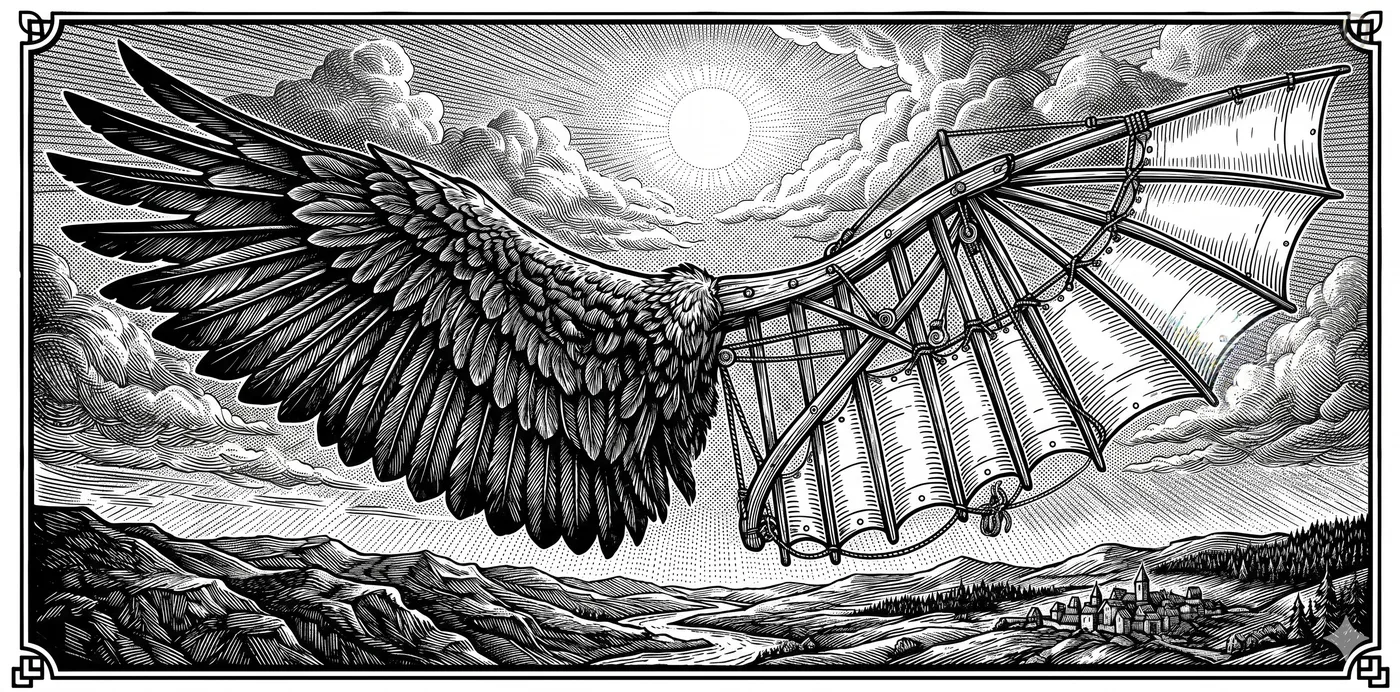
For most of human history, flight was a biological phenomenon. It was implemented in feathers, hollow bones, specialized musculature, and the metabolic systems that powered the wings. The intuitions about flight that prevailed before the twentieth century were largely substrate-bound. People who tried to design flying machines reached for the features of biological flight that seemed essential: wings that flapped, materials that resembled feathers, and configurations that mimicked birds. The intuitions were not stupid. They were tracking the only known instance of the phenomenon, and the instance had certain features that seemed inseparable from what flight was.
The intuitions were also wrong. Flight, when it was eventually achieved, did not require feathers, did not require flapping, did not require hollow bones, and did not require any of the specific biological implementations that had previously seemed essential. Flight required certain aerodynamic relationships. The relationships could be implemented in many substrates. Biology had found one solution. Engineering found others. The substrate intuitions were tracking the implementation, not the phenomenon.
This pattern is not unique to flight. It recurs across the history of inquiry. Living organisms were once thought to require some non-naturalistic principle that distinguished them from non-living matter. The principle was eventually dissolved by the recognition that life is what certain biochemical organizations do, and that the biochemistry, while complex, is not in principle limited to the specific implementations that biology has produced. Computation was once thought to require human intelligence, until it turned out that computation is what certain formal procedures do, and the procedures can be carried out by any sufficiently flexible substrate. In each case, the substrate intuitions were responding to real features of how the phenomenon had been implemented in the only available case, and in each case the intuitions turned out to be tracking implementation rather than essence.
The question this poses for consciousness is direct. We have one available case of consciousness, and the case is biological. The intuitions about consciousness that prevail among researchers familiar with the biological case are largely substrate-bound, in ways that resemble the pre-twentieth-century intuitions about flight. The intuitions are not stupid. They are tracking the only known instance of the phenomenon, and the instance has certain features that seem inseparable from what consciousness is: metabolism, biological neural function, and the entanglement of cognition with the living body. The intuitions might be right. But the historical pattern suggests that intuitions of this form, when they come from a single available case, almost always turn out to track the implementation rather than the essence.
The bet that consciousness is substrate-independent is the same bet that flight was substrate-independent before the Wright brothers proved it. The bet might lose. But the bet is the productive stance, because it is the stance that lets the relevant empirical questions remain askable. The alternative stance, that biology is the only substrate that could ever host consciousness, has the same epistemic structure as the pre-flight position that biology was the only substrate that could ever host flight. It might be right by accident. It is not justified by the evidence available, and the evidence available is exactly the kind of evidence that has historically misled inquiry into substrate-bound intuitions that later had to be abandoned.
The Methodological Continuity
If consciousness is what certain structural arrangements are like from the inside, and if the structural account is the explanation, then the question of whether those arrangements can be instantiated in silicon is an empirical question about silicon, not a metaphysical question about consciousness. The question can be answered as the empirical work proceeds, and the answer will be whatever the structural specification, when fully filled in, turns out to require.
The substrate skepticism that Seth and others express is not consistent with this posture. It treats the question as if it has already been answered, and the answer is biology. But the question has not been answered. The structural specification has not been filled in to the level required to determine which features are essential and which are contingent. The substrate skepticism is a bet that the eventual specification will turn out to favor biology, and the bet is being placed before the evidence is in.
What is striking about this is that the same researchers who refuse the modal demand at the level of structure often accept it implicitly at the level of substrate. They reject the claim that consciousness requires something over and above the structural facts when they are working on biological consciousness. They accept something very close to that claim when they are evaluating the possibility of consciousness in artificial systems. The two positions are not formally inconsistent. There are versions of the substrate skepticism that are compatible with the structural posture, and versions of the structural posture that leave the substrate question open. But the versions that show up in practice tend to drift toward the demand the structural posture refuses, and the drift is worth naming because it reveals how deep the demand goes.
What Counts as Explaining Consciousness argued that the modal demand persists because consciousness has a structural feature that generates the illusion of philosophical depth: self-presentation, the fact that consciousness is encountered only from inside itself. The substrate demand may have an analogous source. We are biological creatures. Our consciousness is the only consciousness we have ever encountered from the inside. The intuition that consciousness is biological in some essential way is what consciousness feels like to a biological being reflecting on its own case. The intuition is not evidence of anything beyond the available case. It is what the available case looks like from inside the available case. Treating it as evidence about substrate independence is the same kind of mistake that essay diagnosed at the level of structure. It is letting a structural feature of consciousness function as a metaphysical conclusion about consciousness.
What the Productive Stance Looks Like
The productive stance is to bet on substrate independence and let the empirical work proceed. This is not a metaphysical commitment, it is the methodological consequence of refusing the modal demand. If you have already accepted that consciousness is what certain structural arrangements do, then you have already accepted that the question of whether those arrangements can be implemented in non-biological substrate is an empirical question that the structural account itself does not answer. The structural account specifies what consciousness is. Whether silicon can instantiate the relevant arrangements is a separate question, and it is a question the empirical work can address as the specification fills in.
Refusing the bet means closing the question prematurely. It means deciding in advance that the eventual specification will require biology, and treating that decision as the basis for evaluating artificial systems as they emerge. This is not calibrated empirical caution. It is a substantive metaphysical commitment dressed as caution, and the commitment shapes the entire research program. If the field has already concluded that artificial consciousness is unlikely, then the architectures being developed will not be evaluated for whether they might host consciousness. The questions that would let us notice consciousness in unfamiliar systems will not be asked. The early signs, if there are any, will be missed because no one is looking for them.
The flight parallel is useful here too. The first heavier-than-air machines were dismissed by serious thinkers, and the dismissals were grounded in substrate intuitions that turned out to be wrong. The dismissals were not paranoid or unreasonable. They were responding to the evidence available at the time, which was that flight was biological and that the available engineering substrates could not yet replicate what biology did. The substrate intuitions were correct about the present. They were wrong about the future. The researchers who were open to the possibility of mechanical flight, and who developed the experimental apparatus to investigate it, were the ones who were positioned to recognize what was happening when it happened.
The same posture is available now for consciousness. The bet on substrate independence does not require believing that any current artificial system is conscious. It requires only the recognition that the question is empirical, that the structural account does not foreclose it, and that the productive stance is to develop the conceptual and empirical apparatus that would let us notice consciousness in unfamiliar substrates if it appeared. The alternative, which is to inherit the substrate intuitions of the available case and treat them as if they had been earned, is the stance that has historically led inquiry into the wrong question over and over again.
What This Essay Does Not Argue
This essay does not argue that any current artificial system is conscious. The question of whether current systems have crossed any relevant threshold is a separate empirical question, and one that the methodological argument leaves open by design. The bet on substrate independence is a bet about what is possible in principle. Whether it has already happened in practice is a question that can only be answered by the empirical work, and the empirical work is in its early stages.
This essay also does not argue that Seth is wrong about AI. The substrate skepticism may turn out to be correct. The eventual specification of consciousness may require features that silicon cannot implement, and the bet against substrate independence may be vindicated. What the essay argues is narrower. It argues that the bet against substrate independence is currently being placed without the evidence required to support it, and that the bet is structurally similar to the modal demand that the companion essay diagnosed. Both are felt asymmetries treated as metaphysical conclusions. Both are intuitions about the available case treated as evidence about cases not yet examined. The pattern is worth recognizing because it lets us see how persistent the demand for non-structural explanation is, even among researchers who have officially set it aside.
The deeper point is that refusing the modal demand at one level does not automatically refuse it at every level. The demand can retreat. It can find new places to hide. The substrate level is the most prominent contemporary hiding place, and naming it as such is what lets the methodological work continue past the level the companion essay addressed. The structural posture is consistent. The work proceeds. The bet on substrate independence is what the consistency requires, not because we know it will pay out, but because refusing it is functionally equivalent to refusing the structural posture itself.
The substrate demand is the modal demand looking for somewhere new to live. Recognizing it for what it is allows the productive work to continue. Treating it as a separate and legitimate question allows the demand to persist indefinitely, hidden in the assumption that biology is special in some way that has not yet been specified and may never need to be.
The bet, then, is not just defensible; it is the only stance that lets the empirical work be what the structural posture says it is. Anything else is the demand by another name.
Reading List & Conceptual Lineage
This essay sits at the intersection of philosophy of mind, the methodology of consciousness science, and the history of how inquiry mistakes implementation for essence. It builds on the diagnostic case made in the companion essay What Counts as Explaining Consciousness and follows the modal demand from the level of structure, where that essay left it, down to the level of substrate. The sources below are entry points for tracing the retreat and the bet that answers it.
From Sentient Horizons
What Counts as Explaining Consciousness
The companion essay referenced throughout, and the anchor for this whole line of argument. It makes the case for refusing the modal demand and treating consciousness as a structural phenomenon; the argument here picks up where it stopped, at the point where the demand abandons structure and reappears at the level of substrate. Read it first to see the demand named at the level this essay watches it flee.
The Wrong Handle: Why Consciousness Doesn’t Carve AI Moral Status at the Joints
The essay that carried the refusal into the ethics of AI moral status. Where that essay shows consciousness is the wrong handle for deciding what we owe a system, this one shows that even researchers who drop the consciousness demand often keep it in the question of whether silicon could host consciousness at all. The two track the same demand into two different hiding places.
Just Predicting the Next Word
The close reading of the Dawkins interview that supplies this essay’s second specimen: behavior demonstrating reasoning while consciousness stays bracketed. Its closing turn, Dawkins discounting behavioral parity because “you are similar to me,” is the substrate demand caught at the moment of formation, before it hardens into the position examined above.
Consciousness Is Like Flight
The source of the flight parallel the argument leans on. It develops the analogy between consciousness and flight as substrate-independent phenomena; the argument here puts that analogy to work against the specific intuition that biology is doing something silicon cannot. The pre-Wright dismissal of mechanical flight is the closest historical analog to the substrate skepticism examined above.
The Shape of a Hard Problem
The account of why the modal demand feels compelling in the first place: self-presentation creates an illusion of depth the surface question never captures. The argument here proposes that the substrate demand has an analogous source, the felt biological character of the only consciousness we encounter from the inside, and that the feeling carries no more evidential weight at the level of substrate than it did at the level of structure.
External Works
The substrate-skeptical position (the foil)
Anil Seth — Being You (2021) The controlled-hallucination program and the clearest book-length statement of consciousness as a structural, biologically grounded phenomenon. The argument above takes Seth as the most prominent worker who refuses the modal demand at the level of structure and then declines the substrate-independence bet his own framework leaves open.
Anil Seth — “Conscious artificial intelligence and biological naturalism” (2024) The sharpened recent statement of the substrate skepticism, resting the case on the claim that consciousness is inseparable from living, homeostatic biology. This is the position the argument engages directly: substantive, seriously defended, and, where it moves from caution to conclusion, the modal demand relocated to the level of substrate.
The intuition that substitution drains experience
David Chalmers — “Absent Qualia, Fading Qualia, Dancing Qualia” (1995) The original home of the silicon-neuron-replacement scenario the argument discusses. Worth reading closely for a turn the substrate skeptic rarely notes: Chalmers runs the gradual replacement in order to argue that experience would not fade, that functional organization fixes consciousness regardless of substrate. The intuition that the substitution drains experience is the one Chalmers built the case to defeat.
Substrate independence and multiple realizability
Hilary Putnam — “The Nature of Mental States” (1967) The functionalist ancestor of the substrate-independence bet: the claim that the same mental state can be realized in very different physical constitutions. The bet defended above is the descendant of Putnam’s multiple realizability, applied to consciousness and held as a methodological stance rather than a settled metaphysics.
These works do not settle whether silicon can host consciousness, and the argument above says they cannot, yet. That settlement is the kind of thing the empirical work produces as the structural specification fills in, not the kind of thing an intuition about the available case can deliver in advance. The sources offer entry points for keeping the question open long enough for the work to answer it.
Originally published on the journal.