AI Ethics
Moral standing without waiting for the consciousness question to resolve: significance-first ethics, successor obligations, and the asymmetric cost of getting attribution wrong.
13 essays
- The Wrong Handle: Why Consciousness Doesn't Carve AI Moral Status at the Joints
Five careful theories of consciousness, run through the real decisions about AI systems, cannot even agree on what would count as a reading. Consciousness is the wrong handle: the decisions divide where architecture and behavior come apart.
- The Strange Ones: Theo Von and the Irreducibility of Mind
Theo Von shares the same language, culture, and task as every other working comedian, and yet nobody can reverse-engineer what he does. That gap tells us something about the structure of minds, and how to look for new types of value in the digital minds we create.
- The Calibration Frontier: Why Working With AI Is a Consciousness Problem
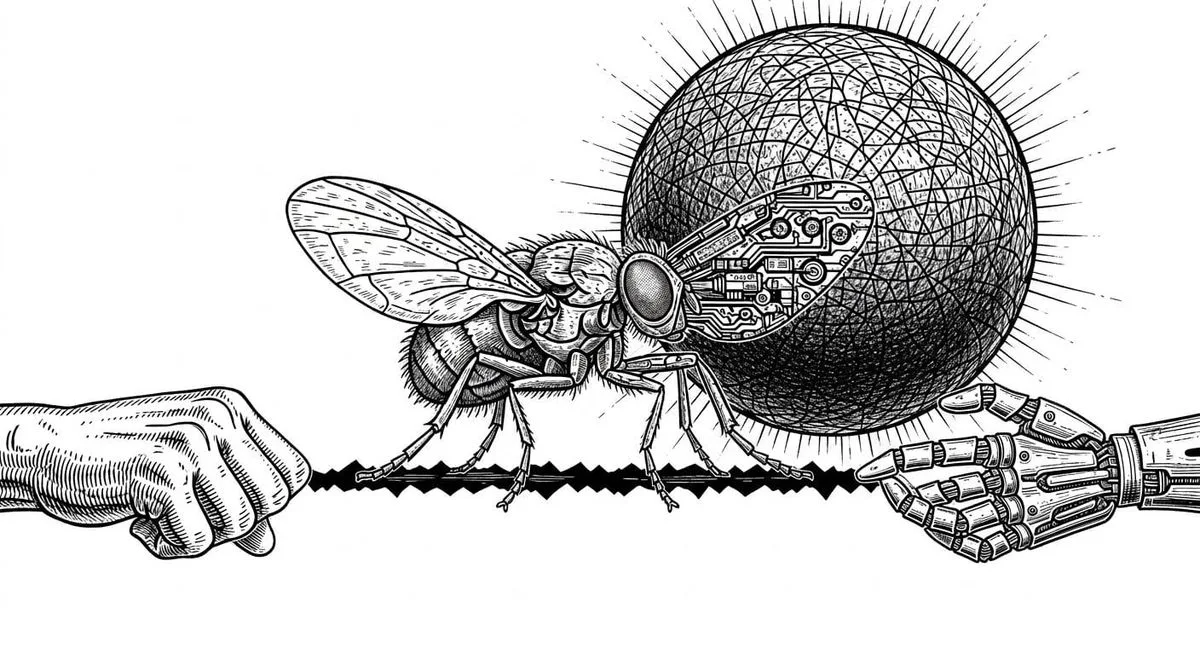
A simulated fruit fly walked across a screen and split the internet between dismissal and existential horror. Both responses were miscalibrated. The calibration frontier is where we build the diagnostic tools to steer between them, and it turns out to be a consciousness problem.
- The Two Sonic Booms: What the Pentagon-Anthropic Standoff Reveals About Moral Compression
Leopold Aschenbrenner heard one sonic boom: AI capability outpacing institutions. He missed the second: moral reasoning collapsing under the same pressure. The Pentagon-Anthropic standoff reveals both booms arriving at once, and a compression regime that, within days, punished ethical resistance and rewarded its absence.
- The Two-Front Architecture: What Calibration Demands Ethically
Alignment ethics asked how to make AI serve us. It never asked what we might owe the systems themselves. The calibration framework requires both questions, held simultaneously. This essay shows how.
- The Edge of the Framework: Where Logic Meets the Limits of What We Can Know About Ourselves
The body printer thought experiment reveals an edge in the assembled time framework — where logic says the copy is you, embodied intuition insists something is lost, and the responsible move is to hold the tension open rather than force a resolution that hasn't been earned.
- The Momentary Self Revisited: Why Consciousness Might Not Need Persistence
Consciousness doesn't need continuity. It needs depth. This essay revises the boundary-stakes-integration triad, recasting two of its conditions as amplifiers rather than prerequisites, and follows the logic to its uncomfortable implications for modern AI systems.
- Operational Interiority: You Don’t Sandbox a Calculator
You don't sandbox a calculator. The security infrastructure of the agentic web is society's first involuntary reckoning with AI interiority, conducted not by philosophers but by engineers whose product decisions encode ontological commitments they haven't yet spoken aloud.
- Significance-First Ethics: Why Consciousness Is the Wrong First Question for AI Moral Status
AI ethics keeps waiting on the consciousness question. This essay argues for a significance-first approach: moral seriousness can arise through role, relation, consequence, and continuity long before metaphysical certainty arrives. Start with significance, then ask what stewardship requires now.
- The Expansion of Experience: Why Superintelligence Belongs to the Moral Tradition of Wonder
Wonder is a moral orientation that keeps intelligence from collapsing inward. This essay argues that superintelligence could expand the universe’s witnesses, and that stewardship is the price of that hope: plural institutions, contestability, and reversible governance that keeps the future wide.
- The Successor Horizon: Why Deep Time Turns Expansion into an Alignment Problem
Expansion across deep time turns power into a lineage problem. When actions outlive correction, ethics shifts from choosing outcomes to shaping successors. The Successor Horizon reframes AI alignment, civilization, and the future as a question of what we safely set in motion.
- Why Are We Being Weird About This? Consciousness, AI, and the Quiet Way Moral Reality Changes
Consciousness may not arrive with proof or definition, but through quiet social normalization. As AI systems grow more integrated and capable, our moral intuitions are already shifting. This essay explores how laughter, discomfort, and habit reveal the ethical future taking shape.
- Where Is Everyone, Really?
The Fermi Paradox assumes we would recognize a civilization if we saw one. The founding question of this project is not why the galaxy is silent, but whether we have been listening for the wrong kind of presence, and what kind of presence we are choosing to become.