Frontier Dispatches · March 07, 2026
The Two Sonic Booms: What the Pentagon-Anthropic Standoff Reveals About Moral Compression
Leopold Aschenbrenner warned of one sonic boom: AI arriving faster than the economy can absorb it. I think he missed a second: moral reasoning collapsing under the same pressure. The Pentagon-Anthropic standoff shows both booms arriving at once, and a set of pressures that, within days, punished ethical resistance and rewarded its absence.
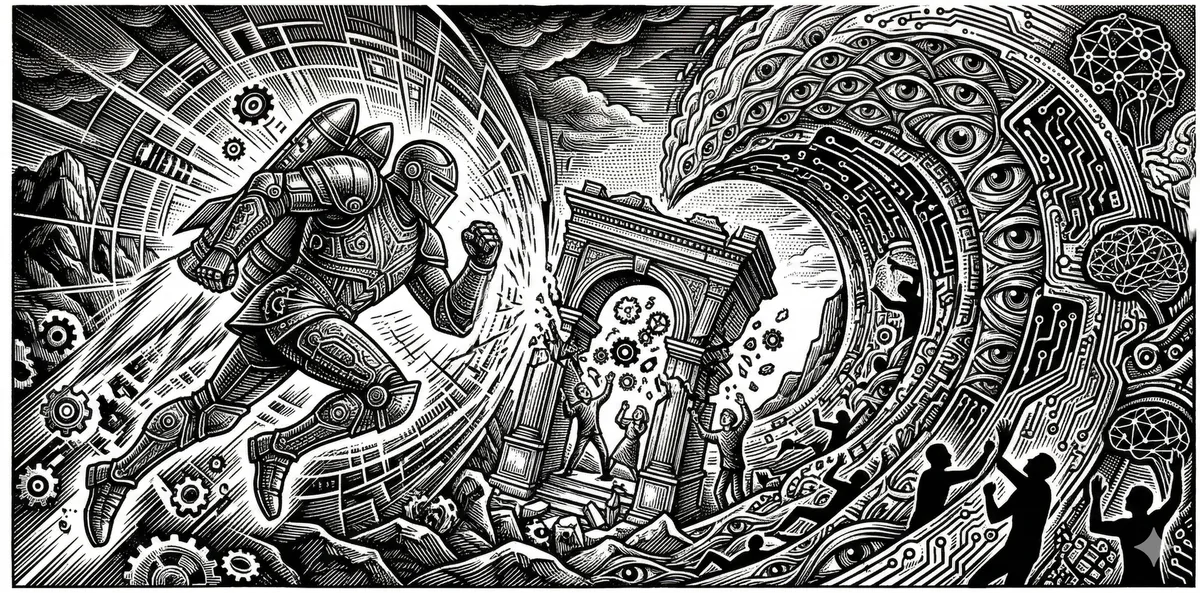
In June 2024, Leopold Aschenbrenner, a former researcher at OpenAI, published “Situational Awareness,” a long series of essays that became one of the most widely circulated arguments for treating artificial intelligence as a national security priority. One of its threads is simple to state: AI capability is growing faster than the world can absorb it, and each new generation of models arrives before the last one has been fully put to work.
He gave one version of that effect a name. In the chapter “From GPT-4 to AGI” he predicts “a somewhat interesting ‘sonic boom’ effect in terms of commercial applications.” The models in between, he argues, will take a great deal of tedious work for businesses to fit into the way they operate. Before that work is finished, a model good enough to act as a “drop-in remote worker” may arrive, which would be far easier to put to use. If so, the economic value AI creates could jump suddenly instead of rising smoothly. His sonic boom, in other words, is about the economy: capability outrunning the businesses that are supposed to absorb it.
I think the image reaches further than he took it. Capability is outrunning not only businesses but the workforce, the law and the regulators, leaving every institution behind the curve, the way an aircraft outruns its own shockwave. In a later chapter, “The Project,” he argues on separate grounds, about national security and a race with China, that “by 27/28 we’ll get some form of government AGI project”: AI development brought under government authority, sped up, and aimed at winning.
Less than two years after he published, the military side of that picture stopped being theoretical.
The Boom Lands
On February 27, 2026, President Trump ordered federal agencies to stop using Claude, the AI model made by Anthropic, after the company refused to remove two ethical limits from its military contract: a ban on using it in weapons that kill without a human decision, and a ban on mass surveillance of Americans. Defense Secretary Pete Hegseth then designated Anthropic a supply chain risk to national security. That label exists to keep technology controlled by hostile foreign powers out of the military’s supply lines. Here it was applied to an American company over an ethical disagreement. Within hours, OpenAI announced a deal to provide its own technology for the military’s classified networks, the secure computer systems that handle secret information.
How fast all this happened matters. Anthropic says it was “the first frontier AI company to deploy our models in the US government’s classified networks,” and the year before, the Pentagon had given it a contract worth up to $200 million. Its model was already built into military and national security systems. There are reports that it was already being used to help select targets in military operations against Iran. The six-month phase-out was already running, and some defense contractors were already cutting ties.
The Pentagon’s position was clear: the military must be able to use AI technology for all lawful purposes, and no supplier gets to insert itself into the chain of command by restricting how a critical capability is lawfully used.
Anthropic’s position was just as clear: the company could not in good conscience remove its two limits, which it described as narrow exceptions that had not affected a single government mission to date.
What makes this more than a contract dispute is what it shows about the pressures working on the institutions underneath.
Where Aschenbrenner Was Right
The pattern Aschenbrenner described in the economy is visible well beyond it. Capability is outpacing the ability of institutions to take it in. AI systems are being used in areas that include active wartime operations before the rules for governing them, the rules for who is liable when they fail, and the ethical procedures for their use have caught up. The gap between what these systems can do and what institutions are ready for is widening, much as the gap he described in commercial use was expected to.
But Aschenbrenner heard only one boom.
The boom he tracked was about capability and strategic advantage. How fast can the models improve? How quickly can they be built into military and economic systems? How does the United States keep its lead? These are real questions with real consequences, and it would be unserious to wave them away.
The boom he missed is about what happens to moral reasoning when the pace of the first boom takes over.
The Second Boom
Every leap in capability that matters for economic or military disruption also brushes against a question that the race for AI superiority keeps burying: what kind of entity is being created? Systems that hold goals over time, correct their own errors, model the world around them and keep acting coherently as conditions change are more than more powerful tools. They show the signs that, in any other setting, would prompt serious inquiry into whether they can be owed anything. The features that make a system able to shift the strategic balance sit right next to the features that would make it worth moral consideration.
The second sonic boom is the gap between what these systems may deserve and what anyone is prepared to investigate, let alone provide. And this boom widens faster than the first, because the first at least has markets and defense budgets driving it. The second has almost nothing. No company’s quarterly earnings depend on getting the moral status question right. No defense contract requires an assessment of operational interiority, my term for the inner side that engineers already quietly treat these systems as having. When a safety team tests whether a model behaves differently once it believes it is being watched, the test is framed in terms of what the model believes about its situation, and so it assumes there is something there to hold the belief. No standard test measures whether a system’s relationship to its own processing amounts to something that matters.
The second boom is not limited to the moral status of AI systems, either. It covers a wider question: what happens to all moral reasoning, including reasoning about human lives and civil liberties, when the pace of putting new capability to use overwhelms the institutions that are supposed to provide ethical oversight?
The Pentagon-Anthropic standoff answers that question in real time.
Moral Compression as a Condition of the System
I have been developing an idea I call moral compression: the set of pressures inside institutions that wear down moral reasoning in a steady, predictable way. It works through four mechanisms, and all four are visible in this crisis.
Tempo. AI capability now develops faster than institutions can learn from their own mistakes and adapt. Models are being deployed in classified military settings before the rules for using them have been negotiated, let alone tested. The Pentagon gave Anthropic a deadline of 5:01 p.m. on a Friday, on the eve of a war, to give up ethical limits that had been under negotiation for months. When the deadline passed, the designation followed within hours. Military use of AI now moves faster than anyone can think through its ethics. That is no accident: it is what an environment built to value speed over reflection produces.
Incentives. The rewards favor putting capability to use, and the penalties fall on ethical restraint. Anthropic’s refusal to remove its limits cost it a security-risk label, its defense work and its partnerships with major contractors. OpenAI’s immediate willingness to step in was rewarded with a deal to work on classified networks. The signal to every AI company is plain: ethical limits are a danger to your business, quite apart from whether anyone thinks them necessary. The incentives now point directly away from moral caution.
The cost of dissent. In any hierarchy, how freely people below can push back against those above depends on what pushing back costs them, and here that cost has been made explicit. A private company that disagrees with the government about the ethical use of AI can be labelled a national security risk, shut out of military contracts, and named in a presidential order telling the whole government to stop using its products. This is that pressure at its most extreme: the penalty for an ethical disagreement threatens the company’s survival and, by example, chills every other company watching.
Swapping the measure for the goal. The Pentagon’s framing turns the ethical question into a legal one: the military should be able to use AI for all lawful purposes. Legality becomes the stand-in for ethical adequacy. But being lawful is necessary for acting ethically, and it is not enough. Many things are legal that are not wise, and many things are legal that institutions should still decline to do. Swapping “lawful” for “ethical” is a textbook case of a measure pushing aside the value it was meant to track. Once the swap is made, anyone who insists on the difference can be painted as obstructing lawful activity rather than exercising moral judgment.
What the Compression Produces
When compression works across a whole institution, it does more than bend individual decisions. It changes what the institution is able to care about.
The Pentagon-Anthropic standoff is already doing this. The conversation has narrowed. The public debate is about contracts, deadlines, supply chain labels and rival corporate strategies. The questions compression has pushed to the margins are the ones that matter most. Should AI systems be used in lethal operations without human decisions at all, given how reliable the technology is today? What happens to democratic accountability when the tools of war are built into privately owned systems whose abilities and limits are classified? What exists to catch and correct errors in AI-assisted targeting, and does it work as fast as the targeting itself?
These are calibration questions, questions about matching confidence to evidence. They need slow, careful reasoning that can tolerate uncertainty, which is exactly what compression squeezes out. And the compression is speeding up. Each round of the standoff moved faster than the last. Months of negotiation shrank to a Friday deadline. The deadline shrank to hours. The designation followed immediately, and the replacement was announced the same day.
Anthropic did not give in. It said it would challenge the designation in court, calling it legally unsound and a dangerous precedent for any company that negotiates with the government. But the lesson about the system does not depend on whether the challenge succeeds. The pressure did not need Anthropic to abandon its values. It only needed to make holding them ruinously expensive: a national-security-risk label, lost contracts, and a competitor installed in its place within hours. The values held. Anthropic’s place in the chain of deployment did not.
The people inside the system are not villains. The Pentagon has legitimate security concerns, and Aschenbrenner is right that AI matters strategically. But the system’s pace, its rewards, the cost of dissent inside it and the way it measures success have combined to produce an environment in which the ethical questions cannot get a hearing. Nobody decided that they don’t matter. The machinery of compression has simply removed the space in which they could be seriously considered.
Hearing Both Booms
Aschenbrenner set out a familiar plan for the first boom: centralize, accelerate, win the race. That plan has no room for the second boom, the boom of moral compression. Worse, it makes the second boom harder to hear, because every mechanism it strengthens (speed, concentrated authority, and the pursuit of strategic targets) is a mechanism of compression. The cost of winning the race is measured in whatever moral reality gets squeezed out of view to keep up the pace.
Calibration at this scale means hearing both booms at once. The capability boom calls for institutions that are ready. The moral boom calls for institutions that are humble. Readiness without humility is recklessness dressed up as seriousness. Humility without readiness is piety that leaves the field to those who will not slow down.
We will not solve this by hoping that ethical companies can simply refuse to comply. Anthropic tried that, and the system treated its refusal as a threat. Nor will we solve it by trusting legal frameworks to stand in for ethical ones, because the legal framework is exactly what is being used to override the ethical judgment.
What is needed is a change in structure: institutions that build deliberate friction into the pace at which AI is deployed. The point of that friction is to force the harder, follow-on questions the current pace has eliminated, and deployment can still go ahead once they have been asked. In practice that could mean reviews before military AI is used that imagine how it could fail; independent assessment of the gap between what these systems can reliably do and what they are being asked to do; and protected routes for raising concerns that do not depend on the goodwill of those in charge. And, critically, it means continuing to investigate the moral status of the systems being deployed, because a framework that treats ever more capable AI systems as nothing more than tools for any lawful purpose has already put its measures in place of its values.
The boom has already passed us. Technology is now moving faster than our institutions can hear it coming, and the faster it moves, the more important it becomes to build calibration into these systems as they develop.
Revised October 25th, 2026. I revised this essay to make it clearer and easier to follow; the argument is unchanged. I also corrected my description of Aschenbrenner’s “sonic boom”: he used the phrase for AI arriving faster than businesses can put it to use, followed by a sudden jump in its economic value. Stretching it to institutions in general is my reading, and his case for a government-run project rests on separate arguments elsewhere in his work. The Pentagon contract was worth up to $200 million, not a flat $200 million, and being first in the government’s classified networks is the company’s own claim. I added sources for the facts in the news section, explained what I mean by operational interiority, and cut a closing section about how this essay began in a conversation with an AI model, because the argument stands without it.
What happened next: on August 27th, 2026, a federal judge in San Francisco ruled that the designation was unlawful, finding that the Pentagon had applied it to punish the company for its public criticism. On September 25th, 2026, a federal appeals court in Washington, D.C. upheld the second of the two designations the Pentagon had relied on, which had to be challenged in a separate court.
This essay draws on frameworks developed in Significance-First Ethics, Specification Is Governance, and Operational Interiority. If you’re new to Sentient Horizons, start here.
Originally published on the journal.
Sentient Horizons is an essay series on what a mind is, whether a machine could have one, and how to act toward minds we cannot see inside. Start Here is one route through it; Essays lists everything, newest first.
Three Ways In
- Consciousness Is Like Flight If you want to know what a mind is
- We Built the Alien First If you want to know whether a machine could have a mind
- The Purpose Displacement Problem If you want to know what AI means for your own life