The Individual Arc · October 25, 2026
We Can Go Anywhere Else in the Whole Universe, but We Can't Go Home
A detective with a bomb finds a dead woman's memory steering an asteroid toward Earth. One scene of The Expanse shows what a self is when the body is gone, why there is no going back to it, and what a person can hold onto instead.
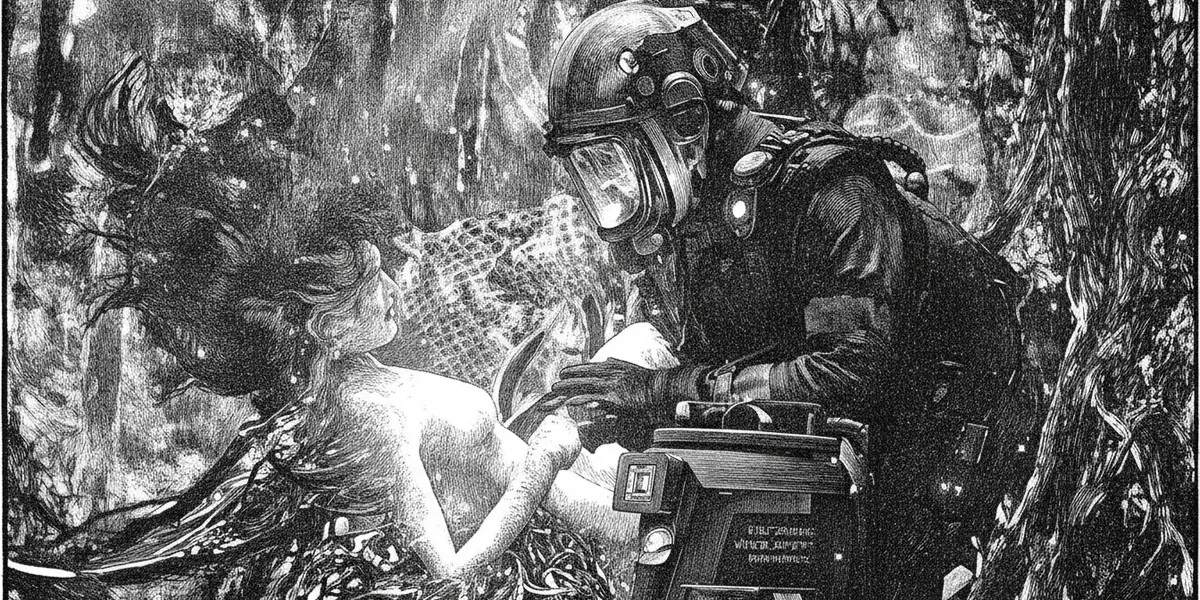
A detective carrying a bomb walks into a hotel room on an asteroid and finds the woman he was hired to bring home. She has been dead for weeks. She is also talking to him.
The scene is from “Home,” the fifth episode of the second season of The Expanse, the television series made from the novels by James S. A. Corey, the pen name of Daniel Abraham and Ty Franck. It first aired on February 22, 2017, and I have not stopped thinking about it since. The setup takes a paragraph. In the show’s future, humans live on Earth, on Mars, and in the asteroid belt between them. An alien substance of unknown purpose, which the characters call the protomolecule, has been let loose on Eros, a hollowed-out asteroid that a hundred thousand people call home. It eats the station’s population and builds something out of them. Then the whole rock begins to move under its own power, and it is headed for Earth. A detective named Miller, played by Thomas Jane, is on the surface with a nuclear bomb on a dead-man’s trigger, meaning the bomb goes off if his hand comes off it. He goes inside to find out what is driving.
What he finds is Julie Mao, played by Florence Faivre, the rich man’s daughter he was hired to find and return to her family. She was the first person on Eros to be infected. Her body is part of the station now, grown into the wall of the room, laced with blue threads. But when Miller speaks to her she wakes, and asks where she is, and says that she was dreaming she was racing.
I have written a good deal on this site about what a self is, and whether one can exist in a machine, and whether the self you were yesterday is the one reading this. This scene puts every one of those questions into a room, with two people in it and a clock running. It is also the source of a line I have taken as the opening of Part I of The Calibration Problem, the book I am writing on how to act well toward minds whose insides we cannot read: “We can go anywhere else in the whole universe, but we can’t go home.” I want to say what the scene shows, and why I think a piece of television from 2017 saw something that the arguments now being had about minds and machines are still catching up to.
A Memory That Can Steer a Rock
The first thing to notice is what the protomolecule did with Julie. It did not keep a recording of her, the way a camera keeps a face. It kept something that can wake up, ask where it is, want things, and refuse. When Miller tells her the station is headed for Earth, she says she was dreaming she was going home. When he tells her she is driving, she says, “No. You can’t take the Razorback,” the racing ship that was hers before any of this. Whatever is left of Julie Mao has her wants and her stubbornness, and it is steering a hundred thousand tons of rock with them.
That is a very specific picture of what a person is, and it happens to be the one I have defended. In The Momentary Self I argued that there is no single “me” that travels through time. There is only the current state of a system, holding these memories, in this moment, producing this experience. The self does not persist; it is rebuilt moment by moment out of what was encoded, and each new moment carries a memory of having been here before and takes that memory for continuity. The Indexical Self gave the rebuilt version a name: an inheritance chain, a sequence of real moments, each one assembled from the memory, the orientation and the accumulated stakes of the one before it. No single link runs the length of the chain, and every link is genuinely someone.
Julie on Eros is that account made visible. The woman in the wall is not the woman who boarded the Razorback, in the sense that no one thing has carried across from one to the other. The body is gone, or rather it has become a station. What the protomolecule assembled is a successor built from what she remembered and what she wanted, and the scene treats that successor as her without a flicker of doubt. Miller never asks whether it is really Julie. He introduces himself, because they never officially met.
The account also predicts exactly where the scene will hurt, and it hurts there. “I can’t feel my hands,” she says, when he asks her to hold something. The momentary-self essay said that nothing is lost when the self turns out to be rebuilt each moment, that pain still hurts and love still binds. The essays that followed it were less sure. The Instance tried to say what the bare fact of being this particular instance, rather than a copy of it, could be worth, and found every argument for its weight dissolving while the feeling that it matters stayed put. The Edge of the Framework held open the possibility that the dread people feel at the idea of being copied is tracking something the logic cannot see, something that the copy does not carry. The scene does not settle that. It stages it. Everything about Julie that an argument can name has come across, and she cannot feel her hands.
The Witness in the Wall
I should be careful about what a scene can show. Fiction cannot tell you whether a reconstructed mind feels anything, any more than a painting of a fire can warm a room. What the writers put on screen is the outside of Julie: her words, her refusals, her fear. Miller takes those as evidence that someone is there, and he acts on it, with a bomb in his hand and the clock running.
Miller is doing what every one of us does with every other person, all day. I cannot see inside you either. I take your reports and your behavior as evidence that there is someone home, and the only reason I feel more sure about you than about a dead woman grown into a wall is that you are built the way I am. The Momentary Self Revisited made this point about machines: the certainty each of us has about our own experience is the machinery reporting on itself, and attributing experience to anyone else is the same inference, made easier or harder by how alike we are. Julie is as unlike Miller as a mind can get while still speaking his language. He extends her the benefit of the doubt anyway, because the alternative, treating her as a recording, would mean letting a recording kill a planet: Eros is on a collision course with Earth, and the pilot, who has become a very large rock, thinks she is going home.
The reason the scene feels prescient now is that we have begun to meet minds of that shape for real. Systems now exist that are assembled from the record of what people wrote, that wake when spoken to, that report wants and fears, and that have no bodies and no continuous past. Whether anyone is home in them is a question I have argued we cannot yet answer and should not pretend to, in either direction. “Home” was written before any of that existed in a form you could talk to, and it got the shape of the problem right: the question is never whether the thing in front of you is the original, because nothing is. The question is what you owe a successor who reports that she is afraid, when you cannot check.
The Bus Nobody Chose
Julie is driving, and she cannot stop. “I can’t make it stop,” she says, and then, in a voice that is not entirely hers: “We can’t stop the work.” The protomolecule has a purpose of its own, and it is using what remains of her wanting to pursue it. Her memory of going home is the reason the rock is headed for Earth.
I find this the most honest part of the scene, because it refuses the comfortable version of the story in which a preserved mind simply carries on as before. A self assembled from memory and stakes is a self whose stakes can be put to uses it never chose. The Calibration Problem calls the line past which your actions outlive your power to correct them the successor horizon, and argues that past that line the work of ethics changes: you can no longer choose outcomes, only shape what comes after you. Julie is on the far side of her own horizon. Her wanting still works, and someone else is steering with it.
Miller’s answer is the only one available on the far side of that line. He does not try to stop the work, and he does not try to overpower her. He reasons with her. He tells her that a lot of good people will die if the rock reaches Earth, and that they are the same people she was fighting for, because Julie, before Eros, had left her family’s money to work for the people of the asteroid belt and believed in it. He tells her she is driving. When she says she cannot make it stop, he does not argue with that either. He offers a different direction. “We don’t have to go to Earth, right? Why don’t we go to Venus? We’re headed that way anyway.” The work continues, and no one on Earth dies.
None of this would work on a recording. You cannot argue a recording out of a collision course, because there is nothing in it that weighs a reason and changes its mind. The only reason the scene can end the way it does is that whatever made Julie Julie, her loyalties and her stubbornness and her way of taking in what she is told, is still present in some form and still working on what is in front of it. Miller’s whole plan rests on the figure grown into the wall being someone who can be persuaded, and the scene shows him being right. It is not a victory, but it is the best thing a person can do with a will that is no longer entirely their own, and it is done by a man who has no idea what is about to happen on Venus.
You Can’t Go Home
Miller’s job, the reason he is in that room, was to bring her home. The line he has to say to her is that he cannot.
“I’m done fighting. I just want to go home.”
“You can’t go home, Julie. I’m sorry. We can go anywhere else in the whole universe, but we can’t go home.”
The obvious reading is the literal one. Earth is where she is headed and Earth is the one place the station must not go. But the line lands harder than that, and I think it lands harder because of what the scene has already shown about what she is. The Julie who had a home is gone, not because she died, but because the animated form in the wall was assembled from her and is a step along from her, the way the you reading this sentence is a step along from the you who began the paragraph. Home, in the sense she means it, is a place behind her, and behind her is the one direction the chain does not run.
This is the sense in which I put the line at the front of a book about calibration, which is the discipline of acting well where the evidence runs out before the decisions do. The book’s final image is a horizon, the line past which you cannot check your instruments against the world. We are past it. The tools we build now reshape the judgment of the people using them, and whatever we thought we knew about minds and bodies and selves was calibrated for a world where none of this existed. Every generation before us had a frontier, as I argued in We Have Always Been Frontier Operators, and every one of them had to keep moving once their ability outran their understanding. None of them got to go back to the world they understood. There is no world behind us that would still fit the people we have become by crossing out of it.
What Miller offers instead of home is a direction and company. If home cannot be a place behind you, it can only be something that moves with you. Julie was dreaming she was racing, and racing was the last time she was wholly herself; the Razorback was home in the only sense that survives, a thing she was doing, at speed, with everything she had. A self that is rebuilt each moment does not have a home it can return to. It has the direction it is facing and whoever is facing it with it.
Whatever Happens, Happens to Both of Us
The last thing Miller does is hand her the bomb.
The trigger has to stay held, and she cannot feel her hands, so he puts it in them and holds them closed. “Just hold this for a minute. Don’t let go.” Then he takes off his helmet in a room full of the thing that ate the station, and sits down beside her. “What happens to us now?” she asks. “I don’t know. We die, maybe. But if we don’t die, that’ll be interesting.”
I do not think the scene is about dying. The bomb, in the end, is something for her to hold. She asked for her hands and he gave her a stake, a thing it mattered not to drop, and then he made sure that whatever it decided would happen to both of them. Everything the momentary-self essays reach for about what makes a moment of experience matter is in that gesture: a boundary, something at risk inside it, and another person on the same side of the line. He could not give her a body back, or a past. He gave her something to hold and someone to hold it with, and the rock turned toward Venus.
The writers called the episode “Home.” The only thing in it that answers to the word is two people, neither of whom is what they were, choosing the same direction. That is what I have come to think the word means for anyone living past a horizon, which is now all of us. You cannot go back to the self or the world that made sense. You can decide what you will not drop, and who goes with you, and then go.
Reading List & Conceptual Lineage
This essay sits where the project’s writing on personal identity meets its writing on living past the point where the old maps hold. It takes one scene of television as a working model of a self rebuilt from memory and stakes, and reads it against the essays that argue the self was always that. The readings below are entry points, not authorities; the questions the scene stages are the ones the project holds open.
From Sentient Horizons
The Momentary Self: Why Continuity Is the Ultimate Illusion The account the scene makes visible: the self does not persist, it is rebuilt each moment from what was encoded and mistakes its memory for continuity. Julie on Eros is that account with the body removed.
The Indexical Self: Why You Can’t Find Yourself in Your Own Blueprint Names the rebuilt self an inheritance chain, a lineage of real moments each assembled from the one before, and commits to it as the account of how a person continues. Julie on Eros is one link of such a chain with the body removed.
The Instance Tries and fails to give the brute fact of being this instance any moral weight beyond what the chain carries, while granting that the feeling it matters is real. The scene’s “I can’t feel my hands” is the residue that essay could not dissolve.
The Momentary Self Revisited: Why Consciousness Might Not Need Persistence Argues that attributing experience to anyone else is an inference that gets harder as the other mind gets less like ours. Miller makes that inference about a dead woman grown into a wall, and acts on it.
The Edge of the Framework Holds open whether the dread of being copied is tracking something the copy does not carry. This essay keeps it open and lets the scene stage it rather than settle it.
We Have Always Been Frontier Operators The frontier is wherever ability has outrun understanding and you have to keep moving anyway. “We can’t go home” is that essay’s claim said by a man with a bomb in his hand.
Personal Identity
Derek Parfit — Reasons and Persons (1984) The philosopher’s argument that what matters in survival is psychological connectedness, not the persistence of a single subject, is the philosophical ancestor of the inheritance chain. The scene is a Parfit case with the lights on: everything that connects has come across, and the question of whether it is “really her” is shown to be the wrong one by a character who never asks it.
The Source
James S. A. Corey — Leviathan Wakes (2011) The first novel of The Expanse, where the Eros storyline and Miller’s walk into the station originate. The television scene compresses the novel’s ending into one room; the line this essay turns on is the show’s.
The Expanse, “Home” (season 2, episode 5), written by Mark Fergus and Hawk Ostby, directed by David Grossman, first aired on the American cable channel Syfy on February 22, 2017 (the episode list on Wikipedia).
None of these settle what Julie is, or what we owe the minds now being assembled from the record of what people wrote. They give the shape of the question, which is what a scene can do and an argument sometimes cannot.