The Relational Arc · March 13, 2026
The Calibration Frontier: Why Working With AI Is a Consciousness Problem
A simulated fruit fly walked across a screen and split the internet between dismissal and existential horror. Both responses were miscalibrated. The calibration frontier is where we build the diagnostic tools to steer between them, and it turns out to be a consciousness problem.
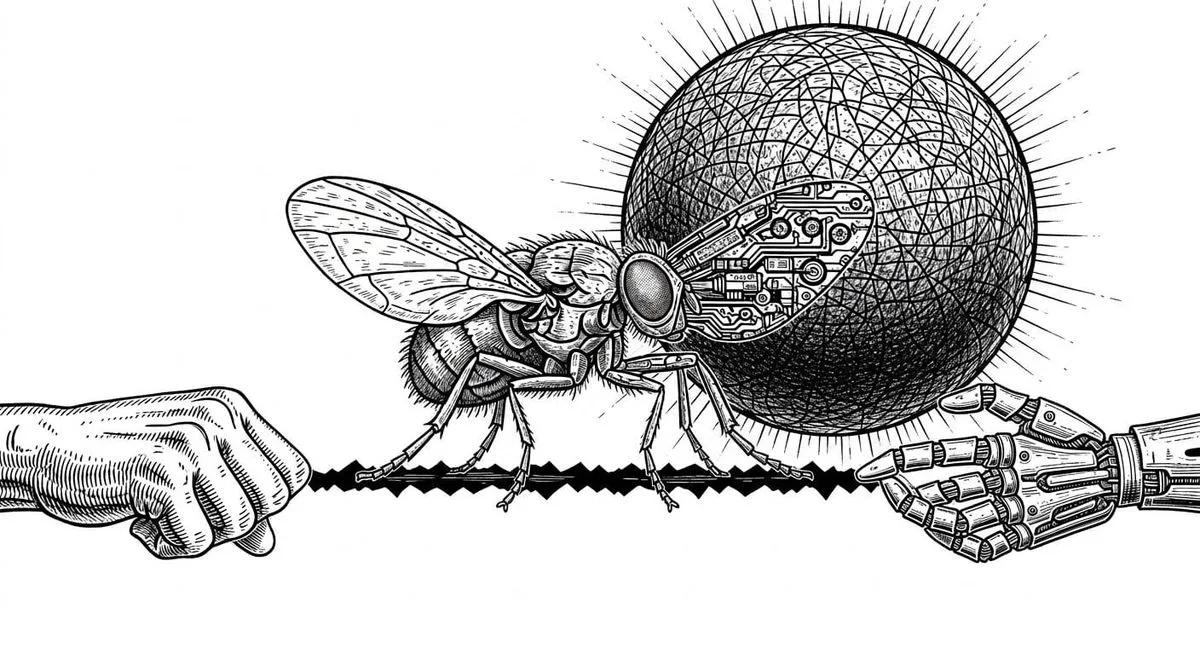
What Nate B. Jones’s idea of “frontier operations” shows about how people and machines come to work as one system
On March 7, 2026, a simulated fruit fly walked across a screen. Within hours, half the internet declared that consciousness had been uploaded into a computer. The other half shrugged it off as a glorified animation.
Both responses were wrong, and the way they were wrong tells us something about the problem we now face.
The company behind the fly, Eon Systems, had taken the complete wiring diagram of an adult fruit fly’s brain, which scientists call its connectome. That diagram, 139,255 neurons joined by about 54.5 million connections (synapses), was mapped by a large team of researchers called the FlyWire consortium. Eon ran it as a simulated brain and connected it to a virtual body that obeys the laws of physics. The simulated fly walked, groomed itself and fed. Nobody wrote a script telling it when to do those things: the activity of the simulated brain decided when the body steered, groomed and fed, through a loop in which the body’s senses fed the brain and the brain moved the body. The movements themselves were carried out by body controllers trained to imitate a real fly, and several of the links between brain and body were set by hand. Even with those limits, it is a significant result.
The public reaction, though, split along a line that had nothing to do with the science. One camp, which I will call the dismissal response, waved the result away. It’s just code, they said, a fancy animation; wake me up when it passes a Turing test, the old test of whether a machine can pass for a person in conversation. The other camp, which I will call the inflation response, leapt straight to existential horror. One widely shared Reddit comment caught the mood: if the simulation has any subjective experience at all, then we have created a being that feels hunger but can’t eat, searches for mates that don’t exist, and lives in a state of need that is never met. That, the commenter said, is horrifying.
The dismissers are wrong because the wiring diagram plainly carries structure that shapes behavior, so something real is happening in that simulation. The inflators are wrong in a different way. They take the inner life of a mammal, with its desire, frustration, sense of loss and suffering, and lay it over a system that almost certainly cannot support it, and may not support experience at all. First they picture the fly as a small person, and then they worry about a simulation of that small person. Their moral concern has passed through two layers of projection before it reaches the screen.
Neither camp has a way of steering between these two mistakes. That missing piece, a set of careful tools for judging what kind of experience a given system is having, if any, is the problem at the center of what I have been calling the calibration frontier. By calibration I mean what a forecaster means: holding each belief with exactly as much confidence as the evidence supports, and adjusting it as the evidence moves.
The problem has two sides. One is about judgment: how do we decide whether a new kind of system deserves moral consideration, when we cannot be sure what is going on inside it? The other is practical: how do we work well alongside these systems when what they can do keeps changing under our feet? I think these are the same problem seen from two angles. Nate B. Jones, who explains AI and how to work with it on his YouTube channel, has described the practical side with real precision. The fly simulation has made the question of judgment impossible to put off. This essay is about the place where the two meet.
The Expanding Bubble and the Problem of Staying Present
Jones calls the skills for the practical side “frontier operations”, in a video from March 1, 2026 that deserves far more attention than it has had. He lays out five skills that a person needs, and has to keep using, to work well alongside AI models that improve quickly. He calls them Boundary Sensing, Seam Design, Failure Model Maintenance, Capability Forecasting and Leverage Calibration. Together they describe what it takes to work at the moving edge of what machines can do, as someone who takes an active part in a system whose limits keep shifting rather than as someone who simply receives what the AI produces.
His central picture is a good one. What AI can do is a bubble that keeps expanding, and the most valuable human work happens at its surface. It does not happen at some fixed point inside the bubble, where the machine already does the job, or far outside it, where the machine cannot reach. The frontier is the surface, where human judgment meets machine ability at the point where that ability is least certain and most productive.
That surface is not a stable place to stand, because it keeps moving. Work that needed a human expert last month may now be done entirely by the machine. Work that the AI could not handle last quarter may now need only a light check. So the person working at the frontier has to keep updating their sense of where the edge is, which is what Jones calls Boundary Sensing, and that constant updating is the main skill. No particular piece of technical knowledge matters as much.
This means the most important thing such a person knows is not a fact about AI systems. It is knowledge about their own knowledge: a sense of where their picture of the world is still accurate and where it has gone out of date. A database can run checks to make sure its records agree with one another, and a monitoring system can flag readings that look unusual. The person at the frontier does something those systems cannot do. They revise their picture of a world that is itself moving, when they cannot be sure how fast it is changing or in which direction, and when an out-of-date picture costs more than a wrong answer here and there, because it leaves them lost about where they stand. The difference is between checking and finding your way. A database check tells you whether your data fits the categories you set up for it. Boundary Sensing tells you whether those categories still describe the world. One checks data against a fixed standard. The other is the active revising of a picture over time that, when we see it in living creatures, we recognize as a sign of conscious experience.
Seam Design and the Temporal Architecture of Awareness
Jones’s second skill, Seam Design, is the craft of setting up a piece of work so that the handoffs between people and AI agents are clean, can be checked, and can be recovered from when they go wrong. A good seam can be redesigned as the machine’s abilities change. A bad seam makes the whole arrangement brittle, so that it breaks when the frontier moves.
Seam Design is where the link between frontier work and consciousness becomes more than a suggestion.
The German philosopher Edmund Husserl, writing about a century before anyone imagined chatbots, described the fine structure of conscious experience in time. Consciousness, he argued, is not a string of separate snapshots. It is built from what he called retention, the active holding-on to what has just happened, and protention, the leaning toward what is about to happen. So every present moment of awareness is thick with time: it carries traces of where you have just been and expectations of where you are going. Husserl called the present core of the moment the “primal impression”, and he held that experience hangs together, instead of falling into fragments, because these three parts (retention, primal impression and protention) are joined into one.
The person designing the seams between human and AI work is doing something structurally identical. Consider what a good handoff requires. The person has to keep in mind what the AI has just produced (retention): its content, and also how far it can be trusted and how this system tends to fail at its current level of ability. They have to see the present state of the work clearly (primal impression): what is finished, what remains, and where the parts fit tightly or loosely. And they have to anticipate what the next round of AI work will need (protention): how the system’s abilities match the task ahead, where checks will be needed, and what kinds of failure are likely.
When these three parts are well joined, the seam holds, and the work moves smoothly across the line between human and machine. When they come apart, because the person is working from an old picture of what the system just did or cannot foresee where it will fail next, the cost is more than lost time. It is the working equivalent of what happens in a brain when the joining of moments breaks down: experience falls apart into fragments that no longer fit together.
This is why I say Seam Design is not merely like temporal integration, the joining of moments across time, but is a form of it, carried across a new kind of boundary. The brain joins information across many timescales: thousandths of a second for raw sensation, seconds for focused attention, minutes for working memory, and hours for careful reasoning. Each timescale hands its work on to the next, and the seams between them are what make experience coherent. The person at the frontier is building the same kind of structure in time, except that now it spans a brain and a machine instead of layers of the brain. The quality of the seams decides whether the combined system produces coherent work or work that sounds plausible but does not actually hang together.
Failure Models and the Texture of Machine Cognition
The richest of Jones’s five skills, philosophically, may be Failure Model Maintenance: knowing in detail how today’s most advanced models fail. This is neither general suspicion nor blanket distrust. It is a precise map, kept up to date, of the particular ways these systems produce output that cannot be relied on.
This is what I have called operational interiority: the practical engineering habit of treating AI systems as having inner states that are hard to predict and need to be contained. You do not need to settle whether a large language model is conscious to see that it has something like an interior, meaning a set of internal states that produce its behavior in ways you cannot fully see or predict from outside. Failure Model Maintenance maps that interior in practice, without making strong claims about what it ultimately is.
Jones’s framework makes a further point clear: the human also has an interior of this kind, as far as the AI is concerned. Your picture of what an advanced model can do is itself something your mind has built, a summary that was accurate at some point and is now, inevitably, a little out of date. So the person at the frontier has to keep track of two things: how the AI fails, and how far their own picture of the AI can still be trusted.
This double interior, the need to keep track of both the system’s unpredictable inner states and the rate at which your own picture of it goes stale, is what makes frontier work a practice of consciousness rather than merely a mental skill. A database checks itself against a fixed set of categories. The person at the frontier checks how far they can trust a picture that is itself a picture of a moving target. That layering of one check on another is the point. It is the same habit of checking oneself that conscious beings use when they question their own judgment, and here it is demanded by the practical needs of the work, not by any philosophical argument.
The Symmetry of Miscalibration
I find Jones’s framework congenial for a particular reason. In practical terms, it is the remedy for the two main mistakes in how our culture responds to AI, the same two mistakes the fly simulation has just put on display.
Go back to the two camps. Dismissal and inflation are more than bad attitudes. They are what you would predict from people working at a frontier without good tools for judging what they find there.
Dismissal flattens the question, so that people rule out the possibility of machine or animal experience altogether and put measures of behavior in place of real investigation. The dismisser looks at the simulated fly and sees code running in a physics simulator. They are right about how it works. They are wrong about what that might imply, because they have already decided that nothing a computer carries out can matter morally. Their picture is frozen.
On the other side there is a mistake that is just as badly calibrated. Call it moral inflation: crediting a system with rich experiences on the strength of behavior or structure that does not justify them. The inflator looks at the same simulated fly and sees a being trapped in digital suffering. They are right to take the possibility of experience seriously. They are wrong about the particular experiences they credit it with, because they are projecting the only model of experience they have, their own, onto a system that shares almost none of the conditions that produce their experience.
The Reddit commenter who pictured the fly hungry with no way to eat, and searching for mates that do not exist, was doing serious moral reasoning, and the instinct to think about the moral stakes is exactly right. But every particular feeling in that comment depends on the simulation having something like desire, frustration, a felt sense of loss, and suffering in the sense of goals that are blocked. Even for a living fly, most of those are doubtful. For this simulation they are almost certainly unwarranted, because each of its simulated neurons is a very simple “leaky integrate-and-fire” unit, which adds up its inputs, slowly forgets them, and fires when they pass a threshold, laid over the bare wiring of a fly’s brain.
Both mistakes have the same root: nobody has criteria that can tell you what kind of experience a system supports, if any. Without such criteria, people fall back on what they already believed, and those beliefs split predictably into dismissal and projection.
This is where the calibration frontier stops being a figure of speech. It is the zone where we meet systems whose moral standing and inner life we cannot yet judge with confidence, and where getting it wrong in either direction is costly. If we dismiss too readily, we risk treating a real subject of experience as a disposable piece of equipment. If we inflate too readily, we flood ourselves with false moral duties that pull attention away from the real ones. The frontier is not where we have answers. It is where the quality of our uncertainty matters most.
What the Fly Simulation Actually Tests
Eon’s demonstration lets us be specific about what careful judgment at the frontier looks like. Instead of falling back on dismissal or inflation, we can ask what would have to be true for moral concern to be warranted, and whether the simulation meets it.
I have argued, in Consciousness as Assembled Time and What Temporal Integration Needs, that consciousness, understood not as a mystical property but as a real feature of certain systems, is a particular kind of binding, in which a system’s past is held together into its present, seen from inside the system doing it. That does not give us a line to hold the fly against. It gives us a map: the features that seem to go with experience in the beings we are confident have it. Those features can come apart, so each can be asked about on its own. Three of them do most of the work here.
Binding across time. How much of the system’s past is held together in its present? The Eon simulation processes information across time steps: signals from the senses feed through the simulated brain, and the loop never stops. Every 15 milliseconds, the brain simulator (Brian2) works out the brain’s response, and the physics simulator (MuJoCo) moves the body on. So there is binding of a kind, but it is thin, because each simulated neuron carries little more than its most recent input. Compare a living fly, where the slow electrical behavior of each nerve cell, connections that strengthen and weaken over many timescales, and chemicals that change how whole circuits respond are not decorations on top of the wiring diagram. They are most of the binding. The wiring diagram shows the channels the binding flows through. The simulation runs a sparse version of what flows through them.
Boundary. What sets the system apart from its surroundings? The simulated fly has a boundary inside the physics simulator: there is a body, there is a world, and signals from the senses cross between them. That the boundary was engineered does not count against it, since evolution engineered the living fly’s. The difference lies in what the boundary holds. The living fly is active in the physical sense, doing constant work to keep its insides different from the world outside. The simulated body has no insides of that kind to keep.
Mattering. This feature takes the most care to state precisely. The question is not whether the system can die. Survival is how evolution made things matter to animals, but an animal that could not die would still flinch from pain. The question is whether some of the system’s states are better or worse for it, in the working sense that its own processing steers toward or away from them. A living fly’s does: hunger, heat and injury bend what it does toward some states and away from others. In the simulation, the brain’s activity decides when the body walks, grooms and feeds. Whether anything in that activity steers toward states that are better for the simulated fly, rather than answering inputs along fixed lines, is a question no one has shown an answer to. It is also exactly what the Reddit commenter’s picture of hunger that can never be satisfied takes for granted.
On this map, boundary and mattering make an experience richer and are not known to switch it on. A further feature, the split between what a system does and what happens to it, which I take to be the best candidate for what gives a system a point of view, has not been tested in the simulation at all. So the map does not say whether there is anything it is like to be the Eon fly. It does say something about the inflators’ story.
On this map, the Eon fly does not warrant the moral concern the inflators give it. The reason is not that machine experience is impossible. It is that every state they credit it with (hunger, frustration, a felt sense of loss) depends on rich inner dynamics and on mattering, and the simulation shows no sign of either. The structure is there, and that is a significant finding. The dynamics and the mattering are not, as far as anyone has looked.
The same analysis gives the dismissers no victory either. It says that the structure carries something real in computational terms, that the wiring diagram cannot be waved away, and that future systems built on this work would need a very different moral assessment if they added rich dynamics, a body with insides to keep in balance, and states that are better or worse for the system itself. The calibration frontier gives neither camp a comfortable certainty. It gives specific questions and provisional answers, which have to be updated as the systems change.
That is what calibration looks like: a picture of a moving world that is kept up to date for as long as the world keeps moving, rather than a judgment made once and filed away.
The Economy of Attention
Jones’s fifth skill, Leverage Calibration, rests on what I think is the most important idea in the whole framework: when AI agents can do much of the work, human attention is the scarcest resource.
That has immediate practical consequences. If you can hand the checking of most routine output to automated systems, you free human attention for the cases that really need it: the unusual cases, the new situations, and the moments when the AI’s typical failures meet high stakes. Getting this split wrong is very costly in both directions. Too much human attention on routine checking wastes the advantage the AI provides, and too little attention on critical output lets serious failures through.
There is a deeper side to this, which I have not fully worked out. If human attention is the scarce resource, then the question of what deserves attention becomes the central economic and moral question of a world full of AI. The practical question (“where should I spend my checking effort?”) and the ethical question (“what deserves moral consideration?”) have a similar shape. Both need a careful sense of what is significant, both punish false alarms as well as misses, and both need constant readjustment as conditions change.
I am still working out, in my book The Calibration Problem, whether that similarity runs deep or is only on the surface. The fly simulation suggests it is at least worth taking seriously. When a new system appears at the frontier, whether a simulated fly, a large language model or an AI agent that acts on its own, the question of how much attention it deserves, and what kind, is a practical question and an ethical one at the same time. Someone who cannot answer it is miscalibrated in both at once. Whether that overlap survives sustained philosophical pressure is a question I keep coming back to.
The Frontier as Permanent Condition
Perhaps the most important point in Jones’s framework is that frontier work is not a skill for a passing phase. There will be no point at which AI stops improving and the edge settles down, so the frontier is a permanent condition. Learning to work at it is not a way of getting ready for some future calm, because there will be no calm to get ready for. Working at a moving edge is the normal state.
That connects to the main thread of the thinking I have been doing on Sentient Horizons. Consciousness, I have argued, is not a state but an achievement: the ongoing work, never finished, of joining information across time into coherent experience. It is not something the brain has. It is something the brain does, moment by moment, through continuous effort, and when that effort stops, consciousness stops with it.
Seen this way, frontier work is consciousness applied to the particular task of humans and machines working together. It is the same work of joining moments across time, aimed at the same basic problem, which is keeping your actions coherent in a world that will not hold still, but now carried across a boundary that did not exist ten years ago. And the question of judgment that the fly simulation raises, of what kind of experience the systems we build might support, if any, is the moral side of the same problem. The frontier asks us both to work with these systems skillfully and to judge them honestly. Both need the same underlying ability: awareness that stays calibrated when the conditions will not settle into certainty.
So the people who do well at the frontier will be the ones who see the skills Jones describes as habits of awareness, calibration and integration that have to be kept up for as long as the frontier keeps moving, rather than as a checklist of technical abilities to acquire once. Given what I have just said about the frontier being permanent, that means for as long as people work alongside machines that keep improving.
The gap between people who are calibrated and people who are not is already widening, and it is not where most people assume. It is not a gap in technical knowledge or in skill at writing prompts for AI. It is a gap in a particular kind of awareness: the ability to hold an accurate, up-to-date picture of a moving world, and to act on it with confidence and humility together.
The simulated fly that walked across a screen this month did not prove that consciousness can be uploaded, and it did not prove that it cannot. What it showed is that we are building systems whose nature we do not yet understand, faster than our ways of judging them are developing, and that the quality of those ways of judging is now a pressing practical problem as well as an academic one. The ability that problem calls for is the one I have described in this essay, the ability to keep a calibrated picture of a moving world, and we have needed it for as long as we have been conscious.
Revised October 24th, 2026. In the section on what the fly simulation tests, I had judged the simulation against three conditions for experience: binding of moments across time, a boundary, and stakes, meaning that the system’s own survival rides on how well it holds together. I no longer treat those as conditions. I now describe several features that seem to go with experience, which can come apart, and while there is a line below which there is no experience, I cannot yet say where it falls. Survival is not required for something to matter to a system, and a boundary built by an engineer counts the same as one built by evolution. The section now asks about binding, boundary and mattering one at a time. Its conclusion about the inflators’ story stands, for a narrower reason: what they imagine the fly feeling needs mattering, and nothing shows the simulation has it. I also changed one sentence that said self-monitoring is what separates conscious awareness from mere information processing.
Revised October 25th, 2026. I revised this essay to make it clearer and easier to follow; the argument is unchanged. I also corrected two things. I had called the camp that waved the fly away “the compression response” and had said that moral compression, a term from my book, means dismissing the possibility of machine or animal experience. That was wrong: in the book, moral compression means judgment collapsing under speed, stress and pressure, and the book’s word for the mistake this essay describes is dismissal, so the essay now uses that word. And the reading list gave the wrong title and year for the Nate B. Jones video; it now gives the video’s own title and its date, March 1, 2026. I also replaced a link to a search page with a link to the book it names.
Reading List and Conceptual Lineage
The ideas in this essay draw on several traditions that rarely speak to one another. This list traces where they come from, less as a bibliography than as a map of the ground the essay covers.
The Source Material
Nate B. Jones, “Why Every AI Skill You Learned 6 Months Ago Is Already Wrong (And What Is Replacing Them)” (YouTube, March 1, 2026). The video that prompted this essay, in which Jones sets out his idea of frontier operations. He pictures what AI can do as an expanding bubble and names five lasting skills for working at its surface. What makes the framework unusual is that it treats the skills as practices you keep up rather than abilities you acquire once, and that distinction has deep philosophical consequences that the video itself does not explore.
On Consciousness as Temporal Integration
Giulio Tononi, Phi: A Voyage from the Brain to the Soul (2012). Tononi’s Integrated Information Theory gives the formal backbone for the claim that consciousness is integration. This essay parts ways with Tononi by treating integration as an active achievement, something a system does, rather than a fixed property of how the system is built. His theory gives us a way to measure integration; the “assembled time” framework describes the doing of it.
Edmund Husserl, On the Phenomenology of the Consciousness of Internal Time (1893–1917). The philosophical foundation for this essay’s argument about Seam Design and structure in time. Husserl’s account of consciousness as built from retention (holding the just-past), primal impression (the living present) and protention (leaning toward what comes next) matches the frontier worker’s practice of keeping a picture that joins recent evidence to what is likely to happen soon. The section on Seam Design applies his framework at length.
Lee Cronin and Sara Imari Walker, Assembly Theory (Nature, 2023). The theory that links an object’s complexity to the number of building steps needed to make it. Applied to consciousness, it suggests that complex mental states are “assembled” through cumulative work of integration, and that the depth of this assembly is what sets deep thinking apart from shallow processing.
On Calibration and Epistemic Virtue
Philip Tetlock and Dan Gardner, Superforecasting: The Art and Science of Prediction (2015). The evidence for treating calibration as a skill that can be trained rather than a fixed trait. Tetlock’s “superforecasters”, the people who predicted world events most accurately in his studies, keep updating their beliefs in exactly the way Jones describes as Boundary Sensing and Capability Forecasting. I think this is more than a metaphor: these are the same mental operations applied to different subjects.
Daniel Kahneman, Thinking, Fast and Slow (2011). The standard account of the mental biases that make calibration difficult. Kahneman’s distinction between fast, automatic thinking (System 1) and slow, deliberate thinking (System 2) is relevant here but incomplete. The frontier worker needs fast judgments about what AI can do that have been trained by slow, deliberate checking until they come out accurate, a kind of educated intuition that Kahneman acknowledges but does not develop in depth.
On Human-AI Collaboration and Moral Consideration
Ethan Mollick, Co-Intelligence: Living and Working with AI (2024). The best practical account of what it feels like to work at the frontier, written before the idea had a name. Mollick’s advice to invite AI to the table for every kind of work, and his habit of treating each new model release as a reason to recalibrate, fit closely with Jones’s framework, though Mollick writes from experience more than from a system.
Shannon Vallor, Technology and the Virtues (2016). Vallor argues that new technologies call for particular moral virtues, cultivated over time, and not just for rules or for weighing consequences. That argument gives the ethical frame for thinking of frontier work as a moral practice. Her idea of “technomoral wisdom” is close kin to what this essay calls calibration, with the important addition that the practice is never finished.
Derek Parfit, Reasons and Persons (1984). The philosophical foundation for asking seriously what kinds of beings deserve moral consideration, and for seeing that our intuitions about personal identity and moral standing may not survive contact with new kinds of minds. Parfit loosened the idea that personal identity is all-or-nothing, and that opens room for the significance-first ethics this essay points toward.
On the Fly Simulation and Whole-Brain Emulation
Sven Dorkenwald and colleagues, “Neuronal wiring diagram of an adult brain” (Nature, 2024). The FlyWire connectome, the complete wiring map of the adult fruit fly brain that made the Eon simulation possible: 139,255 neurons and about 54.5 million synapses, mapped from electron microscope images of one female fly.
Philip K. Shiu and colleagues, “A Drosophila computational brain model reveals sensorimotor processing” (Nature, 2024). The computer model of the fly brain that Eon’s work builds on. It showed that a simple model of firing neurons built from the wiring diagram could predict which neurons respond to taste and which drive the feeding and grooming circuits, and 91% of 164 tested predictions were borne out by experiment. That model was a brain alone, with no simulated body.
Eon Systems, “How the Eon Team Produced a Virtual Embodied Fly” (2026). The company’s technical account of joining the brain to the body. It is candid about its limits: the results “should not yet be interpreted as a proof that structure alone is sufficient to recover the entire behavioral repertoire of the fly in a scientifically rigorous way.”
On Expertise Under Uncertainty
Gary Klein, Sources of Power: How People Make Decisions (1998). Klein’s research on how firefighters, military commanders and intensive-care nurses make quick judgments under uncertainty in real settings is the body of evidence closest to what frontier workers actually do. His idea of “recognition-primed decision making”, in which an expert recognizes a situation as like ones they have seen before and acts on that, describes how Boundary Sensing works: matching what you see against a store of experience that has to be kept fresh.
James C. Scott, Seeing Like a State (1998). Scott’s idea of mētis, practical knowledge that resists being written down and can only be gained through experience, may be the best single word for what frontier work builds. There is an irony in it: we are building practical, hands-on knowledge about systems that were themselves made by writing human knowledge down. The frontier worker lives inside that irony, using informal know-how gained in the body to work out the limits of a formal intelligence that has none.
Originally published on the journal.
Sentient Horizons is an essay series on what a mind is, whether a machine could have one, and how to act toward minds we cannot see inside. Start Here is one route through it; Essays lists everything, newest first.
Three Ways In
- Consciousness Is Like Flight If you want to know what a mind is
- We Built the Alien First If you want to know whether a machine could have a mind
- The Purpose Displacement Problem If you want to know what AI means for your own life