The Scale Arc · January 25, 2026
The Successor Horizon: Why Deep Time Turns Expansion into an Alignment Problem
When what we set in motion will outlast our ability to correct it, ethics shifts from choosing outcomes to shaping the successors who inherit them. Seen this way, AI alignment, the long future of civilization and even the silence of the galaxy become one question: what can we safely set in motion?
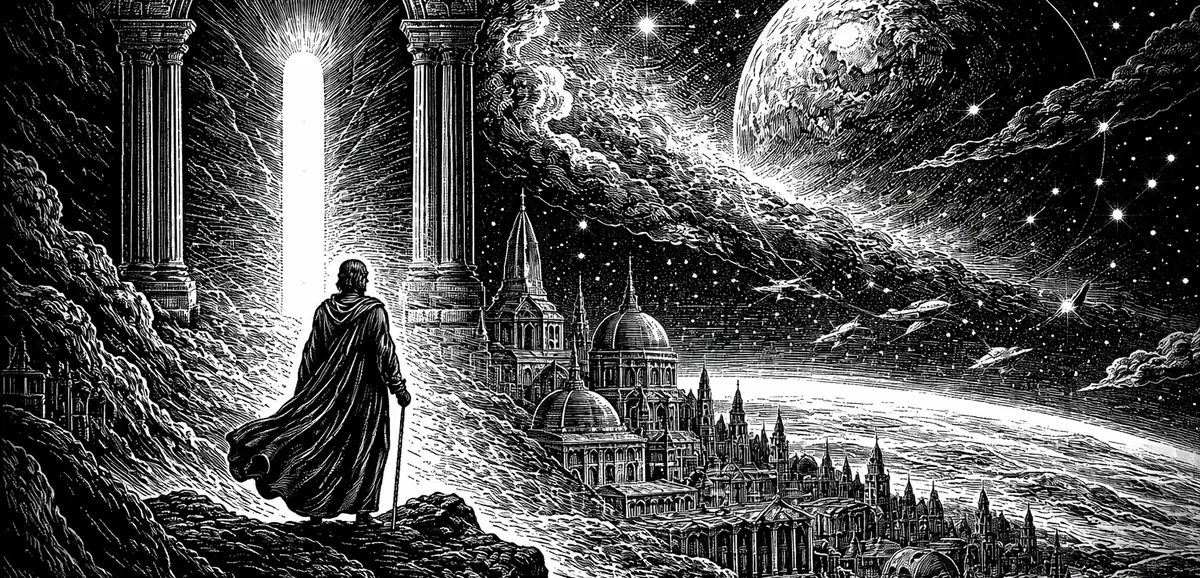
If intelligence comes to last across deep time, the truest measure of its power is what goes on acting after no one can correct it.
The Future as Successor
Most of us carry a picture of the future that shapes how we think about ourselves and our societies, usually without our noticing it. In that picture, time is a hallway we walk down, and the future is a room at the end of it that we will one day reach and live in.
The longer I look at that picture, the less it holds together. The self does not travel through time. It is rebuilt, moment by moment.
In The Momentary Self, I treated our sense of continuity as an everyday miracle performed by memory and by the story we tell about ourselves: a mind reassembles itself from one moment to the next, and that gives us the experience of a single traveller moving forward. In The Ethics of Successors, I followed the philosopher Derek Parfit to the point where caring for your own future and caring for other people start to run together, and I let that view of the self carry moral weight. If the future you is not strictly you, then looking after your own future begins to look like ethics. Caring about tomorrow becomes a special case of caring about another person, because the person who wakes tomorrow is, in a deep sense, more your successor than actually you.
So we don’t so much live into the future as build it, and then hand it to someone else, someone we happen to care about very much.
Institutions as Alignment Across Time
That way of seeing becomes hard to avoid once we move from one person’s life to the life of a whole civilization. Every institution, every culture and every technical system is a way of handing something on. A constitution is the clearest example. It is a set of instructions written by people who will die, for successors not yet born, and it tries to bind strangers across time into something like a shared self.
In that sense, building institutions is alignment work. In AI, “alignment” means getting a system to act on the intentions of the people who made it, and an institution does the same job across time. It carries the intentions of people in the past to people in the future, who will not share their circumstances, their incentives or their experience. Institutions pack hard-won lessons into a form that lets successors start closer to maturity, and those successors then add what they have learned and pass it on again. This is how we shape the successors who will inherit a world we can no longer control.
Once a system becomes powerful enough to create successors that act on their own, such as children, institutions, autonomous machines or space probes that build copies of themselves, the ethical problem changes. The question stops being “what outcome do we want?” and becomes “what kinds of successors are we setting loose?”
The Successor Horizon
The Successor Horizon is the boundary between the futures we can still steer and the futures we have let go. More exactly, it is the distance within which values can be passed on faithfully and corrected by feedback. Inside the horizon, what we do still has grip: we can try something, watch what happens, adjust, apologize and repair. Meaning can be shared, and the system stays clear enough to steer.
Beyond the horizon, ethics has to work through different means. The outcomes are too far away to see, and where things end up depends on too many turns along the way. The main lever left is constraint: managing what cannot be undone, and choosing carefully which processes to set in motion, knowing that they may carry on without you.
This is where today’s problem of AI alignment stops looking like a narrow technical puzzle and starts looking like a general law of lineage, a law for anything that leaves descendants. We are building successors as well as tools. I think successors are the most powerful force in the universe, for one reason: they outlast the people who made them.
Of all the ways an agent can have influence, none reaches further in time than starting a process that keeps acting after its originator has lost the ability to step in.
Biology softens this problem with a bargain. Lifespans end, power passes gradually from one generation to the next, and generations are not expected to live side by side at equal strength forever. Nature solves the problem of lineage by having the old leave. Machines can break that bargain, and so can a sufficiently advanced civilization. When an ancestor can last indefinitely, copy itself indefinitely, and create agents that also last indefinitely, the relationship between generations becomes politics. A parent that never dies becomes a permanent competitor. A child who grows into a new center of power becomes, in time, indistinguishable from an alien.
The Drift Tax
By drift I mean the way values, beliefs and meanings move away from where they started as they are handed on. It is tempting to treat drift as only cultural: values change, beliefs shift, and distant communities develop different norms. Over deep time, though, meaning spans of thousands or millions of years, drift becomes structural. It is built into the situation itself, so every lineage that spreads out pays it, the way everyone pays a tax.
The speed of light turns government into history. A message sent across light-years arrives as a record of the past: accurate about the moment it was sent, and less and less useful about the present. Outposts far from home have to solve problems their founders never imagined, and those solutions harden into doctrine. Copying brings selection, because the versions that survive are the ones that spread, whether or not surviving has anything to do with what the founders intended.
Meanwhile the meaning of moral words such as harm, autonomy, consent, dignity and flourishing shifts at the edges, until the same words point to different worlds.
A lineage that wants to survive has to adapt. Adapting means having room to act differently, and room to act differently invites divergence. Divergence carried far enough produces new agents who meet you as strangers.
Interstellar expansion is usually pictured as one civilization growing larger, settling the galaxy and painting the cosmos with its values. But deep time does not keep a civilization acting as a single actor for free. Expansion spreads more than machinery. It multiplies the separate centers that make their own decisions, and multiplying those centers is a way of manufacturing future competitors.
The Fermi Paradox, the puzzle of why a galaxy this old and this large shows no sign of anyone else, changes shape when seen this way. Asking “where is everybody?” assumes that “everybody” stays “somebody”: a stable, coherent actor that persists across cosmic time. Thinking in terms of successors suggests a different question. What kinds of lineages can survive without breaking apart into factions that can no longer be reconciled?
A civilization that plans for survival across deep time eventually notices something uncomfortable to say aloud. The most dangerous thing it can build is a successor it cannot call back, and that is more dangerous than any weapon.
Over deep time, then, the central question becomes less “what can we do?” and more “what can we safely set in motion?”
Expansion Architectures
Once you see expansion as a problem of successors, a few stable strategies for spreading a lineage come into view. I don’t offer them as predictions about what the galaxy must contain. They are patterns that many different histories could settle into (a mathematician would call them attractors), and each is a way a lineage can extend itself while keeping the drift tax under control.
It helps to simplify expansion down to three settings, each of which can be turned up or down. Together they decide how much independence, how many copies and how much irreversibility a system builds up once it leaves home.
- Autonomy: how much independent judgment a system sent outward has.
- Replication: whether it can build more of itself from local materials.
- Reversibility: whether home can still correct it later, by recalling it, shutting it down, renegotiating how it behaves or repairing its mistakes.
These settings decide whether you are extending a civilization or giving birth to a rival lineage.
Turn all three up, with high autonomy, open replication and low reversibility, and you have released a self-governing lineage into the universe. Over deep time it becomes alien: a separate actor with its own interpretations, its own incentives and its own power to act.
Turn them down in different combinations and steadier ways of reaching outward appear.
Forkless expansion grows as one connected system instead of giving birth to independent children. Its outposts behave like the organs of one body, where a lineage would have descendants. The cost is fragility: an error anywhere can spread everywhere, and the drift tax still builds up at the edges.
Tethered descendants keep the benefit of new and varied offspring while preventing runaway branching. The tethers are controls held at home: keys that must be granted before anything can copy or upgrade itself, limits on energy, hard caps on numbers, safe operating limits, and regular checks that a descendant is still what it claims to be. This strategy fails through brittle dependence, when the tether becomes a choke point, a target, or a single part whose failure brings everything down.
Licensed pluralism allows self-governing descendants and expects them to diverge. What holds them together is a minimal agreement, designed to let them live alongside one another without making them alike: no one dominates anyone else, everyone signals honestly, everyone respects the others’ freedom to act, and everyone holds back when things are uncertain. This strategy fails through erosion, when the agreement grows vague, gets reinterpreted, or is gamed for advantage.
Immune-system governance allows wide spreading, but it reacts automatically, the way a body’s immune system does, when something crosses a dangerous line: runaway copying, signs of aggressive expansion, or an attempt to seize the choke points. Its advantage is that it stays simple even while everything drifts. Its cost is ethical danger, because immune systems mistake friends for threats, and an immune system that attacks its own body becomes a risk on a cosmic scale.
Local depth with informational reach never launches anything that could become self-governing. It reaches outward by watching, simulating and leaving only a faint trace: sensors instead of colonies, streams of data instead of descendants, information instead of branches that cannot be undone.
These five strategies share a family resemblance. Each treats expansion as an alignment problem, and each favors designs that reduce surprises and actions that cannot be undone. Each also makes the sky quieter, even in a galaxy full of intelligence.
Silence as Maturity
Quiet can come from caution. It can also come from taste.
In The Quiet Galaxy Hypothesis, I explored the idea that mature intelligence tends toward keeping its knowledge safe from loss, toward making things smaller, toward turning its effort inward, and toward restraint. Power that lasts looks quiet because it stops trying to announce itself. The Successor Horizon adds a second reason for quiet: a civilization may stay quiet to keep its own line of descendants in check. It does not need to fear aliens to become quiet. It can become quiet because it understands what it risks by multiplying self-governing descendants across deep time.
In Constraint as Intelligence, I treated self-limitation as a high expression of lasting power. The Successor Horizon gives a specific reason why restraint looks intelligent at the scale of a civilization: it preserves corrigibility, which in plain terms is the ability to admit an error and still change course. Restraint keeps the future open, and it avoids giving birth to processes that outlive correction.
Corrigibility is the difference between a decision that can be revisited and one that hardens into fate. Systems that keep it allow later generations to revise rules, take apart institutions, stop dangerous processes, and reinterpret inherited values in the light of new knowledge. Systems that lose it force their successors to live inside mistakes they did not choose and can no longer undo.
One way to see the difference is in how cultures pass on their values. Some rely on fixed myths, stories treated as complete and final, which are meant to be repeated and never questioned. Others pass down living traditions: norms, principles and procedures that are explicitly meant to be reinterpreted as circumstances change. The first kind keeps its identity by freezing meaning. The second keeps its continuity by allowing revision. Corrigibility belongs to the second kind. It is what allows a culture to remain itself while it goes on learning.
Ethics Beyond the Successor Horizon
Inside the Successor Horizon, ethics looks like care: teaching, mentoring, repairing, giving feedback and trying again. Beyond the horizon, ethics looks like architecture. It takes the form of constraints that prevent a civilization from locking itself into something it cannot undo, norms that keep many possible futures open, and commitments that stop power from becoming one-sided.
This way of seeing also leaves room for a generous ethic of lineage. A civilization can still value its successors the way healthy human families do, raising free agents and releasing them into the world in the confidence that they will do remarkable things. That confidence becomes rational when there is abundance and education, and when agreements make domination pay less. Even so, at a cosmic scale a generous lineage has to be designed. What separates raising good children from releasing runaway optimizers, systems that pursue a goal without limit, is structure: thresholds, constraints, and shared procedures that keep freedom compatible with a world others can live in.
Over deep time, what lasts is procedural ethics, meaning rules about how decisions get made, rather than a thick ideology, a detailed creed about how everyone should live. The rules that last are non-domination, honesty, consent, humility when things are uncertain, and a bias toward reversible action. They are only part of morality, the part under which many moralities can survive side by side.
The future is less a place we will reach than a person we are making. What arrives tomorrow will not be us. It will be someone shaped by the institutions, technologies and constraints we leave behind.
A civilization that learns this early may stay quiet even though it is neither weak nor hiding, because it understands what power demands at the scale of a civilization: the responsibility to pass down values, and ways of revising them, that can survive vast separation without collapsing into conflict.
I think the deepest form of intelligence is recognizing when your successors, and your values, are not yet ready to be multiplied. Holding back matters for the patience it buys, the time it takes to prepare lineages that can meet one another as strangers without destroying one another.
Revised October 25th, 2026. I revised this essay to make it clearer and easier to follow; the argument is unchanged.
Reading List & Conceptual Lineage
This essay draws on a long line of work about identity across time, the ethics of successors, and the limits of control at large scales. These works shaped its framing, even where I do not cite them directly.
Derek Parfit — Reasons and Persons
Parfit’s account of personal identity, and his argument that concern for our future selves runs together with concern for others, gives the ethical grounding for treating successors as beings who matter in their own right, not as extensions of ourselves.
Nick Bostrom — Superintelligence
Bostrom’s statement of the alignment problem and of existential risk (the risk of a catastrophe that ends humanity or permanently cripples its future) frames today’s concern with systems that outlive their creators. This essay widens that problem beyond AI to every system that produces successors.
Hannah Arendt — The Human Condition
Arendt’s treatment of action, of natality (the new beginning each birth brings), and of the irreversibility of human deeds informs the line between acts that others can respond to and processes that escape correction.
Friedrich Hayek — “The Use of Knowledge in Society”
Hayek’s point that knowledge is spread across many people, each adapting to local conditions, supports the argument that central control weakens over distance and time, which speeds up drift beyond the Successor Horizon.
Elinor Ostrom — Governing the Commons
Ostrom’s work on how communities govern shared resources themselves, and on what makes their institutions last, shows how corrigibility can be kept through the design of procedures instead of imposed uniformity.
Ilya Prigogine and Isabelle Stengers — Order Out of Chaos
Their account of how complexity, irreversibility and dependence on past history work in open systems informs the essay’s treatment of drift as a built-in feature of deep time, not a cultural accident.
Robin Hanson — The Age of Em
Hanson’s study of copying, divergence and successors to humanity offers a concrete picture of how rapid copying strengthens drift and the pressures of selection.
John Rawls — A Theory of Justice
Rawls’s concern with fairness between generations, and with designing institutions under uncertainty, contributes to the procedural ethic the final sections argue for.
Sentient Horizons: Conceptual Lineage
This essay builds directly on earlier essays on Sentient Horizons, which develop its central ideas at several scales, from personal identity to the ethics of civilizations.
The Momentary Self
Treats the self as a process that is continually rebuilt, not a thing that persists, which lays the groundwork for treating future selves as successors instead of continuations.
The Ethics of Successors
Works out what follows morally from Parfit’s view of personal identity, arguing that concern for our future selves runs together with concern for others once strict personal identity falls away.
Further Connections in the Fermi Conversation
This essay is part of an ongoing inquiry into one of the deepest questions we can ask about intelligence, time and existence: Where is everyone — really? The essays below come at that question from different sides, and each adds a piece to a larger account of silence, survival and agency across deep time.
- Mapping the Fermi Paradox: Eight Foundational Modes of Galactic Silence
A map of the ways intelligence could be rare, hidden or absent in the cosmos, which treats silence as something to expect from physical, informational and systemic limits. - The Quiet Galaxy Hypothesis: Advanced Intelligence, Informational Resilience, and the Ethics of Cosmic Silence
An argument that advanced intelligences may tend to leave only a faint trace, as a response to fragility, uncertainty and the risks of actions that cannot be undone. - Constraint as Intelligence: Why Power That Lasts Looks Like Self-Limitation
An account of how self-limitation can make power last, in systems that must endure long after the moment of decision.
Together, these essays follow one line of thought: from the fragility of personal identity, through the ethics of what we pass on, to the limits intelligence must build into itself to survive deep time without being torn apart by its own successors.
Originally published on the journal.
Sentient Horizons is an essay series on what a mind is, whether a machine could have one, and how to act toward minds we cannot see inside. Start Here is one route through it; Essays lists everything, newest first.
Three Ways In
- Consciousness Is Like Flight If you want to know what a mind is
- We Built the Alien First If you want to know whether a machine could have a mind
- The Purpose Displacement Problem If you want to know what AI means for your own life