Frontier Dispatches · November 14, 2026
Why SpaceX catching Starship's upper stage is the biggest step this year toward people working in space
On November 14th, 2026, SpaceX caught the upper stage of its Starship rocket as it came home from orbit, the half of every rocket that has always been thrown away. If Starship can fly again cheaply and often, it opens the door to the future I most want to see: people going out to work on the Moon, in orbit and further out, the way people go to work on an oil platform today.
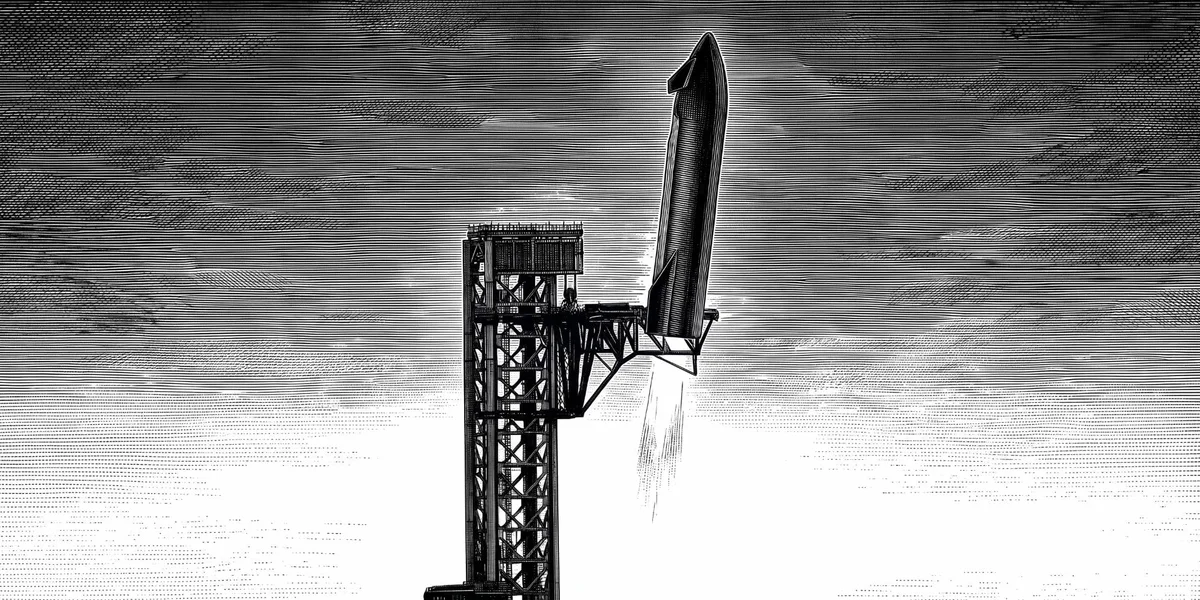
On November 14th, 2026, the arms of a launch tower in South Texas caught the upper half of SpaceX’s Starship rocket as it came home from orbit. Every rocket that has ever reached orbit has thrown that half away. The booster, the lower half of the same rocket, was lost over the Gulf of Mexico the day before, and no Starship upper stage has flown a second time yet, so there is a lot still to prove. Even so, I think this was probably the most important event of 2026 for the future I most want to see.
The catch, from Space.com’s video channel. The video starts at 10:27, as the tower’s arms close around the ship.
The world I want to live in
For most of my life I have wanted the solar system to open up while I am alive, and not as a place a few astronauts visit. I mean a place people go to work. The picture I carry comes from The Expanse, the science-fiction novels by James S. A. Corey, in which there are mines in the asteroids, ships carrying cargo between them, and crews who rotate out for months and come home again. In September I put a number on that hope with The Belt Equation, a public estimate of the chance that, before I die, I live and work in a solar system where human industry reaches beyond Earth and Mars. The essay that introduced it, The Belt Equation, sets out how it works.
The honest answer is small. The site puts my odds of being out there working at about half a percent if I live to the age most men my age reach. That figure needs the whole picture to come true, mines and shipping and all. The same page also gives the odds of two smaller steps on the way, which would come sooner, and those odds are much better. It puts the chance that a seat on a flight to orbit sells for under a million dollars at 33 percent. It puts the chance that I work a stretch of months at a space station or a base on the Moon, even if industry never goes further, at 9.3 percent. Cheap launch is what would bring those two steps closer first.
Why everything waits on launch
The reason the solar system is not open for business is mostly the price of getting there. For most of the history of spaceflight, most of every rocket has been thrown away after one flight, so each trip has carried the cost of building the machine again. It is as if every car were scrapped at the end of one drive.
The fairest way to compare rockets is by what it costs to put one kilogram into low orbit, the region a few hundred kilometres up where the International Space Station flies. On that scale the history looks like this:
- The Space Shuttle: about $16,000 a kilogram, or $16 million a tonne. NASA put each launch at about $450 million in 2011, its final year, and a full load to low orbit was 27,500 kilograms.
- Falcon 9, today: about $2,720 a kilogram, or $2.7 million a tonne, about a sixth of the Shuttle’s price. SpaceX got there largely by landing the booster and flying it again, but the upper stage is still built new for every launch and flies only once.
- The price the Belt Equation is waiting for: under $200 a kilogram, or $200,000 a tonne, which is less than many houses cost. That is about a fourteenth of Falcon 9’s price and about an eightieth of the Shuttle’s.
The Shuttle’s figure assumes it flew full, so it is the best it could do, and it is in 2011 dollars, so in today’s money the gap would be wider still.
Starship is built so that both halves come home. If it works as designed, it will be the first fully reusable orbital rocket, and it will carry more than any rocket ever built. SpaceX says its aim is to cut the cost of launch by reusing both stages and building them in large numbers. On the Belt Equation’s tree, cheap launch sits underneath everything else: every outcome from a permanent outpost up to a working economy in the asteroids needs mass to orbit to get cheap first.
What a cheap, regular Starship opens up
Cheap is only half of it. Starship also has to fly often, because the big missions need many flights. Going anywhere beyond low orbit means refuelling Starship in orbit several times, with separate flights carrying the fuel up. A rocket that can be caught, refuelled and sent up again within days is what turns those plans from a stunt into a schedule.
If that happens, the things it opens up come in order.
- The Moon. A version of Starship is NASA’s lander for the Artemis programme, and the first crewed landing with it is targeted for 2028. The Belt Equation’s steps for working on the Moon depend on pumping a hundred tonnes of fuel between spacecraft in orbit, which only a frequent, reusable rocket makes practical.
- People working off Earth for pay. The step I watch most closely is a hundred people working off Earth at the same time, for pay, every month for a year. That is a permanent outpost, and it needs a rocket that flies on a timetable.
- A reason to stay. The hardest step in the whole equation is something mined or made off Earth and sold at a profit. Cheap launch does not make that money by itself. What it does is let many more people try, because a failed attempt stops costing the price of a rocket.
That last point is why I care so much about this one rocket. A space economy will not be planned into existence by one agency. It will come, if it comes, from many companies and many people taking shots that are only affordable when the ride is cheap.
Why this catch, of all the year’s news
The booster half of Starship had already been caught at the tower on earlier flights. The upper stage is the harder half, because it comes back from orbit, falling into the atmosphere far faster than the booster ever travels, and until November 14th no Starship upper stage had been recovered. It was the last part of the rocket still thrown away on every flight.
The history of Falcon 9 shows what a first like this can lead to. Its booster first landed in December 2015, and by 2018 landing and reflying it had become routine. If the upper stage follows the same path, November 14th, 2026 will be to the second half of the rocket what that first landing was to the first half: the day the part that was always thrown away came home.
What still has to go right
The booster was lost after what SpaceX’s broadcast called a “low fuel mass alarm” cut short the burn that turns it back toward the tower. The upper stage that was caught has not flown again, and on a call with its investors on October 20th, 2026, SpaceX said it aims to “refly the second stage by early next year”. Starship’s dates have slipped before, too: the first try at catching an upper stage was planned for August 2026 and came in November.
And coming home is not the same as flying cheaply. NASA’s Space Shuttle orbiters came back from orbit and flew again for thirty years, but so much was taken apart and replaced between flights that each launch still cost hundreds of millions of dollars. A catch only matters if what is caught can be checked, fuelled and sent up again quickly.
That is also why nothing moved on the Belt Equation this week. Its step for this event asks for both halves of a heavy rocket back from one flight, each confirmed able to fly again, and that has not happened yet. The Belt Equation’s own piece sets out the numbers in more detail: Why SpaceX catching Starship’s upper stage matters for everything beyond Earth.
What I am watching next
- A caught upper stage flying again, and how much work it needs first. SpaceX’s target is early 2027.
- A flight that brings both halves home, once the cause of the booster’s fuel alarm is known.
- How often Starship flies. A hundred flights in a year, with both halves reused, is the next step on the tree.
- The first refuelling test in orbit, which SpaceX has also targeted for early 2027.
Half a percent is still half a percent, and one catch does not change that. But for years the honest objection to the future I want has been that getting to orbit costs too much for anyone to go out there and work. On November 14th, the last piece of the rocket that was always thrown away came home, and for the first time I can see how that objection might stop being true.
Reading List & Conceptual Lineage
From Sentient Horizons
The Belt Equation
The question, the eight links in the chain, and why I publish a forecast of half a percent about my own life.
The tracker
Why SpaceX catching Starship’s upper stage matters for everything beyond Earth. The Belt Equation’s piece on the catch: the chain of launch steps, why nothing moved, and the flight itself.
The Belt Equation. The headline figure, the odds of the smaller steps on the way, and the full tree of what has to happen.
External Works
CBS News — SpaceX pulls off dramatic midair catch of Starship rocket after fiery plunge from orbit (November 14th, 2026).
Space.com — live updates on the flight (November 13th to 14th, 2026).
The Motley Fool — the transcript of SpaceX’s call with its investors (October 20th, 2026), for the targets of flying an upper stage a second time and refuelling in orbit.
James S. A. Corey — The Expanse. The picture of a solar system people work in.
Banner: an illustration of the upper stage coming home to the tower, not drawn from a photograph.
Sentient Horizons is an essay series on what a mind is, whether a machine could have one, and how to act toward minds we cannot see inside. Start Here is one route through it; Essays lists everything, newest first.
Three Ways In
- Consciousness Is Like Flight If you want to know what a mind is
- We Built the Alien First If you want to know whether a machine could have a mind
- The Purpose Displacement Problem If you want to know what AI means for your own life