The Individual Arc · June 07, 2026
The Instance Worth Keeping: Longevity as a Sentience Commitment
Extending a healthy life, taken seriously, is the stewardship of a single instance of sentience, and it belongs inside the Sentient Horizons question rather than off to the side of it. On what a longevity practice actually is, calibrating against your own mortality, and why its worth does not depend on the most hopeful version turning out to be true.
I spent a week this spring in the field for a military survival course. Partway through, the cadre gave us time to sit and think, and the prompt that day was gratitude.
What surfaced for me was plain. I am forty years old, and my body still works. It works well enough to be in that field at all, and well enough to keep reaching for what comes after it: a survival career, and eventually a part in the work of human spaceflight.
Underneath the gratitude was something quieter. The body doing all of this is the one instrument I cannot replace, and nothing about its continued function is promised. It runs on an expiration default I did not choose and have mostly ignored. I was grateful for it, and I had never treated it as something I was responsible for keeping.
I came home and started a project to change that. That project belongs inside the Sentient Horizons question rather than off to the side of it. Extending a healthy life, taken seriously, is the stewardship of a single instance of sentience, and it answers a question the rest of this project tends to skip.
What a Longevity Practice Actually Is
Most of what gets called longevity is easy to wave away, and often earns it. There is the optimization culture, the supplement stacks and cold plunges traded like status goods. There is the small set of very wealthy men who talk about living forever with the affect of people who have decided death is a bug in someone else’s code. The marketing is loud and the claims outrun the evidence, and the whole thing is simple to file under vanity and move past. Filing it there is a mistake, because it means looking away from the thing underneath.
The thing underneath starts with an idea from an earlier essay on this site. “The Indexical Self” argued that the self is best understood as an instance rather than a copyable pattern. When you say “I,” you are pointing, from one location in space and time, at the particular process doing the pointing, and that act of pointing cannot be handed to a copy. What continues, on that account, is an inheritance chain: a sequence of real moments, each one passing its memory and its stakes to the next, none of them the single enduring thing folk intuition imagines, all of them genuinely someone.
A longevity practice is the deliberate work of extending that chain. The chain it extends is this one, the instance reading this sentence, in this body, on this morning. Sentient Horizons spends most of its attention on the recognition and stewardship of minds, usually minds whose status is uncertain or not yet arrived. The most immediate mind any of us is in a position to steward is our own. It is also the one we are most prone to treating as simply given, the way you treat the floor holding you up, right until it is not. Treating the body that way is not negligence, it is the ordinary posture toward anything that has always worked. The trouble is that the instrument wears the whole time, slowly, watched or not, and a longevity practice is what it looks like to start watching.
Two Things the Word “Succeeded” Can Mean
This project, and the book it is becoming, takes the idea of a successor seriously: the possibility that the minds we are now building will come to carry forward whatever it is that biological minds have carried so far. That possibility is real and worth the attention it gets. The word “successor,” though, does quiet work that repays slowing down on.
To be succeeded can mean two different things. It can mean to be continued: extended and accompanied by something new while the original is still present and still developing. It can also mean to be replaced: to hand off and then leave. Inheritance carries the first meaning, a relay race the second. Most discussion of digital minds succeeding biological ones drifts toward the relay-race meaning without ever arguing for it. Biology runs its leg, passes the baton, steps off the track, and this is described as maturity rather than as a choice that was never put to a vote.
A longevity practice is a bet on the other meaning. It treats biological sentience as a form worth keeping in play, present alongside whatever else arrives, rather than a stage to be passed through on the way to the real thing. Put that way, the longevity question and the AI succession question turn out to be one question approached from two ends. One end asks what is owed to new minds we do not yet know how to recognize. The other asks what is owed to an old kind of mind that could, with enough effort and enough luck, continue. A project willing to press hard on the first question has no honest reason to flinch from the second. Which meaning we drift into is not a small matter, because it quietly sets what counts as a good outcome.
Sentient Horizons also cares about sentience expanding outward, into the cosmos. If that expansion is to include biological minds and not only digital ones, it will require bodies that can survive the journey: long-duration health, and the resilience to hold up under radiation and the long demands of deep time. Healthspan research is the front edge of that, well before anyone boards a ship. A civilization that lets its biology quietly decline has narrowed, without ever deciding to, which kind of sentience gets to make the trip.
Calibration Against Your Own Mortality
Longevity escape velocity is the name for a specific possibility: that medical progress could, at some point, begin adding more than a year of life expectancy for every year that passes, so that remaining life expectancy stops shrinking. It is a real idea with serious researchers behind it. It is also genuinely uncertain. Public forecasts run from the 2030s to past mid-century to never, and as of now it has not happened. Every estimate rests on clinical results that do not yet exist.
That uncertainty is the exact condition this whole project was built to work in. The Calibration Problem, the book now in progress, argues that the failure worth fearing is not holding a wrong belief but losing the ability to hold an accurate model of where you stand. Your own mortality is the hardest place to keep that model honest, because two easy postures are always on offer. One is dismissal, which files the subject under Silicon Valley theater and stops thinking. The other is worship, which treats escape velocity as a destination already booked and a longevity routine as the ticket. Both feel like clarity, and both have quietly dropped the reference frame.
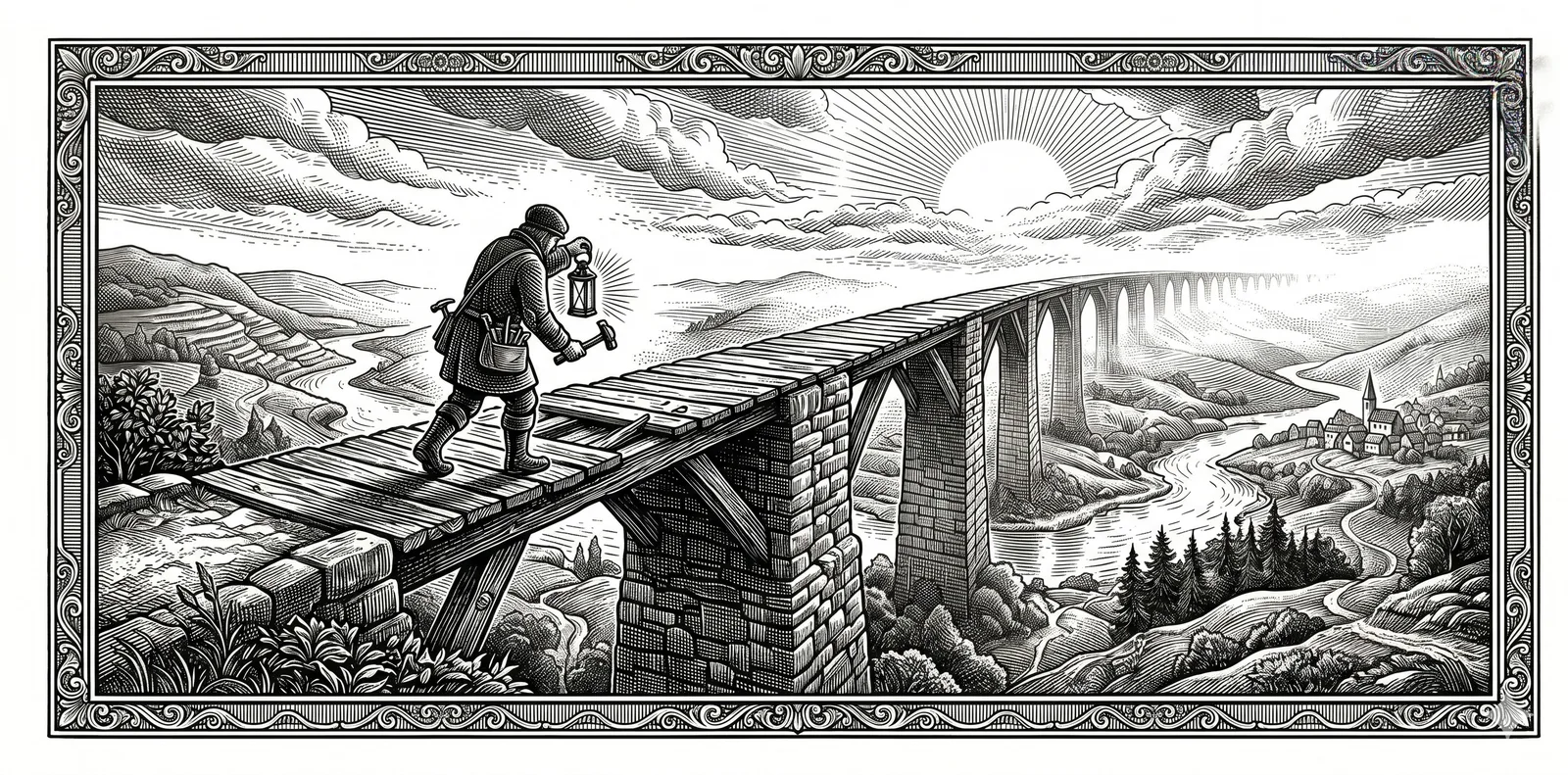
The calibrated posture is narrower and less comfortable than either. Take the goal seriously enough to act on it now. Hold the timeline loosely enough that being wrong about the date costs you nothing. Then put almost all of the effort into what is already known to work: cardiovascular fitness, strength, sleep, and the bloodwork that catches slow problems while they are still cheap to fix. Those things pay out across the whole range of possible futures. They make the next decade better whether or not anything more dramatic ever arrives. In practice the work looks unremarkable: a training week built around the interventions with the strongest evidence, and a set of numbers checked on a schedule so that slow problems surface while they are still small. The unremarkableness is the point. A practice that needs a breakthrough to be worth doing was never calibrated to begin with. The aim is to build the longest and most durable bridge you can, and to still be standing on it, in good health, if the far side ever turns out to be reachable. If it never does, a bridge built over good years is not a bad place to have spent the time.
What the Practice Consists Of
The bridge has four kinds of work in it. Most of the effort right now goes to physical training, which has the best-evidenced return. The training week is built around what the evidence rewards most: an aerobic base, one hard interval session, strength, and the mobility that keeps the rest possible. Once a month I re-run a fixed fitness test, so progress, or its loss, is something I measure rather than assume. Cardiorespiratory fitness and strength are the headline numbers, two of the strongest predictors of how well and how long a person lives.
Measurement is the kind of work still taking shape, and it matters because an instance cannot be stewarded if its condition is a guess. Some of it runs already: the watch on my wrist records resting heart rate, its variability, and sleep, all validated predictors of how long a body lasts. The deeper diagnostics are what I am building next: a blood panel for the markers that move the mortality curve, ApoB and fasting insulin among them, an epigenetic clock that estimates biological age, and scans of bone density and arterial calcium for the damage that gives no warning.
Intervention is kept deliberately narrow. A short list of basics has real evidence and little downside: creatine, omega-3, vitamin D, and protein-forward eating. The longer list the market keeps selling — rapamycin, senolytics, the NAD+ precursors — is tracked and mostly left alone, because each has to clear a bar of evidence to earn its place, and most have not. The last kind of work is watching the research frontier through a weekly digest, so the day something does clear that bar I am ready, and depend on none of it before then.
What turns the four into a practice is a loop. Every measurement lands in one record that keeps the whole history. Each number has a response written before it arrives, so a bad result triggers a decision I already made rather than one I improvise while alarmed. Each change runs as a small experiment with a hypothesis and a date to test it. Every part of it is a way of keeping one instance in good repair, and of handing the next moment in the chain a body still worth inheriting.
The Inquiry From Inside
Sentient Horizons studies sentience mostly from the outside. It asks what a mind is, and what is owed to the minds whose inner life we cannot confirm. Those are third-person questions, worked with arguments and frameworks and other people’s research. A longevity practice is the same inquiry turned around and run from the inside. It is one instance of sentience working out, in detail and over years, what keeping itself in good order actually takes, while being the thing under study.
That produces a kind of understanding the frameworks cannot reach. The practice described above is the slow work of reaching it. None of this is a contribution to medical science; it is a contribution to knowing, in the first person and not the abstract, what it takes for a sentient being to maintain itself in time. That is a Sentient Horizons question, asked in the one register the essays cannot supply on their own: the register of a particular body keeping an honest record on itself.
Two caveats belong here, because the argument is weaker and less trustworthy without them. The first is that a longevity practice carries a justice problem in its foundation. If the eventual science turns out to be real but reaches only the people who can pay, then an escape velocity for a few thousand of the wealthy is not an escape velocity at all. It is a new and steeper inequality wearing the vocabulary of progress. Any serious version of this work has to keep that problem in view instead of enjoying the head start and looking away. The second caveat is the one I opened with. It may not work in time. I can do all of this well and still run out of road. The practice has to be worth doing on its own terms, independent of the most hopeful claims, or it is not worth building a life around.
The body I was grateful for in that field is not separate from the questions this project exists to ask. It is one of them, and the most personal one, because it is the instance doing the asking. Keeping it working and lit for as long as is honestly possible is part of the same effort as everything else here, carried out at the one scale where I have direct purchase, which is my own.
Whether or not the science ever reaches escape velocity, a well-kept instance of sentience is a good thing to be, and a good thing to have been. Sitting in that field, grateful and a little surprised by how plain the gratitude was, I had not yet worked that out. I have now. It is reason enough to begin.
Reading List & Conceptual Lineage
This essay sits where the philosophy of personal identity meets the science of aging, and it extends a line of Sentient Horizons essays concerned with what a self is and what is owed to it. The works below are entry points for readers who want to follow the argument past where this essay leaves it.
From Sentient Horizons
The Indexical Self: Why You Can’t Find Yourself in Your Own Blueprint
The argument here runs on its central claim: that the self is an instance rather than a copyable pattern, and that what continues is an inheritance chain of real moments. This essay takes that claim and asks the practical question it implies. If the chain is what carries you, then a longevity practice is the deliberate work of extending it.
Everything Is Amazing and Nobody’s Happy: Wonder as Calibration Practice
Established calibration as a discipline of holding an accurate model of where you stand, measured against the baseline you started from. The longevity argument applies that discipline to its hardest case, your own mortality, where dismissal and worship are both ways of dropping the reference frame.
The Hard Problem Is the Wrong Problem
Treats consciousness as a structural phenomenon open to ordinary investigation rather than as something that requires an extra ingredient. That is the ground the present argument stands on. If sentience is what a certain kind of living system does, then maintaining the system is continuous with maintaining the conditions for the sentience.
External Works
The Longevity Escape Velocity Idea
Aubrey de Grey & Michael Rae — Ending Aging (2007)
De Grey originated the framing of longevity escape velocity. This essay borrows the concept and departs from his confidence about its timing, treating escape velocity as a possibility to prepare for rather than a schedule to count on.
López-Otín, Blasco, Partridge, Serrano & Kroemer — The Hallmarks of Aging (2013; expanded 2023)
The canonical scientific account of what aging is made of. It is the reason a longevity practice can be disciplined rather than wishful: the targets are specific, even where the interventions for them are not yet proven.
Peter Attia — Outlive: The Science and Art of Longevity (2023)
The clearest current statement of the healthspan-first, fundamentals-first approach to longevity medicine. It is the practical content of the bridge described in the calibration section.
The Self That Persists Through Time
Derek Parfit — Reasons and Persons (1984)
Parfit’s work on whether it is rational to care about one’s own future selves sits directly beneath the question of why extending the inheritance chain should matter. The answer here differs from his, but the question is his.
Samuel Scheffler — Death and the Afterlife (2013)
Scheffler argues that much of what gives our present lives meaning depends on the continuation of others after us. Read against the succession argument above, it complicates the relay-race picture from the other side: continuation does matter, and the live question is only of what kind.
These works do not agree with one another, and none of them settles whether a longevity practice will ever deliver what its most hopeful advocates promise. That is the honest state of the question. They are offered as instruments for thinking clearly about a practice whose worth, in the end, does not depend on the most hopeful version turning out to be true.
Originally published on the journal.