The Individual Arc · May 30, 2026
The Purpose Displacement Problem
The automation debate asks which jobs vanish. The harder question is what work was actually for, and whether meaning can survive once AI removes the scarcity that made human contribution feel needed.
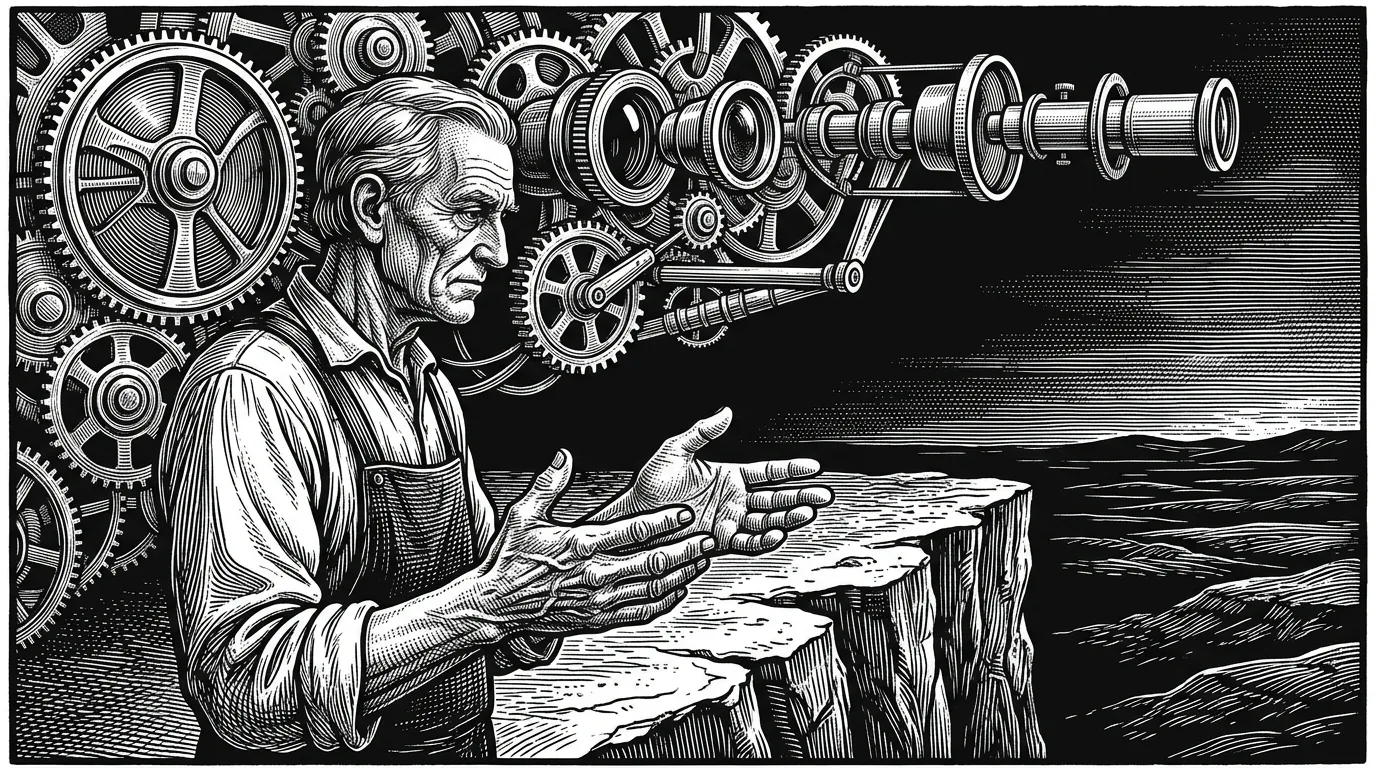
The automation debate is mostly an argument about jobs: which ones disappear, which new ones emerge, and how the economy redistributes around the change. Underneath it sits a harder question, the one almost no one asks with the same seriousness: what work was actually for.
The paycheck is the obvious answer and the least interesting one. What did the experience of mastery, contribution, and productive effort provide, as features of a human life, that made those lives feel coherent and directed? And what happens to that structure when intelligence and advanced human capability are no longer scarce?
This displacement is not just about unemployment. It is about the erosion of the preconditions for a particular kind of meaning. When AI systems become capable of performing not just tasks but judgment, when expertise and cognitive capability cease to be scarce, the displaced person hasn’t just lost income but standing as a contributor. The displacement strikes at who you are before it strikes at what you earn, and that ordering matters because economic displacement has economic solutions: retraining programs, new industries, redistribution of gains. Whether those solutions are adequate is a separate argument. The structural problem I’m describing doesn’t have an economic solution, because it’s not an economic problem. It’s a problem about the architecture of meaning, and scarcity has been one of that architecture’s load-bearing supports.
What Work Was Actually For
Work has historically served several functions at once, and they weren’t all about earning a living.
The economic function is the one automation debates focus on, and the disruption is genuine, but it’s the easiest part of the problem to solve. Economic displacement can be addressed in principle by standard policy mechanisms. The deeper functions cannot.
Work structures human identity. You are a doctor, a carpenter, a teacher, not just in the sense that you perform those tasks but in the sense that you are someone who can perform them, recognized by others as belonging to a domain. Professional identity is a way of locating yourself in a web of mutual dependencies, of knowing what you offer and being known for offering it. This is not vanity but a form of social legibility that most people rely on more than they realize until it’s gone. Ask anyone who has retired involuntarily, or been laid off from a job they were genuinely good at, how long the loss of that legibility takes to process. The answer is usually: longer than the financial adjustment.
Work provides mastery : the ongoing experience of confronting difficulty and becoming more capable through sustained effort. This appears to be a structural human need, not merely a preference. We don’t just want to achieve things. We want to be the kind of thing that can achieve things, and the process of becoming that kind of thing through genuine difficulty is generative in ways that passive comfort is not. The literature on intrinsic motivation converges on this point from multiple directions.
Work creates contribution : the sense that you are genuinely needed. That your specific capability addresses a real need that others can’t meet without you. This is subtly different from being valued. You can be valued as pleasant company, as a source of entertainment, and as someone others enjoy having around. Contribution requires that the need is real and your role in meeting it is non-substitutable. A patient whose diagnosis depends on your judgment. A family whose house stands because you know how to make it stand. The weight of mattering comes from the reality of the need and the reality of your irreplaceability in meeting it. And contribution structures time: it gives days their shape and seasons their direction, organizes life around a forward-looking horizon of projects that extend across months and years. The project orientation is not incidental to how work generates meaning. It is part of how activity anchors a life in time.
What AI displacement threatens, at full development, is all three of these simultaneously except the economic function. People can still practice medicine, make furniture, teach children, and write code, if they choose. But the frame that made those activities generative of meaning collapses, because the scarcity that was load-bearing disappears. You can still do the work. You can’t make the work needed in the way it once was.
The Assembly Requirement
There’s an analogy from Assembly Theory that illuminates why scarcity is load-bearing.
Assembly Theory measures the informational richness of an object by asking how much causal history went into producing it. A crystal has a low assembly index: relatively few non-repeating steps to produce it, given the right conditions. A living cell has a high assembly index: an enormous number of steps, each building on the last, requiring the specific causal history of biological evolution. The assembly index is a measure of depth.
Applied to human contribution, the theory maps onto two distinct phenomena that are easy to conflate and important to keep separate.
The first is output assembly : the informational richness of what gets produced. A precise medical diagnosis selects the right answer from a vast space of possibilities. Good legal argument integrates law, precedent, and circumstance into a structure that couldn’t be built without genuine understanding. The output assembly of expert work is high because the output is specific, non-generic, calibrated to actual conditions in ways that require real knowledge to achieve.
The second is capability assembly : the accumulated causal history in the person who can produce that output. The years of residency, the thousands of cases, the failure-and-correction cycles that built genuine judgment. The physician’s capability has a high assembly index not because of any single diagnosis but because of the unrepeatable history that made them capable of it.
These two forms of assembly come apart under AI. A well-trained diagnostic system may produce higher output assembly than most human physicians: more accurate, more consistent, and better calibrated across a wider range of presentations. That output assembly has genuine value. But from the perspective of any human user of the system, the capability assembly is zero. Nobody had to become anything to access it. The capability exists, at a distance, available to anyone who can pay the subscription fee.
This is the structural shift that matters for meaning. When capability assembly was required to access high output assembly, when the only way to make excellent diagnoses was to become an excellent diagnostician, the capability conferred standing. Being recognized as someone who had done the irreducible work of becoming. The meaning attached to expert contribution was parasitic on this recognition: on the acknowledgment that here is a person who assembled themselves into something others hadn’t, through effort that couldn’t be skipped or compressed.
When AI decouples output assembly from capability assembly, that recognition becomes structurally unavailable. The output quality may be higher than ever. But the sense of being needed, which turns out to have been doing enormous load-bearing work in the architecture of meaning, was tied to capability assembly, not output quality. And capability assembly is exactly what AI makes unnecessary.
The decoupling invites a fix that should be refused. If human capability assembly has stopped conferring standing, one response is to protect it by force: to wall off certain domains, slow the systems that outperform people, and keep work in human hands by rule rather than by need. The appeal is understandable, but the move is a mistake. Holding a society’s output back to preserve the old basis of human standing buys a neededness that has been manufactured rather than met, and it forfeits the real gains the capability would have produced: in medicine, in science, and in material well-being. Both the person and the society come out worse, the person left with a hollow role, the society poorer than it had any reason to be. The harder task, and the only one worth the effort, is to build new sources of capability assembly: paths by which more people can still become someone through real effort and be recognized for it, free to pursue their own flourishing in a world where economic output is no longer the only measure of what a life is worth.
The Same Question at Two Scales
Civilization is itself a cognitive system, capable of something like a theory of mind toward its own members and toward other forms of intelligence. That cognition can degrade. Purpose displacement is what happens when the same structural problem that the Quiet Galaxy hypothesis traced at civilizational scale operates at the scale of an individual life.
A civilization loses coherent agency when it can no longer integrate information across time into directed action, when the assembly index of its collective decisions collapses, and the feedback loops between observation and steering break down. A human life loses coherent direction when the activities that structured its time and identity no longer function as genuine contributions, and when the sense of being non-substitutably needed erodes.
The structure is the same at both scales. What’s at risk in each case is the depth and integration that made the system coherent. Both are questions about what happens to agency when the conditions that generated it change faster than the agent can adapt. A civilization that loses the capacity for directed collective action drifts. A person who loses the conditions for meaningful individual contribution drifts. The drift looks different from the outside, but the internal experience, the slow erosion of coherence and direction, is recognizably the same phenomenon operating at different scales.
The Mistake We’re Making
Most responses to purpose displacement make a category error. They treat the problem as one of finding new activities for humans to perform. New jobs, new roles, new sectors. The reasoning goes: technology always displaces some activities and creates others. The agricultural revolution eliminated peasant farming but created industrial workers. Automation will be no different.
This reasoning is partially right about economic displacement and entirely wrong about structural displacement. The real problem is not what people will do but what will make what they do feel like a genuine contribution rather than a consolation activity.
Consolation activities can be pleasant, even absorbing, even socially recognized. But they lack the structure of genuine contribution because they don’t arise from positions of real need. They’re elective rather than necessary, and the difference between elective and necessary turns out to be doing more structural work in the architecture of meaning than most people recognize.
The structural problem is this: meaning of the kind I’ve been describing requires someone who genuinely needs what you specifically can provide. When AI systems can address those needs as effectively as humans, or more effectively, the positions of genuine need that structured human contribution start to disappear. You can still do the activities. But you’re doing them in a frame of elective contribution rather than necessary contribution, and the sense of being needed, which was carrying more weight in the architecture of a meaningful life than we typically acknowledged, doesn’t automatically transfer.
The category error is thinking the solution is finding new things for people to do. The solution, if there is one, is reconstructing the conditions under which activities generate the kind of meaning that sustains a life. That requires understanding what those conditions actually were, which is the step most policy responses skip entirely.
Voluntary Difficulty as Candidate
The human response to purpose displacement, so far, tends toward voluntary difficulty. Physical training pushed past comfort, artistic creation, intellectual work, craft and making. These are activities where the challenge is real even if the necessity is chosen. You could take the easier path, but you don’t. You lift the weight, write the essay, develop the skill.
There’s a real case for this as a partial solution. Voluntary difficulty preserves the assembly requirement in the sense that the mastery is genuine, the depth of effort is real, and temporal structure is maintained. Communities of recognition form around these practices: athletes who understand what the training costs, readers who engage seriously with the ideas, and fellow practitioners who know the craft.
But there’s an asymmetry that simple voluntary difficulty cannot fully bridge.
When Deep Blue beat Garry Kasparov in 1997, and engines pulled out of human reach entirely over the decade that followed, chess did not die. People study it, compete at it, and build whole lives around it, fully aware that the strongest player in any room is never going to be a person again. Voluntary difficulty works here without strain, because chess was never meeting anyone’s need. Nobody ever required the best move from you. The point was the contest and the play, and when the machines took the top of the game they took nothing the human pursuit of it had ever depended on.
Now consider a surgeon who has spent twenty years developing the judgment to operate on a child’s heart. The years of residency, the failures that taught her what the textbooks couldn’t, the accumulated weight of thousands of decisions made under pressure. Now imagine a world where an AI surgical system performs the same operation with better outcomes, more consistently, and with lower complication rates. The surgeon can still operate. She can maintain her skills, even improve them. She can choose to do heart surgery because she finds it meaningful and because the craft is beautiful. But the child’s parents, given the choice, would choose the AI. They should choose the AI. And the surgeon knows this.
She hasn’t lost the skill, the knowledge, the beauty of the craft, or the depth of her training. She has lost the position of genuine need that made all of those things matter in a specific way. The assembly history is still hers, but what it assembles toward has changed. She is practicing an art form where she used to be saving lives, and the difference between those two frames is not something you can bridge by deciding to find the art form sufficient.
This is more uncomfortable than the chess example, because nobody’s life depended on chess. The surgeon’s situation exposes the asymmetry in its starkest form: voluntary mastery in a domain where you are no longer the best available option for the people who actually need what you do.
The deepest question is phenomenological: does voluntary difficulty, chosen freely, carry the same existential weight as difficulty that was genuinely required? The answer, I think, depends on a distinction that the binary of “voluntary vs. necessary” obscures.
Toward Genuine Stakes
The binary between voluntary and necessary contribution misses a third category that turns out to be more interesting than either pole, and it doesn’t require altruism or prophetic foresight to access.
Call it frontier-seeking : the deliberate choice to pursue domains where the standards are external, the entry costs are real, and the test of whether you’ve earned your place is administered by conditions you don’t control.
In reactive necessity, the need precedes you. The world has a gap and summons whoever can fill it. In elective consolation, you precede your contribution entirely and search for contexts willing to receive what you’ve chosen to offer. Frontier-seeking is neither. You aren’t responding to a present summons, but you also aren’t choosing difficulty because the alternative is drift. You’re asking a more precise question: where are the most interesting things going to happen, what does it cost to get in the room, and am I willing to pay that cost under conditions I don’t set?
The externality of the test is real, but it isn’t what sets frontier-seeking apart, because necessity has it too. When you pursue entry into a genuinely demanding domain, one with real selection standards, real consequences for failure, and requirements that don’t bend to your preference for easier, you are accepting that the world, not you, determines whether you’ve earned your place. That same structure was doing the load-bearing work in necessity-based contribution all along: not the absence of choice, but the presence of a genuine external standard. The surgeon’s meaning didn’t come from having had no alternative to medicine. It came from being in a domain where patients either recovered or didn’t, where the judgment was real, where the test was administered by reality rather than by herself.
What separates the two is the state of the need when you arrive. In reactive necessity, the role already exists and is summoning you; society has named it, mapped the path to it, and waits for someone to fill it. Frontier-seeking enters the domain before the role has hardened, when the standard is already real but no one has yet codified it into a position that calls for applicants. The same work can fall on either side of that line. A neurosurgeon today fills a defined, credentialed role the world already knows it needs. Harvey Cushing, operating early in the twentieth century when brain surgery was barely a field and most operations ended in death, was entering a domain that had not yet decided it needed him. Same scalpel, same indifferent judge. What changed is whether the role existed to receive him.
The same flip is happening now. A decade ago, AI alignment research had no labs, no funding, and no job titles; the people who entered it spent years on a problem most dismissed as science fiction, judged only by whether the technical work held up against real systems. Now “alignment researcher” is becoming a credentialed role the field summons people into. The work didn’t change; the summons arrived late.
Frontier-seeking reconstructs that structure without requiring a present summons. The person who chooses difficulty because the domain they’re pursuing doesn’t care whether it feels meaningful is doing something different from the person who chooses difficulty because it feels meaningful to them. Both are making choices. But one is building toward a test administered by preference, and the other toward a test administered by reality. The first is consolation with extra effort. The second is genuine assembly under genuine stakes, deferred.
The load-bearing feature of necessary contribution was never that you lacked a choice. It was that the standard was real. You can seek that out. The frontier imposes it whether or not you were summoned.
The Lineage Problem
There is a second dimension to frontier-seeking that the framing of external standards alone doesn’t capture: the question of from whom the test is administered.
Being tested by conditions is one thing. Being tested by practitioners who hold the capability you are trying to develop is something structurally different, and more valuable. The surgeon’s residency wasn’t just hard because medicine is demanding. It was hard because the people who assessed her judgment had spent decades developing their own, and their recognition of competence meant something precisely because it came from within a living tradition of people who actually knew what good looked like. You can’t fake your way past a surgeon who has performed ten thousand procedures. The assessment carries weight because the assessor carries weight.
This is what universities once provided and increasingly don’t. The credential signals lineage: this person was trained by people who held the thing, and those people judged them sufficient. What has eroded isn’t just the rigor of the testing but the authenticity of the transmission. You can acquire information from almost anywhere now. You can pass assessments designed by people who have never done the thing at the level that matters. What you cannot acquire from anywhere is the recognition of practitioners whose judgment the field actually respects, because that recognition is constituted by relationship, by demonstrated development within a community of people who know the difference between capability and its performance.
The most valuable institutions for frontier-seeking are therefore those where three elements remain bundled: real external stakes, genuine entry costs, and a living tradition of competency transmission administered by people who hold the capability and can recognize real development when they see it. Those institutions are increasingly rare. Markets have pressure-tested nearly every profession and found ways to decouple the credential from the transmission. You can get the certificate without the lineage, and often the market will accept it. The places where that decoupling hasn’t happened tend to be the places where the downstream consequences of incompetence are too concrete to paper over, places where the stakes are real enough that nobody can afford to pretend.
The military is one such place. You are paid to be trained rather than paying for the credential, because the institution has a genuine stake in whether you become capable: not whether you report feeling capable, not whether you score adequately on a written assessment, but whether you can do the thing under conditions that don’t negotiate. The practitioners who assess you have been through what you’re going through. They know what genuine development looks like from the inside, and they know what performed development looks like, and they cannot be fooled by the difference for long because the gap eventually shows up where it costs something real. The economic structure inverts the university model: the institution absorbs the cost of your formation because it needs you to actually be formed.
Space travel is the same structure pushed to its limit. The arbiter there is not a human institution at all but physics itself, the least foolable examiner there is. A vacuum does not care how you scored, who trained you, or how capable you feel; a seal either holds or it kills you. The competence that counts is the kind that survives contact with orbital mechanics, radiation, and dozens of systems that must work in sequence with no room to bluff. Those who prepare astronauts know that environment from the inside, and what they pass on is not a credential but the difference between the habits that survive it and the ones that don’t. Nowhere is the distance between performed competence and the real thing more concrete, because nowhere are the consequences of getting it wrong less negotiable.
This economic inversion matters beyond the individual case. The distribution problem with frontier-seeking, that it may be accessible only to those with the resources and positioning to find and enter the right domains, looks different when there are institutional paths that make the entry cost affordable. The university model asks you to pay for access to a lineage, then delivers the credential with the transmission increasingly optional. Institutions that invert this structure are doing something important: making genuine capability formation accessible to people who couldn’t otherwise afford to seek real stakes. That matters not just because opportunity should be distributed, but because the health of any civilization’s capacity for coherent directed action depends on the number of people who have had the experience of being genuinely tested, genuinely formed, genuinely recognized by people who knew the difference.
The Open Question
There are two plausible scenarios, and they have radically different implications.
In the first, post-scarcity meaning is genuinely available. Human beings develop the capacity to identify where genuine necessity is emerging (in frontier domains, in the problems that AI creates even as it solves others, in the dimensions of civilizational transformation that require human judgment precisely because they can’t be reduced to optimization) and build toward those futures with enough clarity to reconstruct the architecture of contribution. Frontier-seeking replaces reactive necessity as the primary mode through which individual lives find direction, and the institutions that bundle real stakes with genuine competency transmission expand rather than contract.
In the second, something essential is lost. Most people lack the positioning to identify which domains will impose genuine standards, or the resources to pay the real costs of entry. Meaning reconstitutes itself, but only at the frontier, only for those who can afford to seek it. The rest drift into consolation, not because the will is absent but because the conditions for frontier-seeking are not equally distributed and no one is seriously working to distribute them. These scenarios aren’t mutually exclusive. The optimistic version may be true for some while the pessimistic version is true for most.
If the second scenario describes where we’re heading, it connects to the Fermi Paradox in a way I’ve been developing elsewhere in this work. The Quiet Galaxy hypothesis asks why the universe appears cognitively sparse: why, given the age and scale of the cosmos, we see no evidence of other technological civilizations. The standard answers involve hard filters: nuclear war, misaligned AI, ecological collapse. These are catastrophes that destroy civilizations visibly and fast.
But there’s a softer filter that deserves more attention. A civilization develops artificial intelligence capable enough to displace human cognitive labor across most domains. The economic problems are solved, or at least solvable. But the meaning problems are not, because the conditions that generated individual purpose depended on a scarcity that no longer exists. Individual coherence degrades, not catastrophically and not all at once, but steadily, as the activities that structured lives lose their connection to genuine need. People drift toward consumption and pleasant distraction because the frame that made effortful contribution feel necessary has collapsed and no adequate replacement has emerged.
The civilizational consequence is that the directed collective agency required to solve long-horizon problems erodes from below. The civilization doesn’t lack intelligence or capability. What it lacks is the motivated substrate: individual minds with the conditions for sustained, directed effort toward something beyond their own comfort. A civilization in this state is something like a brilliant mind with no motivation, capable of extraordinary things but oriented toward none of them. Purpose displacement as a civilizational filter is particularly dangerous because it doesn’t feel like a crisis; it feels like comfort, even like success. The civilization continues producing output at increasing scale while losing the coherent agency that would make it cosmically legible, the agency that leaves traces and projects intelligence outward. It neither signals nor travels nor makes itself findable; it produces, locally and briefly, and then falls quiet. Not with a bang, but with a drift.
I don’t know which scenario is right. The optimistic version says we’re approaching the hinge point where the pressure to figure this out generates the solutions, that the question, once clearly named, becomes tractable. The pessimistic version says we’re already past it and the drift has begun, that we are already living in the early stages of a filter that will be visible only in retrospect, if at all.
What I do know is that this is the question underneath the automation debate, the one that isn’t being asked with the seriousness it demands because the serious version of it is genuinely uncomfortable to sit with. It asks not what we will do when AI can do most things, but whether we will be able to sustain the conditions under which doing things generates the kind of meaning that keeps a civilization directed. Whether we can reconstruct, distribute, and protect the institutions that bundle real stakes with genuine transmission. Whether frontier-seeking can become something more than a path available to the few.
The civilizational essays asked whether we can sustain coherent intelligence across deep time. I’m increasingly convinced the answer runs through this question: whether individual minds can find genuine purpose in a world that no longer structurally requires them, and whether the institutions capable of providing that purpose can survive the pressures that are dismantling them.
It doesn’t have a clean answer yet. But it has a shape, and the shape is where the work begins.
Reading List & Conceptual Lineage
This essay sits at the intersection of philosophy of work, assembly theory, and existential risk. It draws on the Sentient Horizons series’ ongoing project of tracing how coherent agency operates at multiple scales, and asks what happens to the individual instance of that agency when the conditions that structured it dissolve. The following works provide entry points for readers who want to pull the threads further.
From Sentient Horizons
The Quiet Galaxy Hypothesis
Develops the civilizational filter framework that purpose displacement applies at individual scale. Purpose displacement is proposed here as a soft filter, distinct from the hard filters (nuclear war, misaligned AI) that dominate Fermi Paradox discussions, operating through the erosion of motivated substrates rather than catastrophic destruction.
Three Axes of Mind
Provides the dimensional framework for evaluating minds of any kind. The distinction between output assembly and capability assembly maps onto the axis structure: a system can score high on capability while scoring low on the depth dimension that tracks how that capability was assembled.
Assembled Meaning
The companion piece to the Assembly Theory argument above. Where Assembled Meaning develops the general case for why assembly depth matters for significance, the argument here applies the framework specifically to human work and the problem of what happens when output assembly decouples from capability assembly.
Depth Without Agency
Explores what it means for a system to possess genuine depth without the directed agency to deploy it. The civilizational drift scenario at the close of the argument above describes a version of this condition operating at species scale.
Work, Meaning, and the Problem of Purpose
Viktor Frankl — Man’s Search for Meaning (1946)
Frankl’s account of meaning under extreme deprivation is the essential background text for any argument about the structural preconditions of purpose. The departure here: Frankl’s framework assumes that meaning is available to anyone who orients toward it through attitude and choice. Purpose displacement asks whether that orientation requires external conditions that can be removed.
Matthew Crawford — Shop Class as Soulcraft (2009)
Crawford’s argument that manual competence provides a form of cognitive engagement that knowledge work often lacks is a direct ancestor of the capability assembly concept. The key extension: Crawford writes from a world where the craftsman’s skill is still needed. Purpose displacement asks what happens to his argument when the need disappears but the craft remains.
Edward Deci and Richard Ryan — Self-Determination Theory: Basic Psychological Needs in Motivation, Development, and Wellness (2000)
The empirical backbone for the claim that mastery, autonomy, and relatedness are structural human needs rather than preferences. The three functions of work developed above (identity, mastery, contribution) map loosely onto SDT’s framework, though the emphasis on contribution as requiring genuine external need goes beyond what SDT typically claims.
David Graeber — Bullshit Jobs: A Theory (2018)
Graeber documents the widespread experience of performing work that the worker suspects is unnecessary. Purpose displacement extends this observation forward: if bullshit jobs are what happens when the worker knows the need is artificial, AI displacement is what happens when everyone knows.
Assembly, Complexity, and Civilizational Risk
Abhishek Sharma, Sara Walker, Leroy Cronin, et al. — Assembly Theory Explains and Quantifies Selection and Evolution(Nature , 2023)
The scientific framework borrowed and adapted above. Assembly theory provides a rigorous measure of how much causal history an object encodes. The move here is to apply this measure not to molecules but to human capability and institutional transmission, distinguishing what a person can produce from what a person had to become in order to produce it.
Toby Ord — The Precipice: Existential Risk and the Future of Humanity (2020)
Ord’s taxonomy of existential risks provides the framework within which purpose displacement is proposed as a soft filter. The distinction matters: Ord’s risks are mostly catastrophic and fast. Purpose displacement is gradual and comfortable, which is part of what makes it dangerous as a civilizational filter.
These readings don’t converge on a solution to purpose displacement, and that is partly the point. The problem sits at an intersection where the philosophy of work, the science of complexity, and the study of existential risk rarely speak to each other. The works above offer footholds in each territory for readers willing to hold all three in view.
Originally published on the journal.