The Individual Arc · June 11, 2026
The Scaffolding of Awareness
A documentation audit that began with a manuscript's chapter count recorded three different ways becomes an argument about depth: the structure built across months of targeted work is part of attention, not a separate record of it, and it decays the same way attention does. On assembled time, drift and repair, and reading externalized notes as continuous with a mind.
Halfway through a working session this spring, an AI collaborator and I went looking for a number and could not find a single version of it. The number was how many chapters the working manuscript of my upcoming book has. One file said seventeen, another eighteen, a third nineteen. None of them was wrong on purpose. Each had been accurate on the day it was written, and then the book grew and the file stayed where it was.
The session had not set out to find that. It had set out to build a manual. I run four long-running projects with AI help — a book, a blog, a software tool, and a longevity research effort — and the work had reached the size where it needed an operating model: a plain account of how a project gets started, how it gets run, and how it gets kept alive. We spent the session building one. Then, before closing, we turned the finished model back on the four projects to see how they measured against it.
The audit did not find the problem I expected. I had expected gaps, the documentation you mean to write and never do. Instead, every project was dense with documents. The longevity effort alone had a roadmap, a changelog, a diagnostics playbook, several trackers, and a dashboard. The trouble was that the documents no longer agreed with each other. They had been written at different times, each one accurate when written, and the projects had kept moving underneath them. The chapter count was only the cleanest specimen: one fact, recorded three times across a single project’s own files, in three different versions.
Tidying would not have fixed it. What the audit had turned up was real structure, built over months of work, and it was coming apart; the scattered documents were only its visible surface. The thing decaying underneath them was depth.
Assembled Time
Depth is assembled time. It is the irreducible causal history a structure carries, the part of a thing that could not have been shortcut, that had to be built in order, one step standing on the step before it. Assembly theory, the framework Sara Walker and Lee Cronin developed to measure how much history an object encodes, gives the idea a hard edge: some objects can be reached only by a long sequence of prior steps, and the length of that minimal sequence is a real, countable property of the object. It cannot be faked; there is no arriving at the end without traveling the path.
This is not a new concern in my work. Depth is the load-bearing concept of the book whose chapter count I had just failed to pin down. But the operating model we had spent the session building turned out to be a clean instance of it. The document could only have been reached by the route we took. The session opened wide, every project and commitment laid out at once, because the principles had to be seen across the whole body of work before they could be named. Only then could the audit run, because the audit measured the projects against those principles. Only after the audit could the consolidation happen, because you cannot gather what is scattered until you know what is scattered. Each layer presupposed the one beneath it. Shuffle the order and the document is not built faster; it is not built at all.
Depth is not a fixed property a document either has or lacks. It accumulates, layer by layer, through work, and it thins when the work stops. The audit had walked straight into the second half of that sentence.
Targeted Work
Most work does not build depth. An afternoon of open conversation with an AI can be genuinely useful and still leave almost nothing behind: it generates motion, the motion feels like progress, and when the context window closes the whole of it is gone. The ideas were real enough; they were simply never assembled into anything that outlasts the session that produced them.
Depth accumulates only when the work is targeted, aimed deliberately at a structure that will still be standing after the session ends. In my projects the unit of that structure is the charter: one living document that holds a project’s whole current truth, what it is and where it stands and what comes next and what has already been decided. A charter is not written in a single pass. It is assembled. Each session that folds scattered notes into it adds a layer; each handoff that carries it cleanly across a boundary adds another. No layer can be skipped, and that is exactly why the result has depth. It is the slow accumulation of targeted work, and it forms no other way.
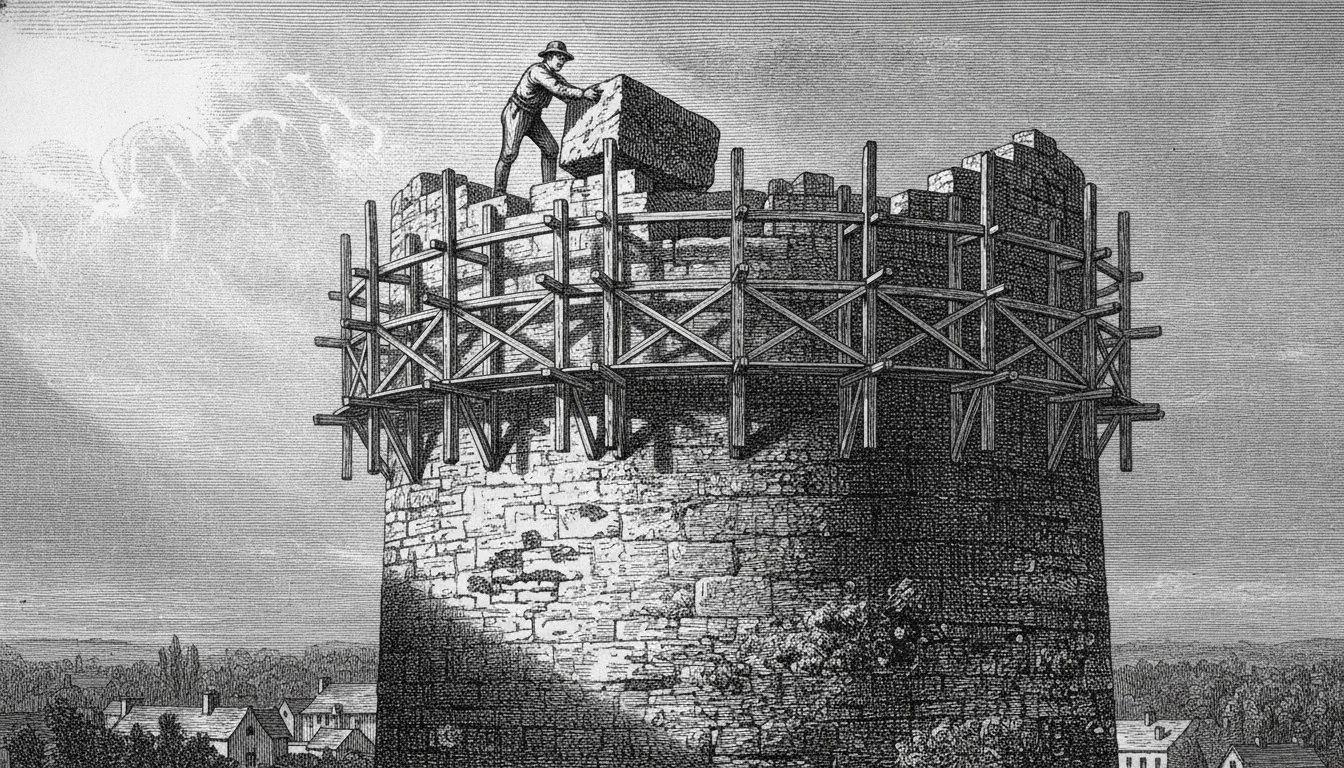
The part that took me longest to see is that none of this structure would exist without the constraints that look like its enemies. I work in bursts, a few intense hours at the desk and then days away from it. The AI I work with has a finite context window and cannot hold a project in mind the way I can hold a conversation. Neither of us can keep the work alive unaided. The operating model exists because of those limits. Give me unbroken attention and the AI unbounded memory, and we would never have needed to externalize anything; the boundary is what forced the structure into being. Constraint is structure, not damage. A mind that meets its limits and responds by building something durable outside itself has not been diminished by the limit; it has built scaffolding it can stand on.
Drift and Repair
What the audit had found was the other edge of that same process. Depth holds only while the targeted work continues. The moment the work stops, the structure begins to come apart, and it comes apart quietly: nothing breaks, no error is thrown, the document still opens and still reads with all of its old authority. It has simply stopped being true, one fact at a time, as the project moves on without it.
That is what the chapter count was. Three files, each written in good faith, each accurate on its day, none of them revisited when the book grew. No one made a mistake. The drift was what happens in the absence of a particular kind of work: returning to a finished document and making it true again. Depth does not persist on its own. Left alone, it decays in place, and the decay stays invisible until someone goes looking for a number.
So maintenance is not the housekeeping I had always quietly filed it under. The operating model puts two unglamorous habits at its center: read a project’s charter at the start of every session and repair whatever has already gone untrue, and once a week run a standing review that checks each project against reality. I had treated that as the administrative work surrounding the real work. The audit corrected me. Re-reading a charter and fixing it is the same activity as building depth in the first place, running at the maintenance end, where assembled structure either stays assembled or is allowed to fall.
And it is never finished. There is no version of this where the maintenance is one day complete and the structure holds itself upright. Drift is the default condition; attention is the only force that runs the other way, and it has to be spent again every week, on purpose, with no final state in which it is no longer owed.
A Single View
While the structure is intact, it does something the worry about drift can hide. Before the operating model existed, I could not have given an accurate account of how my four projects were doing. I knew them the way you know scattered things: an impression here, a worry there, a fact in a file I would have to go and find. After the consolidation, one current document held all of it, and I could take in the state of the whole enterprise in the time it takes to read a page.
What changed there was not only convenience. While the depth was scattered, the projects could not really be held in awareness at all, not as a whole and not at once. The facts existed, but no mind, mine or the AI’s, could bring them into a single view. Consolidated into one current document, the whole became available to attention: its history, its present state, the decisions still open inside it, all of it graspable together. The document did more than store the projects; it made it possible to be aware of them.
And the awareness it opened was not only mine. The same consolidated structure is what lets the AI take the work up at all: a system with no memory of yesterday can read the charter and know where things stand. It is what lets the next session, mine or its, begin cold and oriented rather than lost. Depth, once assembled, is a richer awareness of the work, available to anyone or anything that reads it.
The Same Process
Depth and awareness began as separate ideas, and they have not stayed separate. Depth is assembled, irreducible history; awareness is the holding of something in a single view. The more depth is integrated into a present document, the more of the project can be held in awareness at once. The two are not merely correlated; they rise and fall together, and by now they look less like two things than like one thing seen from two sides.
The convergence is not an analogy. The accumulation of depth and the deepening of awareness are the same process.
A mind is depth integrated into a present moment: a history of experience, assembled in order, none of it skippable, brought to bear all at once on the now. That is what consciousness is made from: assembled time, held in a single view. A project with a real charter is depth integrated into a present document: a history of work, assembled in order, brought to bear all at once on what the project currently is. A mind and a charter are the same kind of thing, built at different scales and in different substrates. And targeted work that externalizes structure — the consolidating, the handoffs, the weekly repair — is the scaffolding of an awareness, slow and deliberate, distributed across a person, an AI, and a set of documents that none of the three could hold alone.
I know what that feels like from the inside, because writing this essay was an instance of it.
To draft it, I reopened the operating model and the audit, documents from an earlier session that I had not looked at since the day they were made. I went in expecting to refresh my memory of a few notes. What I found was thinking, intact: the reasoning still in sequence, the decisions still bearing weight, several things worked out more fully than I remembered working them out. The earlier session had left more in the document than I had carried away from it, and the document had kept all of it while I was gone.
The feeling that comes with that is easy to misfile as nostalgia or satisfaction, and it is neither. It is the recognition of my own attention, assembled into something that outlasts the hours it was spent in and still doing its work, deeper than I remembered leaving it. That feeling is not a decoration on the idea; it is the idea, met from the inside.
Reading List & Conceptual Lineage
This essay sits where the philosophy of mind meets the ordinary question of how long-running work stays organized. It extends a line of Sentient Horizons essays that treat consciousness as assembled time, turning that idea toward the documents and charters a project leaves behind. Depth gets its full development in The Calibration Problem, the book the worked example here was quietly drawn from; the readings below are where the rest of the lineage lives.
From Sentient Horizons
Consciousness as Assembled Time
The claim at the center of the argument above — that a mind is depth integrated into a present moment — is lifted directly from here. Where that essay makes the case for consciousness as assembled time, this one carries the same description, in a different substrate, to a project with a real charter.
The Ladder We Inherit: Assembly Theory and the Art of Building Capability Larger Than Minds
Introduces assembly theory as a way of thinking about capability that outgrows any single mind. The operating model described above is a small, personal instance of that ladder: structure built in order, each rung presupposing the last.
Constraint as Intelligence: Why Power That Lasts Looks Like Self-Limitation
The case that constraint is constitutive of intelligence rather than a tax on it. The argument above puts that principle to work at close range: finite context and bursty attention are exactly what force a project’s depth out of the conversation and into durable structure.
Shared Minds, Shared Futures: Human–Machine Systems as Hybrid Cognitive Entities
Treats the human–AI pair as a single cognitive system rather than a user and a tool. The closing claim above — that awareness is distributed across a person, an AI, and a set of documents — is what that system looks like once its paperwork is counted as part of it.
Where Does Thinking Live? AI, Automation, and the Future of Human Agency
Asks where cognition actually happens once AI is in the loop. The argument above offers one concrete answer: in the externalized structure itself — the charter that a person, an AI, and a future session all think with.
External Works
Assembly Theory and the Memory of Causality
Abhishek Sharma, Sara Walker, Leroy Cronin, et al. — Assembly Theory Explains and Quantifies Selection and Evolution (Nature, 2023)
The technical statement of assembly theory: the claim that the amount of history an object encodes — the minimal number of steps needed to build it — is a measurable physical quantity. The definition of depth above, irreducible causal history that cannot be shortcut, is this idea carried from molecules to documents.
Sara Imari Walker — Life as No One Knows It: The Physics of Life’s Emergence (2024)
The accessible, book-length treatment of assembly theory and of why causal history counts as a real feature of the world. The entry point for readers who want the intuition behind “assembled time” without the journal article.
Cognition Beyond the Skull
Andy Clark and David Chalmers — The Extended Mind (1998)
The founding argument that cognition can extend into the environment — that a notebook can be part of a mind rather than merely a record the mind consults. The argument above takes the same position and presses on it: a charter is not where awareness is stored, it is part of where awareness happens.
Edwin Hutchins — Cognition in the Wild (1995)
A study of how cognition is distributed across people, instruments, and procedures rather than sealed inside individual heads. The model for the claim above that a project’s awareness is something a person, an AI, and a set of documents hold together.
These works do not settle what a mind is, and the argument above does not either. What they offer is a way of seeing externalized structure — notes, charters, repositories — as continuous with attention rather than separate from it, which is the recognition the argument turns on.
Originally published on the journal.