The Scale Arc · May 25, 2026
The Shape of a Hard Problem
Vitalism dissolved when biology stopped asking what life is and started asking what living things do. The hard problem of consciousness may be waiting for the same move.
For most of a century, serious people believed that living matter contained something that non-living matter did not. The belief was not superstition but a response to a real and visible gap in what chemistry could explain. By the late eighteenth century chemists could identify many of the substances that made up a plant or an animal, and they still could not say what made the plant or animal alive. An organism and the corpse it becomes a few minutes later hold very nearly the same molecules in very nearly the same arrangement, and nothing in the chemistry of the period marked the difference between them. Something was missing from the account. The vitalists named the missing thing and went looking for it.
The name changed across the decades. Early on it was a vital force, a Lebenskraft, the active principle that organized inert matter into a living body. In the vitalist revivals around the turn of the twentieth century it became the entelechy of Hans Driesch and the élan vital of Henri Bergson. The names differ, and they point at the same hole in the same explanation. Living things did something the physics and chemistry of inert matter could not seem to produce, and the vital principle was the placeholder for whatever that something was.
What dissolved vitalism was not an experiment. The story usually told puts Friedrich Wöhler at the center of it. In 1828 he produced urea, a compound known until then only as a product of living kidneys, from starting material that was plainly inorganic, and the textbooks present this as the moment the vital force died. It was not. Wöhler was chasing a question about isomerism and showed little interest in the metaphysics, vitalism kept capable defenders for another three generations, and no single result ever functioned as the refutation. The vital force was never the kind of claim a single result could reach.
What changed was the question. Life stopped being asked as a question about a substance and started being asked as a question about a process. Thermodynamics described how an organism holds itself away from equilibrium. The new metabolic chemistry showed how it builds and rebuilds its own parts. Information theory and evolutionary dynamics, later still, accounted for how it carries a record of what has worked and revises it. The explanatory gap was never filled in the terms the vitalists had set. The terms were retired, and the gap went with them.
The vitalists were not wrong to feel the gap, they were wrong about what kind of gap it was.
The Shape of the Problem
A problem of this kind has a recognizable shape, and once the shape is named it turns up in more than one place.
It begins with a gap between two descriptions. One is the base, the established science of the domain: its physics and chemistry, or for the brain the firing of neurons and everything that firing accomplishes. The other is the target, the phenomenon the base description seems unable to reach. For vitalism the target was life. For the hard problem of consciousness, in the form David Chalmers gave it, the target is subjective experience. A complete account of what the brain does can seem to leave out the experience itself, the something it is like to be the system in question.
The second feature is a temptation. Faced with the gap, it is natural to posit something extra, an additional ingredient the base description lacks and that would close the distance if it could be added. Vitalism posited the vital force. The hard problem of consciousness posits qualia, phenomenal properties treated as a feature of the world over and above the functional and structural facts.
The third feature is what makes the problem hard rather than merely open. The something extra is, by construction, inaccessible to the methods that revealed the gap. The vital force could not be isolated by the chemistry that called for it. Qualia cannot be detected by the third-person methods that call for them. The extra ingredient is defined as precisely the part the available methods cannot reach, which guarantees that no amount of work with those methods will ever produce it. The problem is built so that it cannot be solved from inside its own framing.
The hard problem of matter has the same shape. Physics, the argument goes, tells us only what matter does, how it is disposed to behave and how it relates to other matter. It tells us nothing about what matter is in itself, the intrinsic nature underneath the relations. Bertrand Russell pressed this point in 1927, and Galen Strawson and Philip Goff have revived it since. The gap runs between the relational description physics provides and the intrinsic nature it seems to leave untouched, and the intrinsic nature is, again by construction, the part the relational methods cannot reach.
When a problem presents this way, the first thing worth settling is whether the gap is real and genuinely unfilled, or whether the framing itself is the obstacle.
Walker’s Operational Turn
Sara Walker is a physicist and astrobiologist who works on the origin of life. Her aim, set out in her 2024 book Life as No One Knows It, is a theory of what life is that can be tested, a theory whose terms have measurable consequences in the world. That requirement, that the contents of a theory must cause observable things to happen, is what shapes her treatment of consciousness, and it leads her to a reformulation.
The panpsychists, faced with the two hard problems of consciousness and matter, try to resolve both at once by making consciousness the intrinsic nature of all matter. Walker takes the impulse seriously and then declines its central assumption. If consciousness is the first axiom, the substrate of everything, there is no room left to explain it. The features of consciousness cannot be derived from a consciousness posited as bedrock, and its presence cannot be tested, because a consciousness that simply is everything does nothing in particular. Making consciousness fundamental purchases a kind of closure at the cost of every measurable consequence.
So Walker changes the question. Rather than asking what consciousness is, she asks what consciousness does. If consciousness is a real physical property of at least some objects, and not an illusion or an epiphenomenon, then its presence should make a difference to how those objects behave. There should be something in the world that exists because consciousness exists and would not be there otherwise. The question stops being whether a system has an inner experience, which cannot be checked from outside, and becomes whether a system that has one can do what a system without one cannot.
This is the move that retired vitalism, run a second time. The question of what life is gave way to the question of what living matter does that non-living matter cannot, and life became tractable. Walker proposes the same exchange for mind. What consciousness is gives way to what a conscious system does that a non-conscious system cannot. The reformulation is not a denial that consciousness is real or that the experience is genuine, but a bet that the hard problem is hard because it has not yet been asked in a form with measurable consequences.
That leaves the question the reformulation has to answer. If consciousness earns its place in the physical account by doing something, what does it do, and where would the evidence be found?
Walker’s answer begins with a claim about where to look. The science of consciousness has mostly looked inside the individual brain, searching for the neural signature of experience in a single skull. She suggests this may be the wrong scale. The dynamical consequences of consciousness, the things it causes that nothing else would, may not appear in one mind at all. They may appear only in what minds produce together, when separate inner worlds, each closed to the others, share enough of their contents to make something none of them could have made alone.
The Made World
Consider a rocket. Nothing about a rocket violates the laws of physics. Every material it is built from and every reaction that drives it is permitted by the same physics that governs a bare planet. And yet rockets do not occur. You will not find one on an unattended world, or anywhere else the universe has been left to its own devices. They appear in one circumstance only, where minds capable of imagining them have done the work of building them. A rocket requires knowledge, and the knowledge has to pass through many minds and accumulate before it can be set down as an object separable from the people and tools that produced it. A rocket, in Walker’s phrase, is “physical evidence of imagination.”
Rockets are not unusual in this respect. The built environment is full of objects with the same property: computers, engines, houses, vaccines, written language, a cultivated garden. None of them violates a physical law, and none of them assembles without minds. Each is far too improbable to arise in any setting where imagination has not first made it conceivable and then made it real. They are the things the universe cannot produce until it produces minds, and once minds are present they appear in great number.
This is the operational signature the reformulation was looking for. Consciousness leaves a record, and the record is the made world. The hard problem becomes, in this framing, a detection problem, and detection is the kind of problem that admits of progress. The question of what experience is from the inside was sealed against investigation; the question of which objects could not exist without imagination is open to it. One can ask what threshold of improbability separates what unaided matter can assemble from what it cannot. One can ask how large a network of minds, sharing how much of their inner worlds, a given artifact requires. The substrate question never licensed a research program, and this one does.
The logic is familiar from assembly theory, the framework Walker developed with the chemist Lee Cronin. Assembly theory holds that a molecule above a certain assembly index, a certain depth of construction, is effectively impossible to produce without the selecting and copying machinery of life. Find such a molecule and you have found evidence of life, whether or not the organism is anywhere in view. The rockets argument extends the logic one level up. An artifact above a certain complexity is effectively impossible to produce without the imagining machinery of minds. Life leaves molecular fossils; mind leaves the made world.
One Shape, Three Times
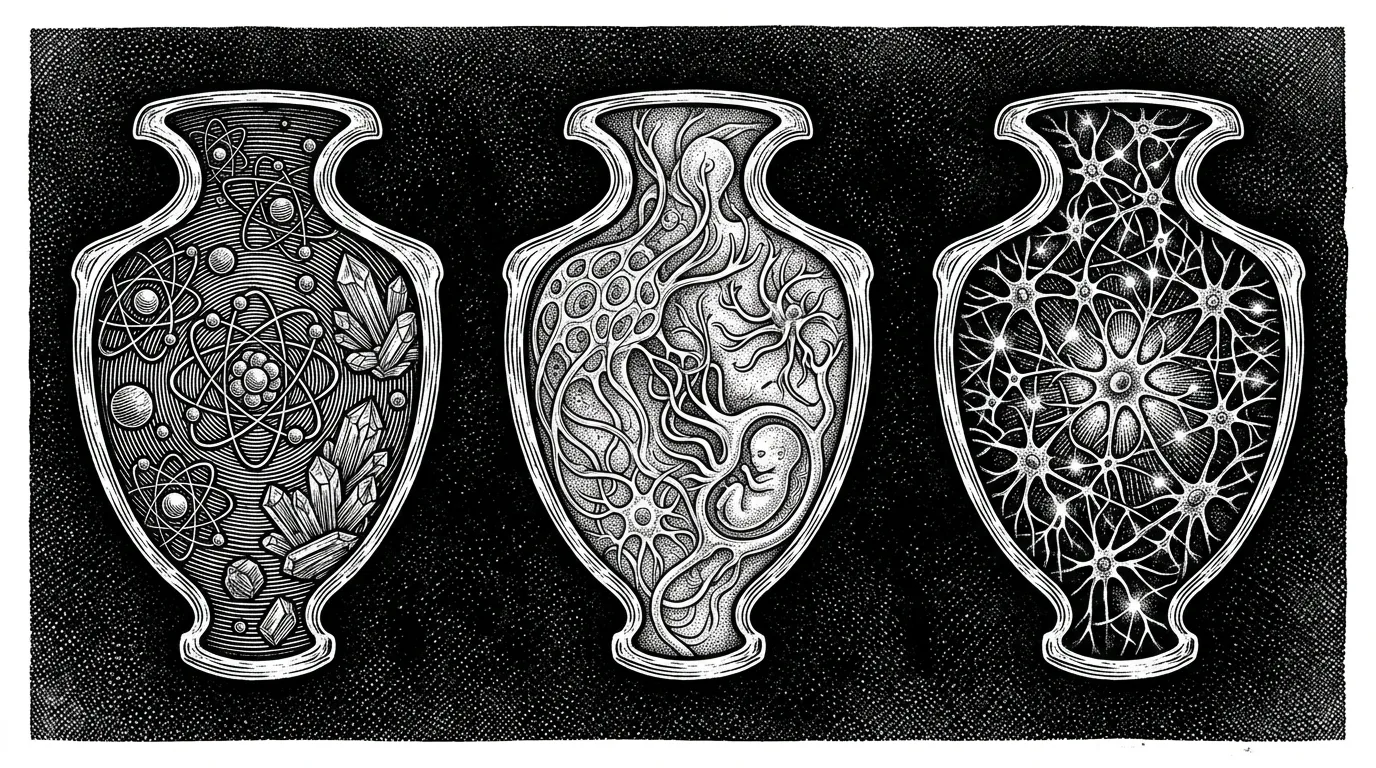
The three hard problems are usually treated as separate puzzles that happen to be difficult. They are better understood as one situation appearing three times. In each case the question asked is a question about substrate, about what something is in its own nature, raised in a domain where the questions that actually yield to investigation are questions about what something does. The hard problem of life asked what the living substance was; the hard problem of consciousness asks what the experiencing substance is; the hard problem of matter asks what matter is beneath the relations physics describes. The shape repeats because the mistake repeats.
That the shape repeats is itself informative. Two of these problems may not even be distinct. Strawson’s version of Russellian monism holds that the intrinsic nature physics leaves out and the consciousness the hard problem cannot reach are the same missing thing, which would make the hard problem of matter and the hard problem of consciousness one problem wearing two descriptions. Whether or not that identification holds, the hard problem of life has already shown what becomes of a problem of this shape when it is finally asked well. It does not get solved; it gets dissolved, because the substrate question is replaced by an operational one it was only ever a confused way of asking.
The Bet and Its Hazard
The bet implicit in Walker’s work, and made concrete by the rockets argument, is that the hard problem of consciousness will go the way of the hard problem of life, not because someone finds the extra ingredient and exhibits it, but because the question that demanded an extra ingredient is replaced by one that does not. The reframing is the same each time. It replaces the question of what the thing is with the question of what it does that nothing else does, and then sends you out to look for the evidence.
None of this answers the three hard problems. What it offers instead is a way to recognize them. A problem that arrives with a gap, and with an extra ingredient that would close the gap but lies beyond every method that revealed it, is a problem whose framing has become the thing to investigate. The question to ask is not what the missing ingredient is, but what reformulation would make the gap disappear.
The reformulation move is powerful, and it carries a hazard. A problem of this shape can turn out to be a real and permanent limit, or it can turn out to be a framing still waiting for its reformulation, and from inside the framing the two look much alike. The vitalists could not tell them apart. The vital force looked, from within their framework, exactly as irreducible as consciousness looks from within ours. They had no way to know their gap was the kind that dissolves until the reformulation arrived and showed them. We are in their position now with respect to consciousness. The hard problem may be a genuine and final limit, or it may be élan vital with better press, and from inside the framing the difference is hard to see.
The hard problem is best held the way a careful late vitalist should have held the vital force. Such a vitalist would have treated the gap as an honest marker of something real that the chemistry of the day could not reach, and treated the vital force itself, the proposed filler of the gap, as a sign that the question had not yet found its working form. The gap is genuine and the framing that names it is suspect, and both have to be held at once.
What Walker has added is the first thing that framing has produced in a long while, which is a place to look: a candidate reformulation, and with it a candidate signature, the improbable made world that no collection of unconscious systems would ever assemble. The signature can be refined and the threshold made precise. Other signatures can be sought, in other domains where the same shape appears. The substrate question may never be answered, and on this account it does not need to be. It needs only to be replaced, slowly, by operational questions that do the work it was always failing to do, until one day it reads the way the question of the vital force reads now, as a question no one is working to answer because no one can any longer feel its pull.
Reading List & Conceptual Lineage
This essay sits where the philosophy of science, the origin-of-life research program, and the philosophy of mind meet, at the question of what to do with an explanatory gap that resists every method built to close it. It builds on a line of Sentient Horizons essays that treat the hard problem of consciousness as a problem of framing rather than a problem of missing data. The works below are entry points for following the reformulation move into each of the domains where it applies.
From Sentient Horizons
What Counts as Explaining Consciousness
The diagnostic groundwork. That essay argued the hard problem of consciousness looks unanswerable only because consciousness is held to an explanatory standard no other phenomenon is required to meet. The argument here widens that diagnosis, finding the same shape in the hard problem of life and the hard problem of matter, and naming reformulation as the move that has already retired one of the three.
The Hard Problem Is the Wrong Problem
Argues that the hard problem of consciousness is mis-stated and that consciousness is better understood as an architectural achievement. Where that essay makes the case for one hard problem, the argument here supplies the pattern it belongs to, the shared shape that says in advance which problems are likely to be framed wrong.
Life Is the Memory of Causality
An earlier reading of Walker and Cronin on what life is. The shift it describes, from life as a substance to life as a causal process, is the template the argument here applies a second time, watching the same move carry from life across to mind.
The Lantern and the Flame: Why Fundamentality Is an Explanatory Dead-End
Makes the case that treating any property as fundamental closes off explanation rather than completing it. This is the principle underneath Walker’s refusal to follow the panpsychists: making consciousness the first axiom buys closure at the price of every measurable consequence, which is exactly the dead end that essay describes.
The Ladder We Inherit: Assembly Theory and the Art of Building Capability Larger Than Minds
Develops assembly theory as an account of how capability accumulates beyond what any single mind holds. The rockets argument is that account read as a detection method: if a molecule above an assembly threshold is evidence of life, an artifact above a complexity threshold is evidence of imagination.
External Works
Sara Walker and the Operational Turn
Sara Imari Walker — Life as No One Knows It: The Physics of Life’s Emergence (2024)
The source of the argument’s central move. Walker’s reformulation of consciousness, from what it is to what it does, and her proposal that the doing shows up only in collections of minds, are developed in the book’s second chapter. The rockets argument is hers; the structural pattern it is embedded in here is what the argument above adds to it.
Abhishek Sharma, Sara Walker, Leroy Cronin, et al. — Assembly Theory Explains and Quantifies Selection and Evolution (Nature, 2023)
The formal statement of assembly theory. Its claim, that an object above a threshold assembly index cannot be produced without a history of selection of the kind life performs, is the precedent the rockets argument extends from molecules to artifacts. It also shows what a working detection method looks like, which is what an operational signature of consciousness would have to become.
The Hard Problem of Consciousness
David Chalmers — Facing Up to the Problem of Consciousness (1995)
The paper that named the hard problem and drew the line between it and the easy problems. The argument here does not dispute the line so much as ask what kind of problem falls on the hard side of it, and whether problems of that kind have a history of dissolving rather than being solved.
The Hard Problem of Matter
Bertrand Russell — The Analysis of Matter (1927); Galen Strawson — Realistic Monism: Why Physicalism Entails Panpsychism (2006); Philip Goff — Galileo’s Error: Foundations for a New Science of Consciousness (2019)
The lineage behind the third hard problem. Russell separated what physics tells us, the relational and dispositional structure of matter, from what it leaves untouched, matter’s intrinsic nature. Strawson and Goff carry the point forward and press the further claim that the intrinsic nature physics omits and the consciousness the hard problem cannot reach may be the same missing thing. That identification is why the argument above treats the two problems as candidates for a single problem.
None of these works closes the gap that any of the three problems names. What they offer is the longer view, in which a problem of this shape is a stage in inquiry rather than a wall, and the task is to find the question that the substrate question was only ever a confused way of asking.
Originally published on the journal.