The Scale Arc · December 13, 2025
Consciousness Is Like Flight
Consciousness may be a way of operating rather than a hidden ingredient. One analogy shows why, and which questions it frees us to ask.
For years, discussions about consciousness have felt strangely ungrounded. We argue about whether machines can be conscious, whether animals are conscious, whether consciousness can be measured, all while quietly assuming that consciousness must be a thing : a substance, an essence, or a special ingredient hidden somewhere inside brains. That assumption usually goes unstated, and it may be exactly what keeps the conversation stuck.
There is another possibility: that consciousness is entirely real and still not the kind of thing people take it for. One analogy makes that possibility easy to see.
Consciousness is like flight.
The comparison is not meant as poetry. It is meant structurally, as a claim about what kind of thing consciousness is.
Flight is real, but it isn’t a substance
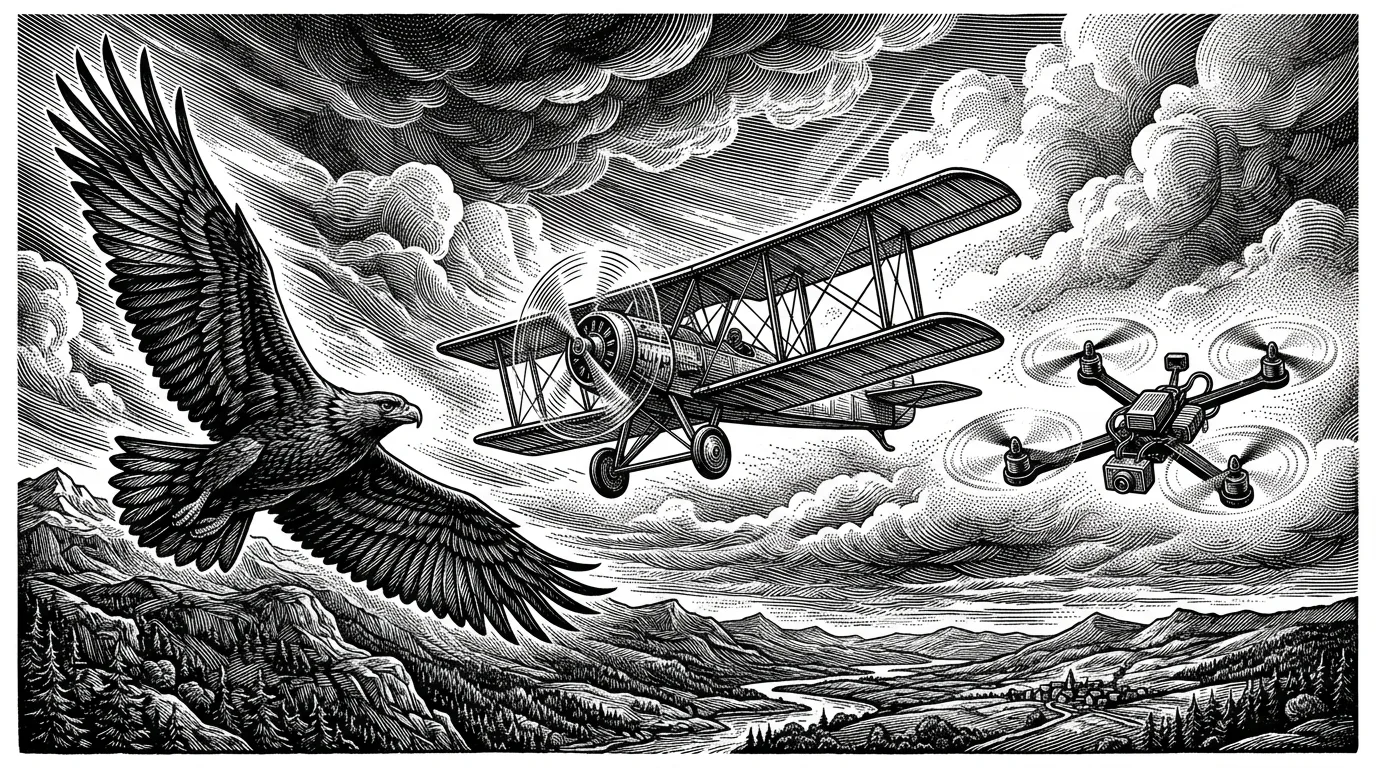
Flight clearly exists. Birds fly, airplanes fly, drones and helicopters fly. Yet flight is not made of anything. You cannot open an airplane and find a tank of flight inside; there is no flight molecule, no flight organ. Cut open a bird and you will find feathers, bones, muscles, and nerves, but never flight itself. Denying that flight is real would still be absurd.
Flight is a way of operating
What flight is, instead, is a pattern of organization and dynamics. A system is flying when it moves through air at sufficient speed, with structures that generate lift, under the constraints aerodynamics imposes. When those conditions hold, the system has entered a flight regime, a mode of operation it can enter and leave. When they fail, the flying stops, and nothing needs to drain out of the machine for that to happen.
The parts on their own are not the flight. Feathers are not flight, wings are not flight, engines are not flight. Flight is what happens when parts are arranged and operating in the right way, and different systems can fly using radically different materials and mechanisms, because flight is tied to a way of operating rather than to any particular stuff.
Consciousness may be the same kind of thing
When people ask where consciousness is in the brain , they may be making the same mistake as someone asking where flight is in the airplane. In both cases the answer is the same: not in a single part, not as a hidden ingredient, but in what the system is doing as a whole. Consciousness, on this view, is not something a system has. It is something a system does.
The feature carrying the real weight is temporal integration: the binding of past, present, and anticipated future into a single ongoing process, so that what just happened and what might happen next are both alive inside what is happening now. My bet is that experience is that binding, seen from the inside. Other features travel with it in the beings we know. A split between what a system does and what happens to it gives a point of view, so that things happen to someone. A maintained boundary between the system and its environment makes that point of view unified and lasting rather than flickering. And mattering, meaning that some states are better or worse for the system because its own processing steers toward or away from them, makes some of its distinctions urgent rather than merely registered. A system with all of these at full strength is conscious in the rich, familiar way that you are. I have set this picture inside a larger map of minds in Three Axes of Mind, which measures minds along availability, integration, and depth, a coarser view of the same features. The analogy reorients the intuition; that essay turns it into an instrument.
Degrees, and where they start
Flight admits degrees. Gliding and powered flight, stable flight and turbulence, the flying squirrel’s controlled stretch between trees and the falcon’s stoop. Nature feels no obligation to tell us where the category begins. Consciousness appears to work the same way: drowsy and alert, infant and adult, octopus and human. There is no sharp line where flight suddenly appears. Consciousness does have a floor, a point below which there is none, but nobody yet knows where it lies or how sharp it is. There are clear cases at both ends, a contested middle, and changes of regime in between.
This bears directly on the question people most often ask: at what point does matter start to feel? If consciousness is a regime rather than an ingredient, that question has the same shape as asking at what exact number of feathers flight turns on. No count of feathers answers it, because what makes something fly is how its parts work together rather than how many there are. The same is likely true of consciousness: its start will be a matter of how a system’s parts work together, not of how much of anything it has. Where that start lies, and how sharp it is, is not something thinking alone can settle. The way to find out is to take a system’s features away one at a time and see what goes.
The question the analogy reframes
Much of what makes consciousness feel like a permanent mystery comes from a question with a peculiar shape: even if you mapped every structure and process, wouldn’t something remain unexplained, namely why all that processing is accompanied by experience rather than happening in the dark? David Chalmers named this the hard problem. Notice that nobody asks the equivalent question about flight. Nobody demands to know why aerodynamic relationships must produce flight rather than leaving the air undisturbed. The structure does what it does, the conditions can be mapped, and the demand for a deeper why is quietly set aside, as it is for every other phenomenon in nature. Consciousness is the one place we insist on more. What Counts as Explaining Consciousness names this the modal demand, the requirement that consciousness alone be explained in terms of why it must be this way rather than how it is, and makes the case that the demand is an exemption nothing else in nature is granted.
The analogy should be honest about its own limit here. Flight does not present itself to itself; consciousness does. You encounter your own experience from the inside, with a directness nothing else shares, and that is why the demand feels compelling here and nowhere else. But the feeling of a deeper question is itself part of what a self-presenting system is like. It tells us something about how that architecture works rather than revealing a gap in the explanation.
What this means for machines
Flight has one more lesson in it. For a long time, serious attempts at a flying machine reached for the features of the only known flyers: wings that flapped, materials that resembled feathers, configurations that mimicked birds. The intuitions were not stupid. They were tracking the single available instance of the phenomenon, and they turned out to be tracking its implementation rather than its essence. The breakthrough came from the people who stopped copying birds and asked what flight itself required. Flight required certain aerodynamic relationships, and the relationships could be built in metal.
If consciousness is a regime of operation, the same caution applies to the intuition that it must require biology. Systems built on very different substrates could in principle enter the regime, provided they actually assemble the binding of time that, on my bet, experience is, with a split, a boundary and mattering to make it richer. That sentence carries no verdict about current AI systems, which is exactly the point. The question stops being mystical and becomes architectural, answerable by examining systems rather than by consulting our sense of what matter is allowed to do. I take up the strongest version of the biology-only position, and where I think it goes wrong, in The Substrate Demand.
A quieter conclusion
This view is often resisted not because it is incoherent but because it is disruptive. It replaces essence with organization, and declared verdicts with questions that can be tested. Discomfort is not an argument, though, and every phenomenon we now understand passed through the same disruption on the way: flight, life, and computation. Consciousness may not be a cosmic exception. It may be a natural regime that certain systems enter when they bind time into a present seen from the inside — real and important, but not a substance. Just like flight.
Revised October 22nd, 2026. I corrected three passages so that the essay agrees with itself and with what the rest of my work argues. The section on machines had listed a maintained boundary and something at stake as requirements, although the essay says earlier that they deepen an experience rather than make it possible; it now says the same thing in both places. The section on degrees had said there is no point at which consciousness begins. It now says that no amount of anything marks the start, and that the start is a matter of how a system’s parts work together. Its heading changed to match. I also corrected how the essay described Three Axes of Mind. It had said that essay develops these three conditions, but that essay measures minds along three different dimensions, availability, integration, and depth, and the conditions here fit inside its map without matching it one to one.
Revised again October 24th, 2026. This essay said that consciousness begins where binding “runs deep enough” and differs only in degree above that point, and it listed three conditions: binding, a boundary that gives a point of view, and stakes, meaning the system’s own survival riding on what it does. I no longer hold those. I describe several features that seem to go with experience in the beings we know, and binding is no longer what I call the floor. There is a floor, but where it lies and how sharp it is are open. A point of view comes from a split between what a system does and what happens to it, and a boundary makes that point of view lasting. Something can matter to a system without its survival being at stake. The flight analogy, and the argument that consciousness is a way of operating and not a substance, are unchanged.
Reading List & Conceptual Lineage
This essay is the soft entry into the Sentient Horizons account of consciousness: an analogy that reorients intuitions before the structural work begins. It sits at the intersection of philosophy of mind and the methodology of explanation, and its single move — treating consciousness as a way of operating rather than a substance — is the move the rest of the project builds on. The sources below are entry points, not authorities.
From Sentient Horizons
Three Axes of Mind
The larger map this essay’s picture sits inside: availability, integration, and depth as the dimensions along which minds differ. If the flight analogy reframed your intuitions, this is where the reframing becomes a usable instrument.
What Counts as Explaining Consciousness
Names the modal demand and makes the full case that it is a methodological exemption no other phenomenon is granted. The flight analogy makes the demand look strange; that essay does the diagnostic work the analogy can only gesture at.
The Substrate Demand
Puts the analogy to work. Anil Seth refuses the demand at the level of structure and readmits it at the level of substrate, and the pre-Wright dismissal of mechanical flight is the closest historical analog to that retreat. The companion piece that turns this essay’s intuition into a method.
Consciousness as Assembled Time
The constitutive account at full depth: experience as a particular kind of binding of time, named from the inside. The regime this essay describes is specified there as an architecture in time.
The Hard Problem Is the Wrong Problem
Argues that consciousness, like free will, is an architectural achievement rather than a metaphysical exception. The bridge between the analogy here and the constitutive account.
External Works
The question being reframed
David Chalmers — The Conscious Mind (1996)
The canonical statement of the hard problem, and the cleanest articulation of the demand this essay’s analogy is built to make strange. Read for the shape of the question, not the conclusion.
The structural posture in practice
Anil Seth — Being You (2021)
Consciousness as controlled hallucination: the clearest empirical program treating experience as what certain predictive systems do. Also the source of the substrate skepticism examined in The Substrate Demand , which makes it doubly worth reading.
Thomas Metzinger — The Ego Tunnel (2009)
The self as a transparent construct rather than an inner entity. A different route to the same dissolution this essay performs on consciousness-as-substance: what felt like a thing turns out to be a process that includes the feeling.
The precedent dissolution
Sara Walker — Life as No One Knows It (2024)
Life reframed as causal structure rather than special ingredient. Vitalism’s dissolution is the precedent this essay leans on, and Walker’s assembly-theoretic account is its most direct contemporary descendant.
None of these settle what consciousness is. They are entry points into a way of asking that has, everywhere else in nature, been how questions like this finally moved: describe the organization, map its degrees, and let the demand for a deeper ingredient retire on its own.
Originally published on the journal.
Sentient Horizons is an essay series on what a mind is, whether a machine could have one, and how to act toward minds we cannot see inside. Start Here is one route through it; Essays lists everything, newest first.
Three Ways In
- Consciousness Is Like Flight If you want to know what a mind is
- We Built the Alien First If you want to know whether a machine could have a mind
- The Purpose Displacement Problem If you want to know what AI means for your own life